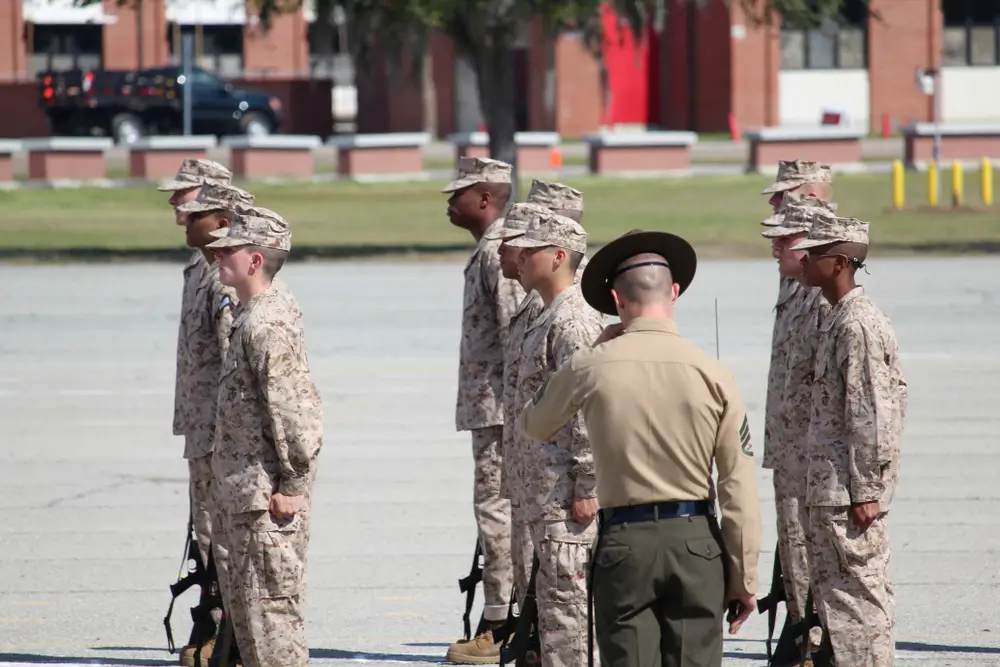
If you are thinking about joining the Marine Corps, the ASVAB is the first real gate you have to pass. The score you earn decides two separate things: whether you can enlist at all, and which jobs you can actually do once you are in. Those are not the same question, and keeping them straight is the key to reading the rest of this guide.
This guide walks through both. You will see the minimum AFQT score the Marines require, how the GED rule changes things, how the five line scores are calculated, and the specific scores tied to popular jobs. The goal is simple: by the end, you should know exactly what number you need to chase based on the career you want.
 ASVAB Test Prep · All Military BranchesReady to Pass the ASVAB?
Official subtest drills (AFQT, CAT-ASVAB), timed practice tests, score calculators and detailed step-by-step explanations.

ASVAB requirements for Marine Corps enlistment
The number that decides whether you can enlist is your AFQT score, the Armed Forces Qualification Test result. For applicants with a high school diploma, the Marine Corps requires a minimum AFQT of 31. That is one of the higher minimum requirements among the five military branches.
GED holders face a stricter bar. If your highest credential is a GED, you need to score at least 50 on the AFQT. The Corps also limits how many GED holders it accepts: published enlistment guidance indicates no more than 5 percent of recruits in a given enlistment period can join with only a GED, which makes a strong score even more important if you do not hold a traditional diploma.
One exception sits below the standard minimum. Marine recruiting policy allows an AFQT score as low as 26 with a waiver, and these waivers are limited and handled case by case, decided by recruiting command leadership rather than by an individual recruiter. Treat 31 as the real target and the waiver as a rare backstop, not a plan.
How AFQT percentile scoring works
The AFQT is the most misunderstood part of the whole test. Many candidates assume a score of 31 means they answered 31 percent of the questions correctly. That is not what it means.
The AFQT is a percentile score. It compares your performance to a nationally representative sample of Americans aged 18 to 23 who took the ASVAB as part of a research study conducted in 1997. An AFQT score of 31 means you performed better than 31 percent of that reference group. The highest possible AFQT percentile is 99.
This score is built from just four of the ten ASVAB subtests: Arithmetic Reasoning, Mathematics Knowledge, Word Knowledge, and Paragraph Comprehension. Everything else on the test feeds into your line scores instead, which is where job qualification gets decided.
Why meeting the minimum is not enough
Clearing 31 gets your foot in the door. It does not get you the job you want.
Marine Corps culture leans hard toward recruit quality, and the most desirable specialties demand scores well above the floor. Higher ASVAB scores unlock more specialized roles, technical training opportunities, and access to additional programs. The branch treats test performance as a real signal of who can handle demanding work.
If you only have one number in your head, make it your AFQT target. But if you want options, aim higher than 31 and plan to hit specific line scores for the field you are after.
Understanding the Marine Corps line score system
After you take the ASVAB, the Marine Corps converts your subtest results into five composite numbers called line scores. These line scores tell the Corps which Military Occupational Specialties, or MOS, you qualify for.
The five line scores are Clerical (CL), Electronics (EL), General Technical (GT), Mechanical Maintenance (MM), and Skilled Technical (ST). Each one targets a broad family of jobs. GT is the workhorse, used for infantry, intelligence, logistics, and many officer-track programs. EL covers electronics, communications, and avionics work. MM is for mechanics and maintenance roles. CL handles administrative, supply, and finance positions. ST covers the harder technical combinations.
How line scores are calculated
Each line score is a sum of specific subtests. The formulas the Marine Corps uses are:
| Line Score | Abbreviation | Formula |
|---|---|---|
| Clerical | CL | VE + AR + MK |
| Electronics | EL | GS + AR + MK + EI |
| General Technical | GT | VE + AR |
| Mechanical Maintenance | MM | NO + AS + MC + EI |
| Skilled Technical | ST | GS + VE + MK + MC |
A few of these abbreviations need unpacking. VE stands for Verbal Expression, and it is not a subtest you sit for directly. VE is a composite built from your Word Knowledge and Paragraph Comprehension scores. Because VE feeds into GT, CL, and ST, your reading and vocabulary performance quietly shapes a large share of your eligibility.
One subtest in these formulas is on its way out. The Numerical Operations (NO) and Coding Speed (CS) subtests are being phased out, which means some line score formulas may be updated in the future. The published standard above is what is currently in use.
Line scores versus the AFQT
These two scores serve different purposes, and it helps to keep them separate in your mind.
Your AFQT decides whether you can enlist. Your line scores decide what you can do. A common misconception is that a high overall ASVAB score guarantees access to any job. In reality, once you clear the AFQT minimum, line scores matter more than the overall number. A recruit can qualify to join the Corps yet still be locked out of a specific MOS for falling short on the required GT, EL, or other line score.
Meeting the line score is also necessary but not always sufficient. Other factors affect the final assignment too: available training slots, security clearance requirements, physical qualifications, and the overall needs of the service. Hit the number first, then everything else comes into play.
ASVAB test structure and subtests
The ASVAB covers ten subject areas. Knowing what each one measures helps you study the right things for the score you need.
| Subtest | Focus |
|---|---|
| General Science (GS) | Physical and biological sciences |
| Arithmetic Reasoning (AR) | Arithmetic word problems |
| Word Knowledge (WK) | Vocabulary and word meaning |
| Paragraph Comprehension (PC) | Reading comprehension |
| Mathematics Knowledge (MK) | Algebra, geometry, trigonometry |
| Electronics Information (EI) | Electronic principles and circuits |
| Auto & Shop Information (AS) | Automotive and shop practices |
| Mechanical Comprehension (MC) | Mechanical principles and physics |
| Assembling Objects (AO) | Spatial visualization |
| Verbal Expression (VE) | Composite of WK and PC |
The four subtests that build your AFQT, Arithmetic Reasoning, Mathematics Knowledge, Word Knowledge, and Paragraph Comprehension, are the ones to prioritize first, since they decide whether you can enlist. The technical subtests then determine your line scores.
CAT-ASVAB versus paper-and-pencil
You can take the ASVAB on a computer or on paper, and the two formats differ in ways that matter on test day.
The computerized version, the CAT-ASVAB, is given at a Military Entrance Processing Station, or MEPS. It has 135 scored questions and a time limit of 197 minutes. The format is adaptive, which means the software selects questions suited to your ability based on how you answered earlier ones. You cannot go back and change an answer once you submit it.
The paper-and-pencil version, the P&P-ASVAB, works differently. It has 225 questions across a 149-minute limit. This format combines Auto and Shop Information into a single subtest, and you complete one subtest at a time, moving forward only when the time for that section expires. Unlike the computer version, the paper test lets you review and change your answers within a section.
| Version | Questions | Time Limit |
|---|---|---|
| CAT-ASVAB | 135 scored | 197 minutes |
| P&P-ASVAB | 225 | 149 minutes |
Scores come out very similar regardless of which format you take, so the choice usually comes down to where and how you test.

Marine Corps MOS requirements: score thresholds by career field
This is where your line scores translate into actual jobs. Requirements vary widely, and a technical specialty can sit well above what a combat role asks for.
Infantry and combat roles
Combat jobs generally have the most modest line score requirements, which surprises a lot of people. The Rifleman position (MOS 0311) requires a GT of 90, and Machine gunner (0331) requires GT 90 or MM 90.
Specialized infantry roles climb higher. Reconnaissance Man (0321) requires GT 105, and Scout Sniper (0317) requires GT 105. So while the entry to infantry is reachable, the elite combat tracks ask for considerably more.
Technical and electronics positions
Electronics work sits at the top of the requirement scale. Several positions demand an EL score of 115, the highest electronics requirement in the Corps.
These EL 115 roles cover the full electronics maintenance series: Telephone Technician (2811), Personal Computer Repairer (2818), Electronic Switching Equipment Technician (2822), Multichannel Equipment Repairer (2831), Ground Radio Repairer (2841), and Aviation Communication Systems Technician (5939), among others. If electronics is your goal, EL 115 is the number to plan around.
Aviation maintenance and avionics
Aircraft roles cluster around a line score of 105. Fixed-wing aircraft maintenance positions across aircraft types such as the AV-8/TAV-8, EA-6, F/A-18, F-35B, and KC-130 consistently require an MM score of 105. Aircraft avionics and electronics roles in the 6xxx series typically require EL 105.
Intelligence and cryptologic linguists
Intelligence work demands high GT scores. Positions like Geospatial Intelligence Specialist (0261) and Imagery Analysis Specialist (0241) require 110, while Counterintelligence/HUMINT Specialist (0211) asks 105. The most recent published data also lists Intelligence Specialist (0231) at GT 110.
Cryptologic Linguist roles, covering languages such as Arabic (2671), Korean (2673), Spanish (2674), and Russian (2676), require GT 105. MAGTF Planning Specialist (0511) requires GT 100.
Administrative and clerical roles
Office and supply jobs run on the CL line score. Positions like Administrative Specialist (0111), Aviation Operations Specialist (7041), and Aviation Supply Specialist (6672) require CL scores in the 90 to 100 range, with Postal Clerk (0161) also in that band.
The table below lists a wide cross-section of Marine MOS codes and their published minimum line scores.
| MOS Code | MOS Title | Minimum Line Score |
|---|---|---|
| 0111 | Administrative specialist | CL=95 |
| 7242 | Air support operations operator | GT=95 |
| 7251 | Air traffic controller-trainee | GT=110 |
| 0451 | Airborne and air delivery specialist | CL=95 or EL=95 or GT=100 |
| 6323 | Aircraft avionics technician, CH-53 | CL=105 or EL=105 |
| 6324 | Aircraft avionics technician, U/AH-1 | CL=105 or EL=105 |
| 6316 | Aircraft communications/navigation systems technician, KC-130 | CL=105 or EL=105 |
| 6531 | Aircraft ordnance technician | CL=105 or GT=105 |
| 7051 | Aircraft rescue and fire fighting (ARFF) specialist | GT=90 or MM=90 |
| 0352 | Antitank missile gunner | GT=95 or MM=95 |
| 6694 | Aviation logistics information management system (ALIMS) specialist | CL=110 or GT=110 or EL=110 |
| 7041 | Aviation operations specialist | CL=95 |
| 6541 | Aviation ordnance systems technician | CL=105 or GT=105 |
| 6672 | Aviation supply specialist | CL=95 |
| 0300 | Basic infantry Marine | CL=90 or GT=90 |
| 0211 | Counterintelligence/human intelligence (CI/HUMINT) specialist | GT=105 or CL=105 or AFQT=55 |
| 6251 | Fixed-wing aircraft airframe mechanic-trainee | MM=105 |
| 6276 | Fixed-wing aircraft loadmaster, KC-130 | EL=105 or GT=105 or MM=105 |
| 0261 | Geospatial intelligence specialist | CL=110 or GT=110 |
| 0241 | Imagery analysis specialist | GT=110 |
| 0231 | Intelligence specialist | CL=110 or GT=110 |
| 0313 | Light armored reconnaissance Marine | CL=90 or GT=90 |
| 7212 | Low altitude air defense (LAAD) gunner | GT=90 |
| 0331 | Machine gunner | EL=90 or GT=90 or MM=90 |
| 0511 | MAGTF planning specialist | CL=100 or GT=100 |
| 0411 | Maintenance management analyst | CL=95 or GT=95 |
| 0372 | Marine Raider | GT=105 |
| 6842 | METOC analyst forecaster | EL=105 or GT=105 |
| 0341 | Mortarman | CL=90 or GT=90 |
| 0161 | Postal clerk | CL=95 |
| 0321 | Reconnaissance Marine | CL=105 or GT=105 |
| 0311 | Rifleman | CL=90 or GT=90 |
| 7314 | Sensor operator (SO), MQ-9 | GT=110 |
Note that MOS codes and exact thresholds are periodically updated as the Corps restructures its force, so treat any table as a strong guide rather than a guarantee, and confirm current requirements with a recruiter.
ASVAB Test Prep · All Military BranchesReady to Pass the ASVAB?Official subtest drills (AFQT, CAT-ASVAB), timed practice tests, score calculators and detailed step-by-step explanations.
Why scoring above the minimum matters in Marine Corps culture
The Marine Corps does not just want bodies. It wants quality, and your ASVAB score is one of the first ways it sorts for that.
A higher score widens your range of options. The better your ASVAB result, the broader your job choices and the greater your potential for special pay and bonuses. Strong scores open doors that a bare-minimum result leaves shut.
Real financial stakes come attached. High scores give access to technical and intelligence specialties that sometimes carry enlistment bonuses during periods of shortage. Beyond the signing incentive, those specialties tend to offer advanced training, additional schools, and faster promotion paths, all of which add up over a career.
The most demanding jobs are genuinely hard to reach. Intelligence roles, signals intelligence specialties, and certain aviation occupations set composite requirements that only a fraction of test-takers can meet, often demanding strong performance on the General Technical composite alongside Mechanical Maintenance or Electronics. These are not jobs you stumble into with a passing AFQT.
Promotion itself stays competitive once you are in. Marine Corps promotions rest on time in service, time in grade, and performance, with a limited number of slots in each MOS. The specialty you qualify for early can shape the trajectory that follows.
Preparing effectively for the Marine Corps ASVAB
Good preparation is mostly about order of operations: study the right things in the right sequence, and give yourself enough runway.
Start with the four AFQT subtests, since they decide whether you can enlist at all. Focusing first on Arithmetic Reasoning, Word Knowledge, Paragraph Comprehension, and Mathematics Knowledge is the right move because these are essential to eligibility. Once those feel solid, shift your attention to the subtests that feed the line score for your target MOS.
Time your prep generously. A workable schedule is at least one to two hours of study per day, beginning roughly eight weeks before your test date. Take a diagnostic test early to find your starting point, then set a target and work toward it.
Know where points tend to slip away. Recurring trouble spots include multi-step word problems in Arithmetic Reasoning, Electronics Information questions on circuits and voltage, and Mechanical Comprehension items involving levers, pulleys, and gears. These are the areas worth extra repetition, especially if you have not touched the material in years.
Consistency beats cramming. Short regular study sessions work better than last-minute intensive bursts. Full-length practice tests under timed conditions are the most useful tool you have, because they build both familiarity with the format and the stamina to push through a long exam.
ASVAB test day: format, timing, and strategies
How you take the test affects how you should approach it. The two formats reward slightly different tactics.
On the CAT-ASVAB, early questions carry extra weight. Because the test is adaptive, your performance on the first items shapes the difficulty of what comes next. You cannot review or change answers once submitted, and the average candidate finishes in about an hour and a half. The practical takeaway is to slow down at the start and answer carefully rather than rushing.
Guessing strategy depends entirely on format. The paper version carries no penalty for wrong answers, so if time runs short you should fill in a guess for every remaining item. On the computer version, the advice flips: you should not guess blindly, since the adaptive scoring responds to your answer pattern. Pacing yourself well throughout is what raises your odds of picking the right answers.
A few rules apply no matter which version you take. No calculators are allowed on any ASVAB format. Read every instruction and question carefully, because the test includes deliberate distractors designed to catch people who skim. And make sure you mark answers in the correct spaces, especially on paper.
ASVAB retesting and score validity policies
If your first attempt does not land where you need it, you have options, but they come with waiting periods.
The retest schedule steps up over time. You must wait one calendar month after your first attempt before taking it a second time, and another month before a third attempt. After that third attempt, the gap jumps to six months between any further retakes. There is no cap on the total number of retests once you are in the six-month cycle.
One detail surprises people: your most recent score is the one that counts, not your highest. Regardless of how many times you retest, the latest result is what gets used for qualification. That means a retake can backfire if you score lower, so go in prepared.
You also cannot retest on demand just because you missed a target. A retest cannot be scheduled solely because your scores fell short of what a specific enlistment option required. Your recruiter has to agree that your scores do not reflect your education, training, and experience, or your previous results have to be expired. This is why the first attempt deserves your full effort.
Scores do expire. ASVAB results stay valid for Marine Corps enlistment for up to two years from the test date. After two years, you have to retake the exam if you still want to enlist.
Marine Corps versus other branches: ASVAB score comparisons
If you are weighing the Marines against other branches, the AFQT minimums give a useful snapshot of where each one sits.
| Service Branch | Minimum AFQT (HS Diploma) |
|---|---|
| Army | 31 |
| Marine Corps | 31 |
| Navy | 31 |
| Air Force | 31 |
| Coast Guard | 32 |
On the raw minimum, the Marine Corps sits at the bottom of the pack, level with the Army and the Air Force at 31 and just below the Coast Guard's 32. The number alone, though, undersells how selective the Corps is. The Marines run as a competitive branch with fewer job vacancies than most others, so overall recruit quality is emphasized well beyond the numerical floor.
The GED rule is where the Marines sit among the strictest. Most branches require a 50 on the AFQT from GED holders, and the Corps caps GED recruits at no more than 5 percent of a given enlistment period. That combination makes a Marine enlistment with only a GED genuinely difficult.
Branches also build their line scores differently. Each service uses its own composite combinations to gauge aptitude for job families. An Electronics Repair job in the Marines looks at General Science, Arithmetic Reasoning, Mathematics Knowledge, and Electronics Information, while the equivalent in another branch may weigh a different mix. Scores do not always transfer cleanly across branches because the underlying formulas differ.
Understanding ASVAB percentiles and standard scores
To read your score report correctly, you need to understand the two kinds of numbers on it: percentiles and standard scores.
The AFQT is a percentile, as covered earlier, comparing you to that 1997 reference group of 18-to-23-year-olds. A score of 50 represents the mean, or average. A 60 sits one standard deviation above the mean, a 70 sits two deviations above, and a 30 sits two deviations below. This is why the scale feels compressed near the middle: most people cluster around 50.
When someone says their ASVAB score, they almost always mean their AFQT. That number is built only from Word Knowledge, Arithmetic Reasoning, Paragraph Comprehension, and Mathematics Knowledge, and it reflects relative standing, not the percentage of questions answered correctly.
Subtest scores work on a different scale. The military converts raw subtest results into standard scores with a mean of 50 and a standard deviation of 10. Most recruits land between 30 and 70. This is why a 60 can feel low if you think in school grades, yet it actually sits above average in the ASVAB system. Each subtest score is itself a percentile, so a 65 on Electronics Information means you did as well as or better than 65 percent of test-takers in your age group.
Other Marine Corps enlistment requirements beyond ASVAB
The ASVAB is one requirement among several. A great score will not carry you past the other gates.
Basic eligibility comes first. Applicants must be between 17 and 28 years old, be U.S. citizens or legal permanent residents, hold a high school diploma or equivalent, and meet medical, moral, and physical standards.
Physical fitness is non-negotiable. Every applicant must pass a physical fitness test, regardless of ASVAB score or any other credential. Recruits face several assessments: an Initial Strength Test during the first week of boot camp, which includes pull-ups or push-ups, crunches or planks, and a timed 1.5-mile run; the Physical Fitness Test with a 3-mile run; the Combat Fitness Test, which measures battlefield functional fitness through Movement to Contact, Ammunition Lift, and Maneuver Under Fire; and a swim qualification.
Training and commitment follow enlistment. Marine recruits go through 13 weeks of recruit training at Parris Island, South Carolina, or San Diego, California, where they are shaped around the core values of honor, courage, and commitment. After that, a standard enlistment commits you to four years of active service followed by four years in the Individual Ready Reserve.
Frequently Asked Questions
What ASVAB score is needed for the Marines, and what is the lowest score?
For this guide, the minimum AFQT score is 32 for an applicant with a high school diploma. GED holders generally need an AFQT score of 50. This threshold establishes enlistment eligibility; specific MOSs require additional line-score minimums.
What is a good Marine ASVAB score?
There is no single “good” score for every Marine applicant because the target depends on the desired MOS. AFQT 32 meets the stated enlistment baseline for high-school diploma holders, but stronger line scores may be needed for intelligence, electronics, aviation, cyber, or other specialized roles.
Is a 70 a good ASVAB score, and how should I interpret scores such as 21, 25, 27, 47, 72, 77, or 92?
An AFQT score of 70 means performance as well as or better than 70 percent of the reference group, so it is above the reference mean of 50. Scores below 32 do not meet the stated Marine minimum for high-school diploma holders, while higher scores can broaden options; however, MOS qualification still depends on line scores.
What is the average ASVAB score for Marines?
The supplied sources do not establish a Marine-specific average AFQT score. They state that AFQT 50 represents the mean of the national reference sample, so 50 should not be treated as the average score of Marine recruits.
What jobs do I qualify for with my Marine ASVAB score?
You need to review both your AFQT and your Marine Corps line scores. Compare GT, EL, MM, and CL results with the minimum line score for each MOS, then confirm current availability and other qualification requirements with a recruiter.
What should I study for the Marine ASVAB?
Start with Arithmetic Reasoning, Mathematics Knowledge, Word Knowledge, and Paragraph Comprehension because they determine the AFQT. Then add the subjects connected to your target line score, including General Science, Electronics Information, Auto and Shop Information, or Mechanical Comprehension as appropriate.
How should I study for the USMC ASVAB?
Take a diagnostic test, identify weak areas, and create a regular study plan focused on both AFQT and MOS-related line scores. Use timed full-length practice tests, review every mistake, and study consistently rather than relying on last-minute cramming.
What's on the ASVAB test for Marines?
The commonly listed Marine ASVAB content areas include General Science, Arithmetic Reasoning, Word Knowledge, Paragraph Comprehension, Mathematics Knowledge, Electronics Information, Auto and Shop Information, Mechanical Comprehension, and Assembling Objects. The AFQT uses four of these areas, while the remaining areas contribute to line scores and job qualification.
Is the ASVAB required for the Marines?
The ASVAB is a central assessment for prospective Marine recruits because it helps determine enlistment eligibility and MOS qualification. Applicants also have to meet separate medical, physical, educational, moral, and other enlistment requirements.
How important is a high ASVAB score after meeting the Marine minimum?
A high AFQT alone does not guarantee a job, but stronger results generally expand the MOS choices and specialized training available to a recruit. The most technical and intelligence-focused roles often require high GT, EL, or MM line scores, and final placement also depends on availability and other qualifications.
Sources
ASVAB Test Prep · All Military BranchesReady to Pass the ASVAB?Official subtest drills (AFQT, CAT-ASVAB), timed practice tests, score calculators and detailed step-by-step explanations.
Coast Guard ASVAB Score: Minimums, Ratings & How to Prep
Navy ASVAB Score Requirements: Minimums and Job Line Scores