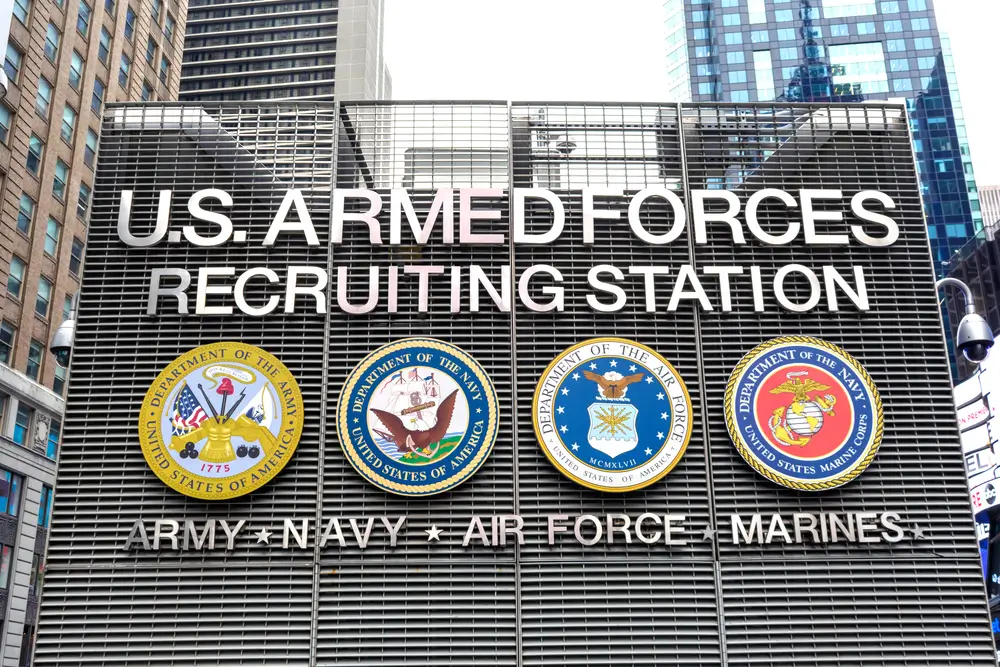
The ASVAB score you need for the Navy depends on two things: your education level and the rating you want. To enlist, most applicants need an AFQT score of 31 with a high school diploma. To land a competitive technical job, you usually need much more, plus the right line scores.
This guide explains the Navy minimum AFQT, how line scores decide which jobs you can hold, the requirements for the most popular ratings, and how to raise your score if your first result falls short. Every figure here reflects current Navy scoring.
 ASVAB Test Prep · All Military BranchesReady to Pass the ASVAB?
Official subtest drills (AFQT, CAT-ASVAB), timed practice tests, score calculators and detailed step-by-step explanations.
Navy ASVAB Score Requirements: AFQT Minimums and Education Tiers
The Navy sets a different minimum AFQT depending on your education credential. Applicants with a Tier I education credential, meaning a high school diploma or at least 15 semester hours of college credit, need a minimum of 31 QT to join active duty or the Navy Reserve.
GED holders fall under Tier II and face a higher bar. They generally need a 50 QT. A Navy pilot program that began on November 4, 2022 lets a limited number of Tier II applicants enlist with 31 QT on limited openings through Fiscal Year 2025.
Beyond those tiers, the Navy runs targeted entry paths for lower scoring applicants. Under current Navy guidelines, a limited number of candidates with 24 to 30 QT who meet the line scores for a rating may enlist through the Future Sailor Preparatory Course Academic. Treat that route as recruiter dependent rather than a published minimum. The Navy's 31 minimum for diploma holders is in line with the Army and Marine Corps.
How the ASVAB Is Structured and How Your AFQT Is Calculated
The ASVAB has nine subtests: General Science (GS), Arithmetic Reasoning (AR), Word Knowledge (WK), Paragraph Comprehension (PC), Mathematics Knowledge (MK), Electronics Information (EI), Auto and Shop Information (AS), Mechanical Comprehension (MC), and Assembling Objects (AO). Verbal Expression (VE) is not a standalone subtest. It is derived from your Word Knowledge and Paragraph Comprehension results.
Your AFQT comes from only four of those nine sections: Arithmetic Reasoning, Mathematics Knowledge, Word Knowledge, and Paragraph Comprehension. The formula is 2VE + AR + MK, where VE equals WK plus PC. That raw score is converted to a percentile, so an AFQT of 50 means you scored as well as or better than half of the reference group.
The Navy groups AFQT results into categories. The minimum enlistment zone for diploma holders sits in Category IIIB at 31 to 49 QT, while top scorers land in Category I at 93 to 99 QT.
| AFQT Category | ASVAB Score Range |
|---|---|
| CAT-I | 93-99 QT |
| CAT-II | 65-92 QT |
| CAT-IIIA | 50-64 QT |
| CAT-IIIB | 31-49 QT |
| CAT-IVA | 21-30 QT |
| CAT-IVB | 16-20 QT |
| CAT-IVC | 10-15 QT |
| CAT-V | 1-9 QT |
You can take the test in two formats. The computer adaptive version (CAT-ASVAB) adjusts each question's difficulty to your answers, and you cannot go back to change a response once submitted. Published test specifications indicate the CAT-ASVAB has 135 questions and a 197 minute limit. The paper and pencil version has 225 questions and a 149 minute limit.
The CAT-ASVAB breaks down as follows.
| Subtest | Question Count | Time Limit (Minutes) |
|---|---|---|
| General Science (GS) | 16 | 8 |
| Arithmetic Reasoning (AR) | 16 | 39 |
| Word Knowledge (WK) | 16 | 8 |
| Paragraph Comprehension (PC) | 11 | 22 |
| Mathematics Knowledge (MK) | 16 | 20 |
| Electronics Information (EI) | 16 | 8 |
| Automotive Information (AI) | 11 | 7 |
| Shop Information (SI) | 11 | 6 |
| Mechanical Comprehension (MC) | 16 | 20 |
| Assembling Objects (AO) | 16 | 16 |
The paper and pencil version uses a slightly different layout, combining Auto and Shop into one section.
| Subtest | Question Count | Time Limit (Minutes) |
|---|---|---|
| General Science (GS) | 25 | 11 |
| Arithmetic Reasoning (AR) | 30 | 36 |
| Word Knowledge (WK) | 35 | 11 |
| Paragraph Comprehension (PC) | 15 | 13 |
| Mathematics Knowledge (MK) | 25 | 24 |
| Electronics Information (EI) | 20 | 9 |
| Automotive and Shop Information (AS) | 25 | 11 |
| Mechanical Comprehension (MC) | 25 | 19 |
| Assembling Objects (AO) | 25 | 15 |

Navy Ratings and Line Scores: How Job Qualification Works
The Navy calls its jobs Navy Ratings, not Military Occupational Specialties (MOS) like the Army. Each rating maps to a Navy Enlisted Classification (NEC) code, and every NEC sets its own minimum subtest combination. That is why two recruits with the same AFQT can qualify for very different careers.
Where the AFQT decides whether you can enlist at all, line scores decide which ratings you qualify for. According to the U.S. Navy, both your overall score and your individual line scores are used to determine eligibility for specific enlisted careers.
The Navy's method is direct. If a rating needs General Science, Auto and Shop, and Mathematics Knowledge to reach a set total, the Navy simply adds those subtest scores. These composite scores lean heavily on math, science, and electronics sections, which is why technical ratings demand far higher totals than general operational jobs.
The table below lists the line score requirements for Navy ratings. Find your target rating, then add the listed subtest scores from your ASVAB report to check whether you clear the threshold.
| Navy Rating | Rating Code | ASVAB Score Requirement |
|---|---|---|
| Aviation Boatswain Mate | ABE, ABF, ABH | VE+AR+MK+AS≥161 |
| Aviation Machinist's Mate | AD | VE+MK+GS≥158 OR VE+MK+EI≥155 |
| Aviation Support Equipment Technician | AS | VE+AR+MK+MC≥206 OR VE+AR+MK+EI≥206 OR AS+MK+AO≥157 |
| Naval Aircrewman | AW | VE+AR+MK+MC≥210 OR VE+AR+MK+AS≥210 |
| Aircrew Rescue Swimmer | AIRCREW AIRR | VE+AR+MK+MC≥210 OR VE+AR+MK+AS≥210 |
| Air Traffic Controller | AC | VE+AR+MK+MC≥220 OR PC+AR+MK≥166 |
| Aerographer's Mate | AG | VE+MK+GS≥162 OR VE+MK+GS≥165 |
| Aviation Structural Mechanic | AM | VE+AR+MK+AS≥210 OR VE+AR+MK+MC≥210 |
| Aviation Structural Mechanic Safety Equipment | AME | VE+AR+MK+AS≥210 OR VE+AR+MK+AO≥210 |
| Aviation Ordnanceman | AO | VE+AR+MK+AS≥173 OR MK+AS+AO≥131 |
| Aviation Avionics | AT, AE (AV) | VE+AR+MK+AO≥217 OR VE+AR+MK+MC≥217 |
| Aircrew Survival Equipmentman | PR | VE+AR+MK+AS≥185 OR MK+AS+AO≥140 |
| Aviation Maintenance Administration | AZ | VE+AR≥102 |
| Boatswain's Mate | BM | VE+AR+MK+AS≥163 OR MK+AS+AO≥126 |
| Builder | BU | AR+MC+AS≥145 OR VE+AR+MK+AO≥209 |
| Construction Electrician | CE | AR+MK+EI+GS≥201 |
| Culinary Specialist | CS | VE+AR≥76 |
| CS Submarine | CSS | AR+MK+EI+GS≥200 OR VE+AR+MK+MC≥200 |
| Construction Mechanic | CM | AR+MC+AS≥162 |
| Cryptologic Technician Interpretive | CTI | MK+VE≥126 OR VE+MK>108 AND DLAB≥110 |
| Cryptologic Technician Technical | CTT | AR+2MK+GS≥212 OR AR+MK+CT≥159 |
| Cryptologic Technician Technical Advanced | CTT (AEF) | AR+MK+EI+GS≥223 OR AR+MK+CT≥162 |
| Cryptologic Technician Maintenance | CTM | AR+MK+EI+VE≥221 |
| Cryptologic Technician Collection | CTR | MK+PC≥110 OR AR+PC≥110 |
| Cyber Warfare Technician | CWT | AR+2MK+GS≥239 OR VE+AR+MK+MC≥239 |
| Damage Controlman | DC | VE+AR+MK+AS≥193 OR VE+AR+MK+MC≥193 |
| Engineering Aid | EA | AR+2MK+GS≥207 |
| Electrician's Mate | EM | VE+AR+MK+MC≥210 OR AR+MK+EI+GS≥210 |
| Engineman | EN | VE+AR+MK+AS≥188 OR VE+AR+MK+AO≥193 |
| Explosive Ordnance Disposal | EOD | AR+VE≥109 AND MC≥51 OR GS+MC+EI≥169 |
| Electronics Technician (AECF) | ET (AECF) | AR+MK+EI+GS≥222 OR AR+2MK+GS≥226 |
| ET Submarine | ETS | AR+MK+EI+GS≥218 OR VE+AR+MK+MC≥218 |
| Equipment Operator | EO | AR+MC+AS≥145 |
| Fire Controlman (AECF) | FC (AECF) | AR+MK+EI+GS≥222 OR AR+2MK+GS≥226 |
| Fire Control Technician Submarine | FT | AR+MK+EI+GS≥218 OR VE+AR+MK+MC≥218 |
| Gas Turbine System Technician Electrical | GSE | VE+AR+MK+MC≥210 OR AR+MK+EI+GS≥210 |
| Gas Turbine System Technician Mechanical | GSM | VE+AR+MK+AS≥200 OR VE+AR+MK+AO≥205 |
| Gunner's Mate | GM | AR+MK+EI+GS≥205 OR GS+AR+2MK≥205 |
| Hospital Corpsman | HM | VE+AR+MK+GS≥208 OR MK+GS+2VE≥208 |
| Hospital Corpsman Dental Assistant | DA | VE+AR+MK+GS≥209 OR MK+GS+2VE≥209 |
| Hospital Corpsman Behavioral Health Technician | BHT | VE+AR+MK+GS≥208 OR MK+GS+2VE≥208 |
| Hospital Corpsman Dental Hygienist | DH | VE+AR+MK+GS≥208 OR MK+GS+2VE≥208 |
| Hospital Corpsman ATF | HM-ATF | VE+MK+GS≥156 AND AR+WK≥105 |
| Hull Maintenance Technician | HT | VE+AR+MK+AS≥193 OR VE+AR+MK+MC≥193 |
| Interior Communications Electrician | IC | AR+MK+EI+GS≥213 OR VE+AR+MK+AO≥218 |
| Information Systems Technician | IT | AR+VE+MK+GS≥212 OR VE+MK+GS≥156 |
| Information Systems Technician ATF | IT-ATF | VE+AR+MK+GS≥214 OR VE+MK+GS≥156 |
| Information Systems Technician Submarines | IT Submarines | AR+2MK+GS≥218 OR AR+MK+EI+GS≥218 |
| Intelligence Specialist ATF | IS-ATF | VE+AR+MK+GS≥215 OR AR+PC+MK≥164 |
| Logistics Specialist | LS | VE+AR≥92 |
| LS Submarine | LSS | AR+MK+EI+GS≥200 OR VE+AR+MK+MC≥200 |
| Legalman | LN | VE+MK≥105 and VE≥52 OR VE+AR≥105 |
| Master-at-Arms | MA | AR+VE+MK+MC≥192 |
| Mass Communication Specialist | MC | VE+AR≥115 and VE≥53 OR PC+AR≥115 |
| Machinist's Mate | MM | VE+AR+MK+AS≥180 OR VE+AR+MK+AO≥185 |
| MM Submarine | MMA/MMS | VE+AR+MK+EI≥207 OR AR+GS+MC+EI≥207 |
| Mineman | MN | VE+AR+MK+MC≥210 OR VE+AR+MK+AO≥216 |
| Missile Technician Submarine | MT | AR+MK+MC+VE≥218 OR VE+AR+MK+AO≥218 |
| Musician | MU | 31 AFQT (no line score criteria) |
| Machinery Repairman | MR | VE+AR+MK+AS≥205 OR VE+AR+MK+MC≥205 |
| Navy Counselor | NC | GS+MK+VE≥156 |
| Navy Diver | ND | AR+VE≥105 AND MC≥51 OR AR+2MK+GS≥210 |
| Operations Specialist | OS | VE+MK+CS≥148 OR AR+2MK+GS≥198 |
| Personnel Specialist | PS | VE+MK≥103 OR VE+MK+CS≥148 |
| Quartermaster | QM | AR+MK+AO+VE≥196 OR MK+VE≥100 |
| Religious Program Specialist | RP | VE+MK≥105 OR VE+MK+CS≥157 |
| Retail Services Specialist | RS | VE+AR≥83 |
| Robotics Warfare Specialist | RW | AR+MK+EI+GS≥222 OR AR+MK+VE+MC≥222 |
| Special Warfare Boat Operator | SB | AR+VE≥105 and MC≥51 OR AR+2MK+GS≥210 |
| Sonar Technician Surface (AEF) | STG (AEF) | AR+MK+EI+GS≥222 |
| Sonar Technician Surface (5YO) | STG (5YO) | AR+MK+EI+GS≥223 OR AR+MK+VE+AO≥228 |
| Sonar Technician Submarine | STS | AR+MK+EI+GS≥218 OR VE+AR+MK+MC≥218 |
| Steelworker | SW | AR+MC+AS≥145 |
| Special Warfare Operator | SO | VE+AR≥108 AND MC≥50 AND AR+MK≥100 |
| Submarine Electronics Computer Field | SECF | AR+MK+EI+GS≥218 OR VE+AR+MK+MC≥218 |
| Utilitiesman | UT | AR+MK+EI+GS≥205 OR AR+AS+MK≥145 |
| Yeoman | YN | VE+MK≥99 OR VE+MK+CS≥148 |
| YN Submarine | YNS | AR+MK+EI+GS≥200 OR VE+AR+MK+MC≥200 |
ASVAB Test Prep · All Military BranchesReady to Pass the ASVAB?Official subtest drills (AFQT, CAT-ASVAB), timed practice tests, score calculators and detailed step-by-step explanations.
ASVAB Line Score Requirements for Key Navy Ratings
The Navy's most demanding ratings sit in the Nuclear Power Program. Nuclear field positions, including Electrician's Mate, Electronics Technician, and Machinist's Mate in the nuclear field, require VE+AR+MK+MC+NAPT of at least 290 with a Navy Advanced Programs Test (NAPT) score of at least 50. An alternative path skips the NAPT and asks for AR+MK+EI+GS of at least 252. The program also expects an AFQT above 50 along with strong math and science line scores, and it pays one of the largest enlistment bonuses the Navy offers, often in the tens of thousands of dollars.
Technical ratings cluster near the top of the line score range. Information Systems Technician (IT) requires AR+VE+MK+GS of at least 212. Electronics Technician requires AR+MK+EI+GS of at least 222. The Cyber Warfare Technician (CWT) sets one of the highest standards in the rating system at AR+2MK+GS of at least 239. Air Traffic Controller (AC) needs VE+AR+MK+MC of at least 220.
Medical and aviation support ratings sit lower on the scale. Hospital Corpsman (HM) requires VE+AR+MK+GS of at least 208, a moderate threshold that leans on verbal and General Science skills for patient facing work. Aviation Boatswain's Mate (ABE, ABF, ABH) requires VE+AR+MK+AS of at least 161.
Cryptologic and intelligence ratings combine high composite scores with extra screening. Cryptologic Technician Interpretive adds the Defense Language Aptitude Battery (DLAB), since the role involves learning a foreign language, and the DLAB threshold rises with language difficulty. Intelligence Specialist, an Advanced Technical Field (ATF) rating, weighs Verbal Expression and reasoning skills most heavily.
The Assembling Objects Subtest: A Navy Specific Component
The Assembling Objects (AO) subtest measures spatial reasoning, meaning how well you can picture the way separate parts fit together to form a whole. The Navy is the only U.S. branch that uses Assembling Objects in its qualification and line score system, so applicants for other services never prepare for it.
AO appears across many Navy ratings and sometimes opens an alternative path. The Navy lets Aviation Ordnanceman qualify with VE+AR+MK+AS of 173 or with MK+AS+AO of 131, for example. On the test itself, AO runs 16 questions in 16 minutes on the CAT-ASVAB and 25 questions in 15 minutes on the paper version. Strong spatial skills tend to track with success in hands on technical training.
What Counts as a Good Navy ASVAB Score
The Navy minimum gets you in the door, but it does not get you the job you want. The average AFQT for Navy applicants is 50. Most recruiters recommend aiming for 50 or higher, since that range qualifies you for the vast majority of ratings and for bonus eligibility.
Higher still is better. Available data indicates that about half of all test takers score 50 or above on each section, while fewer than 20% reach 60 or higher. A score in the 60s or 70s puts the most competitive technical ratings and the Nuclear Power Program within reach.
So is 35 a low score? A 35 clears the 31 minimum for diploma holders, but it still limits you to fewer ratings and rules out technical and nuclear paths. A 47 sits just below the average and closes the door on the most in demand jobs. If you are targeting a technical career, retaking the test to reach 50 or higher is usually worth the effort.

Special Warfare and Elite Navy Ratings
Elite ratings stack demanding physical screening on top of ASVAB line scores. Navy SEAL candidates, who fill the Special Warfare Operator rating, can qualify on either of two line score formulas: GS+MC+EI of 165 or VE+MK+MC+CS of 220. SEAL applicants must also be 28 or younger and meet strict diving and vision standards.
| Line Score Formula | Score Required |
|---|---|
| GS+MC+EI | 165 |
| VE+MK+MC+CS | 220 |
Other special operations ratings carry their own thresholds. Explosive Ordnance Disposal (EOD) requires AR+VE of 109 with MC of 51, or GS+MC+EI of 169. Navy Diver requires AR+VE of 105 with MC of 51. Aviation Rescue Swimmer (AIRR) requires VE+AR+MK+MC or VE+AR+MK+AS of 210. Each of these careers also adds a physical screening test alongside the ASVAB.
Submarine ratings deserve a mention as well. The Submarine Electronics Computer Field (SECF) and other submarine qualified ratings carry their own line score combinations, often set at high technical thresholds.
Retaking the ASVAB and Improving Your Score
A first result is not final. The Navy lets you retake the ASVAB one calendar month after your first attempt. After that first retest, each additional retest requires a six month wait. Any ASVAB taken within two years of a previous test counts as a retest, and applicants must be at least 17 years old to test at all.
Use the wait between attempts with intent. Take a full length practice test, pinpoint your two or three weakest subtests, and concentrate your study there, prioritizing the four AFQT subtests that decide eligibility.
The Prescreening internet delivered Computer Adaptive Test (PiCAT) is a useful checkpoint. The PiCAT is an unproctored practice version that gives a reliable score estimate before the real exam. If you take it, you must confirm the result with a short proctored verification test at a Military Entrance Processing Station (MEPS) within 30 days. Each retake is a genuine chance to qualify for more Navy Ratings, larger bonuses, and a wider set of career paths.
Frequently Asked Questions
What is the minimum ASVAB score to join the Navy?
The current baseline used in this brief is an AFQT of 31 for applicants with a Tier I credential, including active-duty and Reserve non-prior-service applicants. Standard guidance gives Tier II or GED applicants a 50QT minimum, although a limited lower-score pathway may apply in specific cases. The AFQT is a percentile score, not a percentage of correct answers.
Can I join the Navy with a 25 ASVAB score?
A 25 is below the standard 31QT threshold and would not ordinarily qualify. A limited Navy pilot pathway has allowed some applicants below 31 when they meet specified line-score requirements, but availability and eligibility are restricted. Confirm the current rule with a Navy recruiter.
What is a good Navy ASVAB score?
A 31 clears the basic Tier I baseline, but it may not open many specialized Ratings. Preparation guidance commonly treats 50 or higher as competitive and recommends aiming around 60 for wider access; line scores, not AFQT alone, determine eligibility for a specific Rating.
Is a 72 a high ASVAB score?
Yes. A 72 AFQT is above the national mean and falls in CAT-II, which the published category table defines as 65-92. It means you performed as well as or better than 72% of the norm group, not that you answered 72% of the questions correctly. Rating line scores still matter.
Is a 47 on the ASVAB good for the Navy?
An AFQT of 47 is above the 31QT Tier I entry baseline, but it is below the 50 target often used for broader competitiveness. Whether it opens a particular Rating depends on education status, subtest combinations, and current openings.
How hard is the Navy ASVAB?
The ASVAB is multiple-choice, but timed subtests and the CAT-ASVAB's adaptive format make pacing important. Candidates should expect to prepare across math, electronics, mechanics, science, verbal skills, and AO, depending on their target Rating.
What ASVAB score do you need for IT in the Navy?
Published tables do not all show the same pathway or Rating variant. Military.com and ASVAB Boot Camp list IT as AR+2MK+GS=222 or AR+MK+EI+GS=222, while NavyCS's matrix lists IT pathways at AR+VE+MK+GS≥212 or VE+MK+GS≥156. Confirm the current Rating code and threshold with a Navy recruiter.
What ASVAB score is needed for Navy Hospital Corpsman?
Military.com and ASVAB Boot Camp list a Hospital Corpsman pathway of VE+MK+GS=156. NavyCS's matrix gives HM pathways of VE+AR+MK+GS≥208 or MK+GS+2VE≥208, while HM-ATF has an additional combination. Because these are Rating- and pathway-specific tables, confirm the current HM code and requirement with a recruiter.
How do I practice for the Navy ASVAB?
Start with a full-length diagnostic, identify weak subtests, then practice under timed conditions and review why answers are correct. Build coverage around the four AFQT subtests, then add math, science, technical, mechanical, and AO preparation for the Rating you want. Study consistently rather than memorizing answer patterns.
Is 35 a low ASVAB score?
Under the current 31QT Tier I baseline, 35 is above the minimum for basic eligibility. It is not a strong target if you want selective technical Ratings, because those jobs use higher line-score combinations. Treat 35 as an entry-level result, not a career guarantee.
Sources
ASVAB Test Prep · All Military BranchesReady to Pass the ASVAB?Official subtest drills (AFQT, CAT-ASVAB), timed practice tests, score calculators and detailed step-by-step explanations.
Marine ASVAB Score: Minimum AFQT, Line Scores & MOS Guide
Coast Guard ASVAB Score: Minimums, Ratings & How to Prep