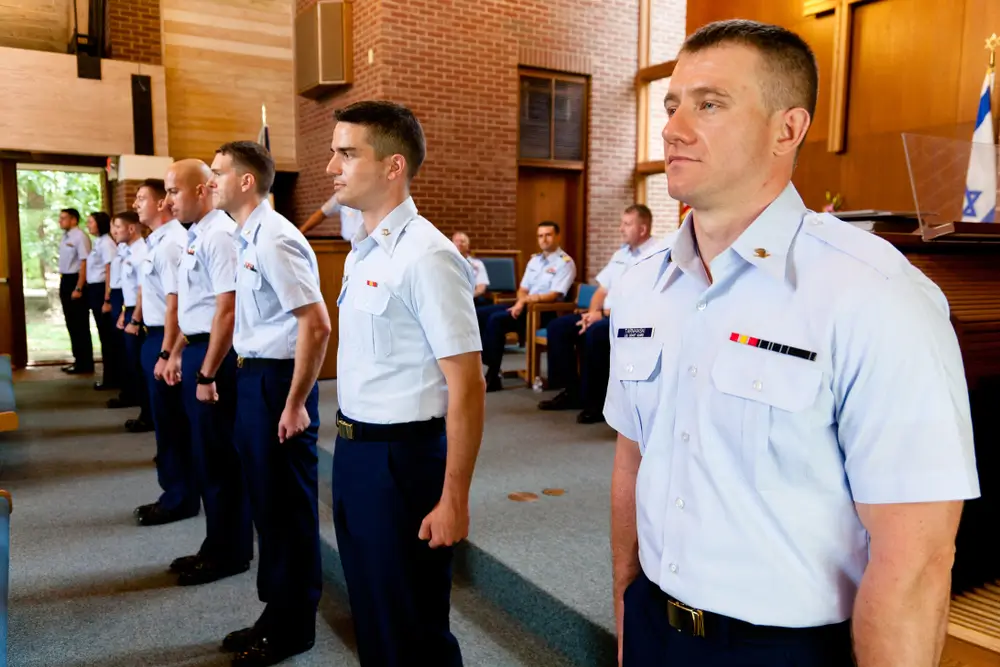
If you have a high school diploma, you need a minimum AFQT score of 32 to enlist in the Coast Guard. That number is low, and it is the least useful figure on this page. The branch is small, it recruits for a narrow set of ratings, and clearing the minimum rarely guarantees a slot. What decides your outcome is how far above it you land.
This guide breaks down exactly what score you need, how the AFQT is built, which Coast Guard jobs demand higher line scores, and how to prepare so you clear the bar with room to spare. The goal is simple. You should finish reading knowing your target number and how to hit it.
 ASVAB Test Prep · All Military BranchesReady to Pass the ASVAB?
Official subtest drills (AFQT, CAT-ASVAB), timed practice tests, score calculators and detailed step-by-step explanations.
Coast Guard ASVAB Minimum Score Requirements
The Coast Guard requires a minimum AFQT score of 32 for applicants who hold a high school diploma, according to official guidance. That is two points above the 31 floor used by the Army, the Air Force, and the Marine Corps.
If you have a GED instead of a diploma, the bar rises to a minimum AFQT score of 50. That is fourteen points higher than the diploma requirement, and it reflects a broader reality: the Coast Guard rarely makes exceptions for candidates without a diploma. Less than 5% of accepted recruits enlisted without one. The practical takeaway is that finishing high school before you apply removes a major obstacle.
Older references sometimes cite 36 or 40, but these figures are out of date. The current official minimum is 32, which is the number to plan around.
Why so high? The answer comes down to size. The Coast Guard operates with fewer than 40,000 active duty personnel, far smaller than the other services. With limited positions and steady demand, the branch can afford to be picky even for entry-level roles. Each available slot draws multiple qualified applicants, which pushes selection pressure well above what larger branches experience.
Waivers and Rare Exceptions
The Coast Guard does grant waivers, but they are not a backdoor around the standard. A waiver authority can approve a candidate whose score falls slightly short of a requirement, and the waiver minimum AFQT is 32. These exceptions are reserved for cases where a recruiter and command judge that a candidate's broader record justifies the call. They are not something to count on. The safer strategy is to study until your score clears the standard outright.
Understanding AFQT: The Score That Determines Eligibility

The AFQT, or Armed Forces Qualification Test, is not the whole ASVAB. It is a single composite score pulled from four specific ASVAB subtests: Arithmetic Reasoning (AR), Mathematics Knowledge (MK), Word Knowledge (WK), and Paragraph Comprehension (PC). This is the number that decides whether you are generally qualified to enlist.
Many applicants confuse their overall ASVAB performance with their AFQT, but the two are different calculations from the same underlying subtest results. The AFQT determines basic enlistment eligibility. The remaining subtests feed into job-specific qualifications, which we will cover below.
The AFQT is reported as a percentile from 1 to 99. It tells you how you performed relative to a nationally representative sample of 18 to 23 year olds. The scoring is standardized using the mean and standard deviation from a 1997 national study, so the number is not a raw count of correct answers.
Here is what the percentiles actually mean. A score of 50 sits exactly at the national average. A 60 is one standard deviation above the mean. A 70 is two standard deviations above, and a 30 is two standard deviations below. So an AFQT of 90 means you scored as well as or better than 90% of that reference population. The score measures how you stack up against other test takers, not whether you cleared an arbitrary threshold of questions.
The formula behind the AFQT is straightforward: AFQT = MK + AR + (2 × VE), where VE is Verbal Expression (the combined Paragraph Comprehension and Word Knowledge result). That weighting gives verbal aptitude significant pull, which is worth keeping in mind when you decide where to focus your study time.
ASVAB Subtests: What the Full Test Measures
The full ASVAB goes well beyond the four AFQT sections. It includes nine subtests covering science, math, verbal, and technical knowledge. While the AFQT gets you in the door, your scores across all nine subtests determine which Coast Guard jobs you can hold.
The table below shows the standard paper-and-pencil breakdown, including question counts and time limits.
| Subtest Name | Abbreviation | Content Focus | Number of Questions | Time Limit (Minutes) |
|---|---|---|---|---|
| General Science | GS | Life Science, Physical Science, Earth Science | 25 | 11 |
| Arithmetic Reasoning | AR | Basic mathematical word problems | 30 | 36 |
| Word Knowledge | WK | Word meanings, synonyms, sentence usage | 35 | 11 |
| Paragraph Comprehension | PC | Reading comprehension from written passages | 15 | 13 |
| Mathematics Knowledge | MK | High school mathematics, algebra, geometry | 25 | 24 |
| Electronics Information | EI | Electricity, radio principles, electronics | 20 | 9 |
| Auto and Shop Information | AS | Automotive mechanics, tools, shop practices | 25 | 11 |
| Mechanical Comprehension | MC | Mechanical devices, structural support, materials | 25 | 19 |
| Assembling Objects | AO | Spatial aptitude, puzzle assembly, object connection | 25 | 15 |
Source: Official ASVAB and enlistment information
The two math subtests carry the heaviest weight for general qualification. Arithmetic Reasoning tests your ability to solve word problems, while Mathematics Knowledge covers algebra, geometry, and core concepts. On the verbal side, Word Knowledge measures vocabulary through synonyms, and Paragraph Comprehension checks how well you pull information from written passages. General Science and the four technical subtests, Electronics Information, Auto and Shop Information, Mechanical Comprehension, and Assembling Objects, matter most when you target specific technical ratings.
CAT-ASVAB vs. Paper-and-Pencil
You can take the ASVAB in two formats, and they differ in important ways. The computerized version, the CAT-ASVAB, is adaptive. The software selects each question based on how you answered the previous one, so correct answers lead to harder questions and incorrect answers lead to easier ones. You cannot skip questions, and once you submit an answer, you cannot go back and change it.
The CAT-ASVAB consists of about 135 total scored questions, and most candidates finish in about an hour and a half. Its structure looks like this.
| Subtest | Questions | Time (Minutes) |
|---|---|---|
| General Science (GS) | 15 | 12 |
| Arithmetic Reasoning (AR) | 15 | 55 |
| Word Knowledge (WK) | 15 | 9 |
| Paragraph Comprehension (PC) | 10 | 27 |
| Mathematics Knowledge (MK) | 15 | 31 |
| Electronics Information (EI) | 15 | 10 |
| Auto Information (AI) | 10 | 7 |
| Shop Information (SI) | 10 | 6 |
| Mechanical Comprehension (MC) | 15 | 22 |
| Assembling Objects (AO) | 15 | 18 |
| Total Scored | 135 | 197 |
Source: Official ASVAB and enlistment information
The paper-and-pencil ASVAB, the P&P-ASVAB, works differently. Every examinee answers the same fixed set of questions, and you are allowed to review and change answers within each section. There is no penalty for guessing, so if you run short on time, filling in the remaining bubbles works in your favor. The P&P version contains 225 scored questions and takes most candidates about three and a half hours.
| Subtest | Questions | Time (Minutes) |
|---|---|---|
| General Science (GS) | 25 | 11 |
| Arithmetic Reasoning (AR) | 30 | 36 |
| Word Knowledge (WK) | 35 | 11 |
| Paragraph Comprehension (PC) | 15 | 13 |
| Mathematics Knowledge (MK) | 25 | 24 |
| Electronics Information (EI) | 20 | 9 |
| Auto & Shop Information (AS) | 25 | 11 |
| Mechanical Comprehension (MC) | 25 | 19 |
| Assembling Objects (AO) | 25 | 15 |
| Total Scored | 225 | 149 |
Source: UnionTestPrep
Coast Guard Ratings and Line Score Requirements
Clearing the AFQT minimum only opens the door. To qualify for a specific Coast Guard job, called a rating, you need to meet additional line score requirements built from particular subtest combinations. These line scores reflect the technical and cognitive demands of each specialty.
The principle is direct. Mechanical ratings reward strong performance on mechanical comprehension, auto and shop knowledge, and math. Electronic and technical ratings lean heavily on electronics information, general science, arithmetic reasoning, and mathematics knowledge. Administrative and intelligence ratings draw more on verbal and clerical aptitude. Knowing which subtests feed your target rating lets you focus your prep where it counts.
The table below shows minimum composite scores for a representative set of Coast Guard ratings.
| Rating Code | Job Title | Minimum Composite Score | Additional Requirements |
|---|---|---|---|
| AET | Avionics Electrical Technician | 171 | None specified |
| AMT | Aviation Maintenance Technician | 213 | Minimum AR: 52 |
| AST | Aviation Survival Technician | 162 | Minimum AFQT score of 65 |
| BM | Boatswain's Mate | 101 | None specified |
| CS | Culinary Specialist | 106 | None specified |
| DC | Damage Controlman | 152 | None specified |
| DV | Diver | 104 | None specified |
| EM | Electrician's Mate | 152 | Minimum AR of 52 |
| ET | Electronics Technician | 171 | Minimum AR of 52 or AFQT of 66 |
Source: Official ASVAB and enlistment information
The spread here is large. Aviation Maintenance Technician (AMT) sits at the top with a minimum composite of 213 plus a minimum Arithmetic Reasoning score of 52. These technicians maintain and repair complex aircraft systems where a mistake carries real safety consequences, so the high requirement matches the technical load of the training and the job.
Aviation Survival Technician (AST), the rescue swimmer rating, requires a composite of 162 and, distinctively, a minimum AFQT of 65. That AFQT floor shows how some ratings demand high general aptitude on top of any subject-specific score. Electronics Technician (ET) and Avionics Electrical Technician (AET) both require a composite of 171, with ET also needing an AR of 52 or an AFQT of 66. At the other end, Boatswain's Mate (BM) needs only 101, making it one of the more accessible ratings for applicants whose strengths lie outside the technical subtests.
One point of nuance is worth flagging. The Coast Guard and the Navy may use direct ASVAB subtest standard scores for job qualification, differing from the composite line scores used by some other branches. If a job requires a combined score of 95 across specific subtests, your scores on those subtests must total at least 95. Most sources present these requirements as composite formulas, so treat the published composite numbers as your working targets and confirm the exact method with a recruiter for your specific rating.
ASVAB Test Prep · All Military BranchesReady to Pass the ASVAB?Official subtest drills (AFQT, CAT-ASVAB), timed practice tests, score calculators and detailed step-by-step explanations.
Why the Coast Guard Is Hard to Join
The Coast Guard's high bar is sometimes mistaken for proof that the jobs are inherently harder. The real driver is selectivity. The branch is small and mission-focused, so it can hold a higher standard even for entry-level roles.
The size gap is dramatic. The Coast Guard runs with roughly 38,000 to 40,000 active duty personnel. By comparison, the Navy fields over 300,000 active members, the Army about 485,000, and the Air Force more than 330,000. With so few positions relative to interest, every slot attracts multiple qualified applicants, and acceptance rates fall well below those of larger branches.
This is why a strong score does double duty. It is not just about qualifying for a rating. Meeting the minimum does not guarantee acceptance into the Coast Guard, so a higher score helps you secure an actual slot and gives you more flexibility when choosing a rating. The branch's specialized maritime work, including law enforcement, search and rescue, and safety operations, also calls for advanced technical skill and quick decision-making, which reinforces the elevated standard.
The comparison across branches puts that in proportion. The Army, the Air Force, and the Marine Corps all set a minimum AFQT of 31 for high school diploma holders, the Coast Guard 32, and the Space Force 36, the highest of any branch. On paper the Coast Guard sits near the bottom of that range. What makes it competitive is not the cutoff but the number of slots behind it.
There is one quantitative benchmark worth noting, with a caveat. The average AFQT score of accepted Coast Guard recruits was 70.4 as of 2009. That figure comes from a single source and is more than a decade old, so treat it as a rough historical reference rather than a current target. Even so, it underlines the point: accepted recruits tend to score far above the minimum.
2021 Policy Changes: Lower Composite Scores and Wider Waivers
In late 2021, the Coast Guard made its first major ASVAB policy changes since 2004. The branch reduced the composite score requirements for A-school attendance by 10 points across all ratings except diver, effective November 1, 2021. The move was designed to close workforce gaps and address steep competition for talent.
The numbers behind the change explain the urgency. More than 600 A-school seats sat empty in fiscal year 2021, and 12 of 21 A-school waitlists lacked enough qualified applicants to fill even a single convening to capacity. The Coast Guard also reported more than 500 unfilled E-4 billets, signaling a real shortage at the junior enlisted level.
The Information Systems Technician (IT) rating is the clearest example of how the reduction worked.
| Metric | Previous Requirement | New Requirement | Status |
|---|---|---|---|
| Composite Score (MK+EI+GS) | 172 | 162 | Reduced by 10 points |
| Arithmetic Reasoning (AR) Subtest | 52 | 52 | Unchanged |
| AFQT (Alternate Qualification) | 65 | 65 | Unchanged |
Source: Official USCG policy announcement
Note what did not change. The specific subtests used for each rating stayed the same, and all subtest minimums, including the IT rating's AR floor of 52, held steady. Only the composite total dropped. Graduation and training standards at A-school were untouched, so the policy lowered the entry bar without lowering the bar to pass.
Expanded Waiver Authority
Alongside the score reductions, the Coast Guard widened its waiver authority. Commanding officer or officer in charge (CO/OIC) and Coast Guard Recruiting Command Accessions authority increased from five to 10 total points, and it now covers subtest minimums beyond the AFQT. Each rating force master chief now serves as the final A-school waiver authority for waivers exceeding 10 points.
A concrete example shows how this plays out.
| Metric | Member Score | Required Score | Points Needed | Authority |
|---|---|---|---|---|
| Composite Score | 154 | 162 | 8 points | CO/OIC |
| Arithmetic Reasoning (AR) | 50 | 52 | 2 points | CO/OIC |
| AFQT | 60 | 65 | 5 points (not waiverable) | N/A |
Source: Official USCG A-school ASVAB announcement
The expanded authority has a track record behind it. More than 300 merit-based waivers were granted annually over the prior three years, and attrition at nearly all A-schools stayed at or below previous levels. The data showed no correlation between waiver status and overall performance as third class petty officers. As Master Chief Petty Officer of the Coast Guard Jason Vanderhaden put it, the goal was to let more members attend the A-school of their choice while keeping graduation standards intact.
How to Prepare for the Coast Guard ASVAB
Good preparation is mostly about time and focus. You should begin studying at least 8 weeks before your test date and aim for 1 to 2 hours of study per day. Plan a similar runway of at least two months. Starting early is what separates a passing score from a competitive one.
Begin with a diagnostic. Take a full-length practice test before you study anything, so you know exactly where you stand. That baseline tells you which subtests need the most work and gives you a number to improve on. From there, build a study schedule that covers all the subtests but weights your time toward your weakest areas.
Prioritize the four AFQT sections first, since those decide whether you qualify at all: Arithmetic Reasoning, Mathematics Knowledge, Word Knowledge, and Paragraph Comprehension. Once those are solid, layer in the technical subtests that matter for your target rating. Researching your rating's specific line score requirements before you start lets you direct effort where it has the most impact on eligibility.
Practice under realistic conditions. Take timed practice tests to build pacing and stamina, and review the explanation for every wrong answer so you understand the mistake rather than just noting it. Track your progress weekly. Watching your score climb confirms your plan is working and keeps you motivated through the harder sections.
There is also an alternative testing format worth knowing about. The PiCAT (Pending Internet Computerized Adaptive Test) is an option you can take from home with no time limit. A recruiter can tell you whether it fits your situation.
Retaking the ASVAB
If your first score falls short, you can retake the test, but the waiting periods are strict. You must wait one month after your first attempt before a second try, another month before a third attempt, and six months after the third attempt before testing again.
The timing detail that trips people up is this: the most recent score counts, not the highest. Published guidance notes that your latest result replaces the earlier one for enlistment purposes. So you should only retake the test when you are confident you will improve. Walking in unprepared for a retake can actually lower the score you walk out with.
There is a Coast Guard-specific wrinkle on the waiting period. Recruits unhappy with their scores generally must wait six months to retake, but a recruiter who determines the scores do not reflect a candidate's education, training, and experience may reduce that wait to one month. This framing differs from the standard schedule other sources describe, so confirm the exact policy with your recruiter.
Scores do not last forever. ASVAB results remain valid for enlistment for up to two years from the test date. If you try to enlist after that window closes, you have to test again.
What Counts as a 'Good' Score for the Coast Guard
The minimum of 32 gets you eligible, but in this branch, eligible is not the same as competitive. Because the Coast Guard rejects many candidates who clear the minimum, your target should sit well above it.
A useful benchmark is that an AFQT of 50 or better is considered a good score for the Coast Guard. A 50 puts you at the national average and meaningfully improves your odds of acceptance and your flexibility when picking a rating. It is the floor for "competitive" rather than just "qualified."
To open up more options, aim higher. Targeting a minimum AFQT of 60 expands your access to specialized roles. Scores in the 70-plus range position you for the most technical and sought-after ratings, and they align with the historically high averages of accepted recruits. A strong score also carries practical rewards. Higher scores broaden your job options, some of which come with special pay and bonuses, so the effort you put into your score pays off across your career, not just at enlistment.
Coast Guard Enlistment Eligibility Beyond the ASVAB
Your score is one piece of a larger picture. To enlist in the Coast Guard you must be between 17 and 39 years old, be a U.S. Citizen or legal permanent resident, hold a high school diploma or GED, pass the ASVAB at the required minimum, pass a medical exam at MEPS (Military Entrance Processing Station), pass a physical fitness test, clear criminal background and credit checks, and meet the branch's mental and moral standards. GED holders also need at least 15 college credits.
The fitness standard reflects the branch's mission. The Coast Guard's physical assessment includes a run, push-ups, sit-ups, and a swim test. The swim component is distinctive among the services and ties directly to the maritime environment Coast Guard members work in. If you are not a confident swimmer, build that skill into your preparation alongside your study plan.
The vetting runs deep. As part of the standard Coast Guard application process, applicants face criminal background checks, credit checks, and a national security background check conducted late in the process. A complete medical exam and drug test at MEPS confirms you meet service medical standards, and you will need to submit a detailed, well-documented medical history before scheduling that exam. Requirements can also differ slightly between active duty and reserve enlistment, so verify the specifics with a recruiter for the path you are pursuing.
Frequently Asked Questions
What ASVAB score do I need for the Coast Guard?
For an applicant with a high school diploma, the current minimum AFQT score is 40. A GED holder generally needs at least 50. Reaching the minimum is an initial eligibility step and does not guarantee acceptance or a specific Rating.
What is a good ASVAB score for the Coast Guard?
An AFQT score of 50 or higher is commonly described as a good Coast Guard benchmark. Candidates seeking more specialized Rating options may use 60 as a stronger target, since higher scores can expand career choices and competitiveness.
Is a 47 on the ASVAB good for the Coast Guard?
For a high school diploma holder, 47 is above the current minimum AFQT of 40. For a GED holder, 47 is below the current standard of 50. The score still does not guarantee acceptance or qualification for a preferred Rating.
Is 72 a high ASVAB score?
An AFQT score of 72 means the candidate performed better than 72% of the reference population used for the percentile score, so it is well above the Coast Guard's minimum of 40. Rating-specific line or composite scores still determine which jobs are available to the candidate.
Is a 70 on the ASVAB good for the Coast Guard?
Yes. An AFQT of 70 is a strong percentile result and is substantially above the Coast Guard's minimum AFQT requirement of 40. It is not a percentage of correct answers, and the candidate must still meet Rating-specific requirements and other enlistment standards.
Is a 70 on the ASVAB hard to achieve?
The supplied sources do not provide a probability or difficulty rating for reaching 70. They do establish that 70 is a percentile score, meaning performance above 70% of the reference sample, so candidates should use a diagnostic practice test rather than assume how close they are.
Is a 77 a good ASVAB score?
An AFQT of 77 is a high percentile score and is well above the Coast Guard's minimum AFQT threshold. It can improve flexibility when choosing a Rating, although the relevant line or composite scores and available positions still apply.
Why is the Coast Guard ASVAB score so high?
The Coast Guard uses a minimum AFQT of 40, the highest baseline requirement among the military branches covered by the sources. Its active-duty force is under 40,000, so applicants compete for fewer places, while the service also cites specialized maritime missions and operational demands. The higher threshold reflects selectivity and force size, not necessarily greater technical difficulty in every Rating.
How should I study for the Coast Guard ASVAB?
Start with a full-length diagnostic practice test, then identify both your AFQT weaknesses and the subtests used by your target Rating. Use timed practice to build pacing, and begin preparation roughly eight weeks before the official test; the supplied guidance recommends regular study and a structured plan. Confirm current Rating requirements with a Coast Guard recruiter because composite thresholds can change.
Sources
ASVAB Test Prep · All Military BranchesReady to Pass the ASVAB?Official subtest drills (AFQT, CAT-ASVAB), timed practice tests, score calculators and detailed step-by-step explanations.
Marine ASVAB Score: Minimum AFQT, Line Scores & MOS Guide
Navy ASVAB Score Requirements: Minimums and Job Line Scores