
You took the ASVAB, your score report arrived, and now you need to make sense of the numbers. Here is the short version. One score decides whether you can enlist at all. A separate set of scores decides which jobs you can actually hold. Knowing the difference between those two layers is the most important thing on the whole report.
This guide walks through both. It explains how the test is built, how raw answers become the scores you see, what the AFQT number really represents, the minimum each branch asks for, and how line scores open or close specific careers. If you are weighing branches or chasing a particular job, this is the map.
 ASVAB Test Prep · All Military BranchesReady to Pass the ASVAB?
Official subtest drills (AFQT, CAT-ASVAB), timed practice tests, score calculators and detailed step-by-step explanations.
What the ASVAB Is and How It Works
The ASVAB (Armed Services Vocational Aptitude Battery) is a multiple-aptitude test taken by more than a million military applicants and students every year. It measures developed abilities and helps predict how well you might do in military training and on the job. It is developed and maintained by the Department of Defense.
The test comes in two main formats. The CAT-ASVAB is a computerized adaptive version given at Military Entrance Processing Stations, known as MEPS. The paper-and-pencil version, the P&P-ASVAB, is offered at Military Entrance Test (MET) sites for applicants who do not live near a MEPS. According to the official ASVAB program, your scores should be very similar regardless of which format you take. Around 70% of applicants take the computerized version, which on average runs in about half the time of the paper test.
There is also the PiCAT, an unproctored online version that lets you complete a full ASVAB on your own time, with the results verified later at a MEPS facility.
Scores stay valid for two years from the test date for non-prior-service applicants. If you need to retake the test, the rules are strict. The first retake requires a 30-day wait, and from the third attempt onward the wait grows to six months. The most recent score is the one that counts, not your highest.
The two formats differ in size. The CAT-ASVAB has 135 questions across ten subtests. The MET-site P&P-ASVAB has 225 questions.
The Nine ASVAB Subtests
The ASVAB measures aptitude across four domains: verbal, math, science and technical, and spatial. It does this through nine subtests.
| Subtest Code | Subtest Name | Content Description |
|---|---|---|
| GS | General Science | Life science, earth and space science, and physical science |
| AR | Arithmetic Reasoning | Solve basic arithmetic word problems |
| WK | Word Knowledge | Ability to understand the meaning of words through synonyms |
| PC | Paragraph Comprehension | Ability to obtain information from written material |
| MK | Mathematics Knowledge | Mathematical concepts and applications |
| EI | Electronics Information | Electrical current, circuits, devices and electronic systems |
| AS | Auto & Shop Information | Automotive maintenance and repair and wood and metal shop practices |
| MC | Mechanical Comprehension | Principles of mechanical devices, structural support and properties of materials |
| AO | Assembling Objects | How an object will look when its parts are put together |
One score on your report is not a subtest at all. Verbal Expression (VE) is a combined figure created by adding your Word Knowledge and Paragraph Comprehension scores. It matters because it feeds into the AFQT and into many composite scores across every branch.
The formats handle a few subtests differently. On the paper version, Auto and Shop Information is treated as a single subtest, and Assembling Objects is not administered. Timing also varies. On the CAT-ASVAB, Arithmetic Reasoning gives you 39 minutes for 15 questions, the longest single block, while Auto and Shop Information allows only 7 minutes for 10 questions.
How ASVAB Scores Are Calculated
Your report does not show a percentage of questions you got right. The scoring is more involved than that, and understanding it removes a lot of confusion.
ASVAB scoring is built on Item Response Theory, often shortened to IRT. The specific method is the three-parameter logistic model, the 3PL model. The 3PL model accounts for how hard each item is, how well it separates strong from weak examinees, and the chance that a low-ability test-taker guesses correctly. According to the official ASVAB program, this lets a tailored set of questions produce scores that mean the same thing across different test forms.
On the CAT-ASVAB, every examinee starts at an initial ability estimate of zero, the middle of the expected range, which updates after each answered item. Once the final ability estimate is set, it is converted to a score through a process called equating, run on every item pool and test form so results stay comparable over time.
The two formats also treat unfinished tests differently. On the paper version, blank items count as wrong. On the CAT-ASVAB, a penalty is applied to the final estimate for unanswered items, which removes any incentive to game the format by skipping questions.
The output of all this is your set of standard scores.
Standard Scores: What the Subtest Numbers Mean
Each subtest produces a standard score with a fixed mean of 50 and a standard deviation of 10. A standard score of 40 means you scored one standard deviation below the mean. A score of 70 means two standard deviations above it. These scores are referenced against a national sample of young people aged 18 to 23.
In practice, about half of all test-takers score at or above 50, and roughly 16% score at or above 60. So a 50 is average, a 60 puts you in the top sixth, and a 70 is well into the top tier.
Standard scores do not decide anything on their own. Their job is to feed the two scores that matter: the AFQT, which sets enlistment eligibility, and the composite scores, which set job eligibility.
ASVAB Test Prep · All Military BranchesReady to Pass the ASVAB?Official subtest drills (AFQT, CAT-ASVAB), timed practice tests, score calculators and detailed step-by-step explanations.
The AFQT Score and Its Categories
The AFQT (Armed Forces Qualification Test) is the gatekeeper for enlistment. It is not a separate test. It is a number drawn from four subtests: Arithmetic Reasoning, Mathematics Knowledge, Word Knowledge, and Paragraph Comprehension. The formula is AR + MK + (2 × VE), where VE is the combined Word Knowledge and Paragraph Comprehension score.
The AFQT is reported as a percentile from 1 to 99. That percentile tells you the share of the reference group that scored at or below your level. According to the official ASVAB program, the reference group is a nationally representative sample of 18- to 23-year-olds who took the test as part of a 1997 norming study. An AFQT of 90 means you performed as well as or better than 90% of that sample. A 50 means you matched or beat half of it, not that you answered half the questions correctly. The highest possible score is 99, because reaching 100 would mean outscoring every single person in the sample.
The AFQT breaks into eight categories.
| AFQT Category | Score Range |
|---|---|
| I | 93–99 |
| II | 65–92 |
| IIIA | 50–64 |
| IIIB | 31–49 |
| IVA | 21–30 |
| IVB | 16–20 |
| IVC | 10–15 |
| V | 1–9 |
Categories I and II represent the strongest scores and the widest access to jobs, bonuses, and officer pathways. IIIA and IIIB are average and below-average but still eligible for most branches. Category IV scores face heavy restrictions. Federal law limits how many low-category applicants the services can accept, with Category IV accessions tightly capped each year and generally requiring a high school diploma. Category V applicants, scoring 1 to 9, are legally ineligible to enlist in any branch.

Minimum AFQT Scores by Military Branch
Each branch sets its own AFQT minimum, and the bar is higher for applicants holding a GED rather than a high school diploma.
| Military Branch | Minimum AFQT (High School Diploma) | Minimum AFQT (GED) |
|---|---|---|
| Army | 31 | 50 |
| Navy | 31 | 50 |
| Marine Corps | 31 | 50 |
| Air Force | 31 | 50 |
| Coast Guard | 32 | 47 (with 15 college credits) |
| Space Force | 36 | 50 |
The Coast Guard asks 32 for diploma holders, and the Space Force sets the highest minimum of any branch at 36. Note that meeting a branch minimum gets you in the door; it does not guarantee a particular job.
Thresholds can move with recruiting needs, and waivers exist. A waiver may be considered for rare and in-demand skills, such as fluency in a needed language, or where strong composite scores line up with hard-to-fill jobs. Always confirm current numbers with a recruiter.
Line Scores: How They Decide Your Job
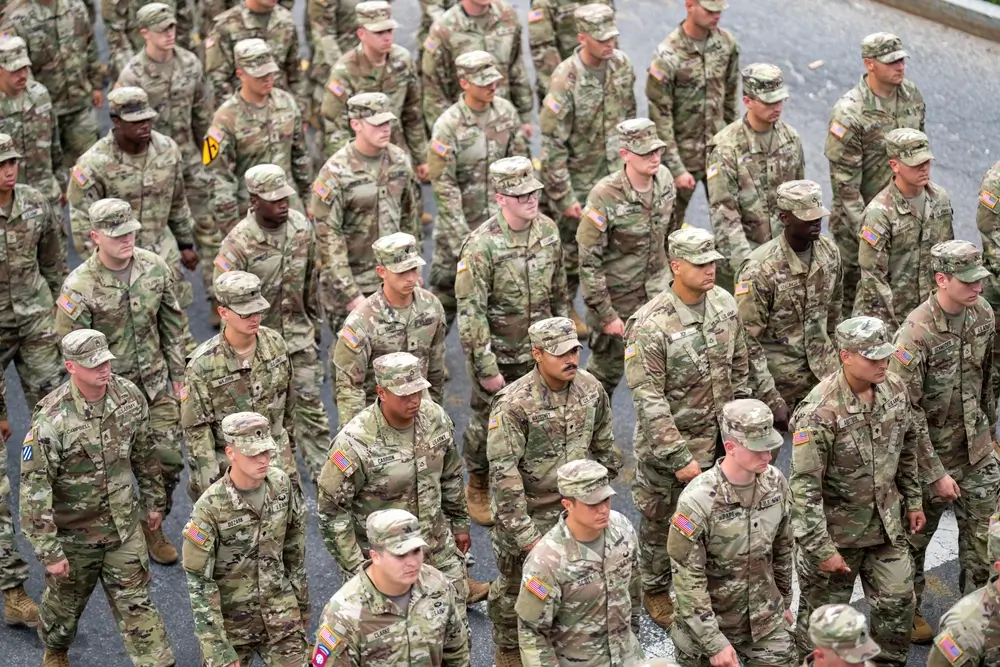
Line scores, also called composite scores, are the second layer. Each branch combines specific subtest standard scores into formulas tied to particular jobs. The services build these formulas around the subtests most closely linked to performance in a given career field. This is what determines which Military Occupational Specialty (MOS), Air Force Specialty Code, or naval rating you qualify for.
The Army calculates 10 line scores by adding standard scores together.
| Composite Score Name | Acronym | Component Subtests |
|---|---|---|
| Clerical | CL | AR, MK, PC, WK |
| Combat | CO | AS, PC, MC, WK |
| Electronics | EL | AR, EI, GS, MK |
| Field Artillery | FA | AR, MK, MC |
| General Maintenance | GM | AS, EI, GS, MK |
| General Technical | GT | AR, PC, WK |
| Mechanical Maintenance | MM | AS, EI, MC |
| Operators and Food | OF | AS, PC, MC, WK |
| Surveillance and Communications | SC | AR, AS, MC, PC, WK |
| Skilled Technical | ST | GS, MK, MC, PC, WK |
The Air Force and Space Force use a different system called MAGE, short for four aptitude areas reported as percentiles: Mechanical, Administrative, General, and Electronics. Each Air Force Specialty Code sets its own minimum MAGE score. The Marine Corps keeps it simpler with three line scores: Mechanical Maintenance, General Technical, and Electronics. The Navy and Coast Guard do not publish composite line scores in the same way; instead they require minimum sums on specific subtests for each rating.
A few real thresholds show how this plays out. Army infantry roles such as 11B, 11C, and 11X all require a Combat (CO) score of 87. Cyber Operations Specialist (17C) requires GT:110 and ST:112. Special Forces Recruit (18X) requires GT:110 and SC:100. On the Air Force side, avionics test station work (2A0X1) needs an Electronics score of E70, and cyber warfare operations (1B4X1) needs a General score of G64. For Navy SEAL candidates entering BUD/S, one qualifying option is a combined GS+MC+EI of 165 or higher.
The General Technical (GT) score deserves special attention. It pairs Verbal Expression with Arithmetic Reasoning and acts as a deciding factor for advanced and leadership roles. Officer and warrant officer candidate tracks, along with Special Forces, all sit at GT:110, among the highest bars in the Army.
What Is a Good ASVAB Score?
There is no single passing score, because "good" depends on your branch and your target job. Still, the percentile scale gives clear reference points.
A score below 31 generally will not qualify you for service. A 50 is the national average. Scores in the mid-70s are clearly above average, and 90 and up opens the most technically demanding roles. Crossing 50 into Category IIIA is the real turning point: it qualifies you for all six branches and a solid range of jobs. A 65 or higher is a standout score that widens access to specialized positions, training programs, signing bonuses, and officer eligibility.
So a 47 actually clears every branch minimum, including the Coast Guard's 32 and the Space Force's 36, but it lands in Category IIIB on the lower end, which narrows the jobs and incentives open to you. A 70 or a 72 lands you in Category II and qualifies you for every branch with room to spare. A 90 reaches Category II near the top, and 93 to 99 is the elite Category I band.
Two misconceptions trip people up. The first is reading a percentile as a percentage correct; a 70 means you outperformed 70% of the reference group, not that you got 70% of questions right. The second is assuming a high AFQT locks in your dream job. It does not. Job eligibility runs on line scores, which can demand strong results in subtests the AFQT never touches, such as Electronics Information, General Science, or Mechanical Comprehension. Scoring well above a job's minimum line score also improves your odds during selection.
GED Holders and Lower-Score Pathways
Applicants without a high school diploma face a higher bar. GED holders generally need a 50 across the Army, Navy, Air Force, Marine Corps, and National Guard. The Coast Guard asks for at least 47 plus 15 hours of college credit.
If your AFQT falls short, the Army offers the Future Soldier Preparatory Course. Applicants scoring 21 to 30 can enter a 90-day academic track that covers every ASVAB subject and includes chances to retake the test. Those scoring 31 to 49 may qualify for a shorter 30-day option with one retake.
Branch flexibility on GED enlistment varies widely. The Army accepts more GED holders than any other branch, with some years allowing around 15% of recruits to enter without a diploma. The Marine Corps is far stricter, capping GED recruits at roughly 5%. The Navy also experimented here. In 2022 it launched a pilot program letting applicants in the 10th to 30th percentile qualify if they met specific line-score combinations, a program set for re-evaluation at the end of fiscal year 2023.
Frequently Asked Questions
What is a good ASVAB score?
A good score depends on the branch and the job you want. An AFQT score around 50 is near the reference-group average, while a score that clears the branch minimum and meets the target line-score requirements is more useful than a single generic benchmark. Check the current requirements with a recruiter because standards can change.
Is a 90, 93, or 99 on the ASVAB good?
Yes. An AFQT score of 90 means you performed as well as or better than 90% of the reference group, while 93-99 falls in Category I. These are strong AFQT results, but job qualification still depends on the line scores required by the service and occupation.
Is a 70, 72, or 77 a high or good ASVAB score?
If the number is an AFQT percentile, each score is in Category II because Category II covers 65-92. A 70 means performance at or above 70% of the reference group, and 72 or 77 indicates an even stronger percentile position; the final job options still depend on line scores.
Is a 57 or 47 a good ASVAB score?
An AFQT score of 57 is in Category IIIA, while 47 is in Category IIIB. Both may meet some branch-level minimums, but neither automatically qualifies you for a particular MOS, rating, or AFSC because those roles use additional line-score requirements.
Is a 40 on the ASVAB good?
An AFQT score of 40 is in Category IIIB, the 31-49 range. It is above several commonly cited high-school-diploma enlistment minimums, but eligibility depends on the current branch standard, education credential, waivers, and job-specific line scores.
Are 25, 27, or 30 bad ASVAB scores?
As AFQT percentiles, 25, 27, and 30 are in Category IVA, which covers 21-30 and is below the usual direct-enlistment minimums cited for many applicants. Some service-specific preparatory programs or waivers may exist, but these scores do not provide broad eligibility by themselves.
Is a 110 ASVAB score good?
The AFQT is a percentile from 1 to 99, so 110 cannot be an AFQT score. A number such as 110 is more likely to be a line or composite score, where values above 99 are possible; its quality depends on the score type and the job threshold.
What is the lowest passing or acceptable score on the ASVAB?
There is no single passing score for the entire ASVAB. The AFQT determines enlistment eligibility, with 31 commonly used for several high-school-diploma applicants, while other branches, education credentials, waivers, and current recruiting policies may require different scores.
Can I join the Army with a 25 ASVAB score?
A 25 AFQT score is below the Army's standard minimum of 31 for high school diploma holders and is in Category IVA. The Army describes a Future Soldier Preparatory Course academic track for applicants scoring 21-30, so a score of 25 may lead to a preparatory option rather than standard direct enlistment, subject to current eligibility rules.
How are ASVAB scores calculated?
The process begins with correct responses, which are evaluated through Item Response Theory to produce an ability estimate. That estimate is equated to a standard score; standard scores from four subtests produce the AFQT percentile, while selected standard scores are combined into branch-specific line scores.
Sources
ASVAB Test Prep · All Military BranchesReady to Pass the ASVAB?Official subtest drills (AFQT, CAT-ASVAB), timed practice tests, score calculators and detailed step-by-step explanations.
Marine ASVAB Score: Minimum AFQT, Line Scores & MOS Guide
Coast Guard ASVAB Score: Minimums, Ratings & How to Prep