
If you scored below 50 on a practice AFQT and your MEPS date is getting close, Paragraph Comprehension is one of the smartest sections to focus on. It carries more weight than its small size suggests, and most of the points it costs people come from a handful of fixable habits rather than weak reading ability.
This guide explains what the PC subtest is, how it is scored, the question types you will face, and the strategies that actually move the needle. The goal is simple: read faster without losing accuracy, and stop giving away easy points.
 ASVAB Test Prep · All Military BranchesReady to Pass the ASVAB?
Official subtest drills (AFQT, CAT-ASVAB), timed practice tests, score calculators and detailed step-by-step explanations.
What the ASVAB Paragraph Comprehension Subtest Is
The Paragraph Comprehension subtest measures your ability to read a short passage and understand what it says. You read various passages and then answer multiple-choice questions about them. According to the official ASVAB website, the section focuses on your ability to obtain information from written passages, nothing more.
It helps to see where PC sits in the larger test. The ASVAB is a multiple-aptitude battery that measures developed abilities and helps predict future academic and occupational success in the military. The official ASVAB website states that it is administered to more than one million military applicants, high school, and post-secondary students each year.
The full battery is made up of ten distinct subtests covering separate knowledge and ability areas: General Science, Arithmetic Reasoning, Word Knowledge, Paragraph Comprehension, Mathematics Knowledge, Electronics Information, Auto Information, Shop Information, Mechanical Comprehension, and Assembling Objects. Paragraph Comprehension is the reading section among them.
Anyone enlisting takes the ASVAB. The U.S. Army confirms that every enlisted Soldier is required to sit the test, and recruiters help schedule it and connect applicants to preparation resources. So PC is not optional for anyone planning to serve.
PC Format and Timing: CAT-ASVAB vs. Paper-and-Pencil

The first thing to know is that the PC subtest looks different depending on which version of the test you take. The number of questions and the time you get both change.
On the CAT-ASVAB, the computerized version most applicants take, you answer 10 questions in 27 minutes. The extra time per question reflects how the computer-adaptive format works: question difficulty can rise as you accumulate correct answers, so the test allows room for that. The U.S. Army notes that roughly 70% of military applicants take this online version, which averages about half the time of the paper test.
The paper-and-pencil format is tighter. The P&P-ASVAB asks 15 questions about 13 or 14 short passages, and you get only 13 minutes to finish. That is well under a minute per question, which makes timing the real challenge on this version rather than reading difficulty.
There is also the PiCAT, an unsupervised pre-screening version you can complete at your own pace. Its PC section contains 11 questions and is untimed, with results validated at a Military Entrance Processing Station (MEPS). If you complete a PiCAT at home, plan for that in-person validation step before your scores count.
Across every format, the passages are short, between 30 and 120 words each. No outside knowledge is required. Everything you need to answer a question is contained in the passage above it. That single rule shapes almost every strategy that follows.
Why PC Matters More Than Most Test-Takers Realize
It is easy to underestimate a 10-question section. That would be a mistake, because Paragraph Comprehension carries outsized weight in the score that decides whether you can enlist at all.
PC feeds directly into your Verbal Expression (VE) score, and VE is doubled when your AFQT percentile is calculated. The AFQT formula is 2(AR + MK) + WK + PC, so your reading and vocabulary performance counts twice. Weak PC results pull down a number that gatekeeps your entire enlistment, which is why this section deserves attention out of proportion to its length.
The minimum AFQT score you need depends on the branch. The U.S. Army states that you must score at least 31 to enlist. The figures for other branches, as reported by the prep sources consulted, are summarized below.
Minimum AFQT Scores by Military Branch
| Military Branch | Minimum AFQT Score (High School Diploma) | Minimum AFQT Score (GED Holder) |
|---|---|---|
| Air Force | 31 | 50 |
| Army | 31 | 50 |
| Marine Corps | 31 | 50 |
| Navy | 31 | 50 |
| Coast Guard | 32 | 50 |
Army minimum per official U.S. Army guidance; remaining branch figures based on recruitment standards.
Beyond eligibility, a strong PC score also helps you qualify for specific jobs. A good result on this subtest is required for a number of military roles, including cook and various surveillance and communications positions, among others. Verbal Expression also feeds several line scores, so reading strength quietly opens doors across career fields.
The Four Main Question Types
Every passage is short, but the questions come in recognizable types. Knowing which one you are facing tells you how to read the passage, and that is most of the battle. There are four main categories.
Global questions ask for the big picture: the main idea, the author's purpose, or the tone. Stems look like "Which of the following is the main idea of the passage?" or "The purpose of the passage above is to." To find the main idea, separate the author's claim from the supporting details. Simple facts, other people's opinions, and background information usually serve as supporting details, and the author's actual point often arrives as a strong opinion, recommendation, prediction, or rebuttal. The main claim frequently shows up right after contrast words like but, though, however, although, and yet.
Detail questions ask for specific information stated directly in the passage. The correct answer is almost always a paraphrase of something written in the text. The trap here is overthinking. Do not read for the main idea or analyze motives. Just locate the fact. And watch the difference between text that simply appears in the passage and text that actually answers the question being asked.
Inference questions require you to read between the lines. The answer is not stated outright, but the passage gives you enough to conclude what the author must also believe. These questions rarely point to one line. Instead, you weigh several statements and determine what follows. Because many inferences are possible from any passage, do not lock in a prediction before reading the choices.
Vocabulary-in-Context questions ask for the meaning of a word as it is used in the passage. The right answer is a word that can replace the original without changing the sentence's meaning. The reliable method is to define the word from context first, then substitute each strong candidate back into the sentence to confirm it reads the same.
A few additional formats show up too. Sequence-of-Events questions test chronological order, so track temporal keywords such as until, before, after, since, next, and finally. Tone questions ask you to weigh mood, style, and audience before checking the options. Quote questions test figurative language, where idioms and metaphors carry meaning beyond the literal, and the correct answer reflects the author's intended message. Exception questions flip the usual logic: three choices are supported by the passage, and you must find the single one that is not.
A Reliable 4-Step Method for PC Questions
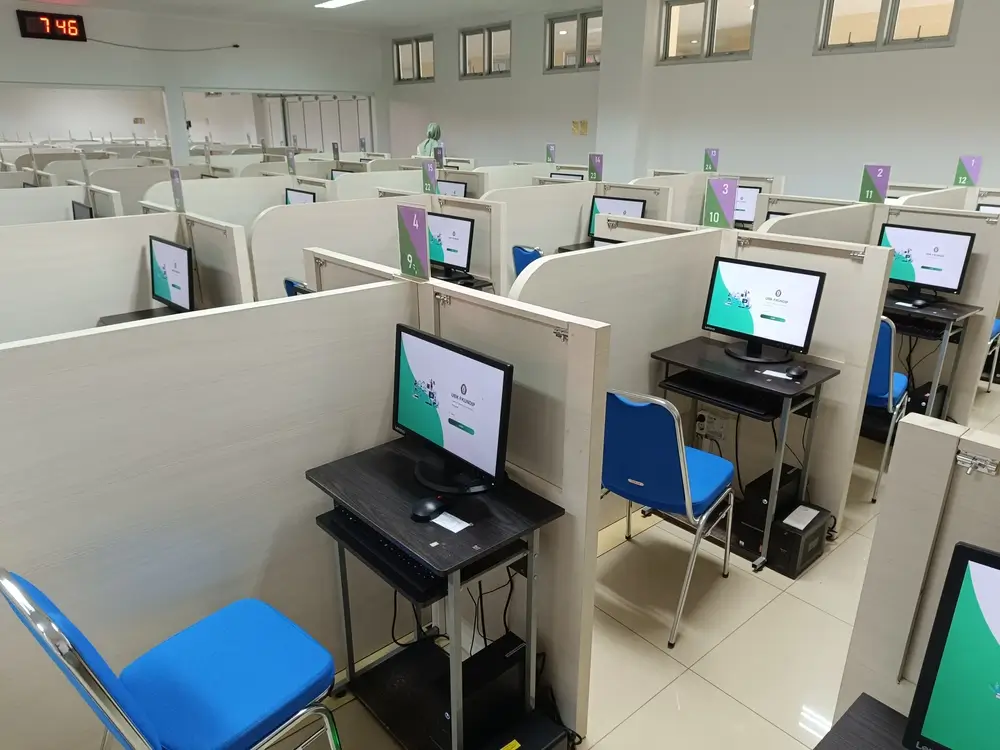
Having one repeatable process keeps you fast and consistent under pressure. A widely taught four-step method works for both the paper and computer versions.
Step one is to read the question stem first. How you read a passage depends entirely on the task, so identify the task before you touch the text. A detail question and a main idea question call for completely different reading.
Step two is to read the passage strategically, only as much as the question requires. For a main idea question, separate supporting details from opinions and recommendations to find the author's overall point. For a detail question, scan for the specific fact. Match your reading to the job in front of you instead of absorbing everything.
Step three is to make a prediction. Take a few seconds to picture what the correct answer should look like before you read the choices. Sometimes you will know the answer outright; other times you will have only a rough sense of its phrasing. Either way, a prediction makes the right option easier to spot and harder to talk yourself out of.
Step four is to match or eliminate. Find the choice that fits your prediction, or rule out the ones that clearly do not. Remember that your goal is not to master the subject of the passage. It is only to answer the question correctly, so keep your focus on the task rather than every detail in the text.
ASVAB Test Prep · All Military BranchesReady to Pass the ASVAB?Official subtest drills (AFQT, CAT-ASVAB), timed practice tests, score calculators and detailed step-by-step explanations.
Common Traps and Wrong Answer Patterns
Most lost points on PC come from predictable wrong-answer designs. Learning to recognize them is faster than re-reading.
The single biggest pitfall is using outside knowledge. Some answer choices are true in the real world or sound like common sense, but if the passage does not support them, they are wrong. The priority rule is blunt: if you cannot point to a line or a clear idea in the text, do not pick that answer. This matters most on inference questions, where a reasonable-sounding choice with no textual support is the classic trap.
Global questions have their own pattern. Wrong choices tend to be too specific, focusing on a single detail rather than the whole passage; too general, reaching beyond the passage's scope; contradictory to what the passage says; or too extreme, overstating the author's opinion. The correct main idea covers the passage as a whole without distorting it.
Inference questions usually go wrong in one of four ways: contradicting the passage, importing outside information, distorting what was presented, or making an extreme claim the passage does not fully back. Choose only what must be true based on the text.
Vocabulary questions have a quieter trap. The most common dictionary meaning of a word is often not the meaning in this passage. Always substitute your choice back into the sentence to check that the meaning holds. Two more quick safeguards: track pronoun references like it, they, and this to the nearest logical noun, and read signal words for what they signal so you never mistake a contrast for agreement.
Speed Reading Without Losing Comprehension
Time pressure, not vocabulary, sinks most test-takers, especially on the 13-minute paper version. The fix is to read smarter, not just faster.
Reading the question before the passage is the foundation. It tells you the question type, which tells you the right strategy, which means you stop reading every passage the same way. Once you know the type, read only what you need. Skim for the fact on a detail question; focus on the first and last sentences plus contrast words on a main idea question.
Signal words let you follow a passage's logic quickly. However marks a contrast, because marks a cause, and for example marks support. Reading for these structural cues is faster than reading word by word, and it keeps you from misreading the relationship between ideas. The common mistake is treating a contrast statement as agreement.
Building speed before test day comes from active reading. Read varied material daily and then summarize it for yourself or teach it to someone else, which forces real comprehension rather than passive scanning. Pair that with timed practice tests that mirror the real format, so you train your pace under conditions close to the exam and avoid leaving questions unanswered.
Vocabulary in Context: Where PC and Word Knowledge Meet
Word Knowledge (WK) and Paragraph Comprehension together form the Verbal Expression score, so they reward overlapping skills. The difference is that WK tests vocabulary in isolation, while PC tests it inside a passage. Strengthening one tends to help the other.
Context clues are your main tool. In one classic example, a professor tries to appear erudite even on subjects he barely knows, and the context tells you the word means learned, which points to "scholarly." In another, a runner shows fortitude by finishing despite foot pain, so the context points to "courage" rather than speed or cheerfulness.
Word parts help when context runs thin. Take abnegate: the prefix ab- means "away from," and the root negate means "to deny the existence of something." Put together, the word means to reject or turn away from, which makes "deny" the correct answer. A working base of common prefixes and roots gives you a reliable backup when a word is unfamiliar.
Inference in Practice: Reading Between the Lines
Inference questions are where the ASVAB tests analytical skill, which is part of why these items contribute to your AFQT score. The meaning is not stated plainly, but the passage gives you enough to reason toward what is likely true.
A well-known example involves the 1918 Spanish influenza. The passage notes that the outbreak killed more in a single year than the bubonic plague killed in a century, drove major advances in medicine, and led to a lasting increase in pay for doctors that encouraged many to enter the profession. From the rise in pay afterward, you can infer that lower pay before the war had been a deterrent to entering medicine. That conclusion is never stated, but it is strongly implied.
The discipline that makes inference work is restraint. Do not assume facts the passage never gives, such as believing a mountain was named for the person who first climbed it. Distinguish between related but separate claims, and keep a clear line between what the text states and what it merely implies. An inference that goes one step too far becomes an assumption, and that is exactly the choice the test wants you to avoid.
What a Good PC and AFQT Score Actually Means
AFQT scores are percentiles, which confuses a lot of people. Your score tells you how you did compared with a nationally representative reference group, not the percentage of questions you got right.
A 47 means you scored higher than 47% of that reference population. It clears the minimum for every branch, so you are eligible to enlist, though it may limit access to certain jobs that require higher line scores. A 70 means you outperformed 70% of the group, which is a strong, above-average result that comfortably exceeds all branch minimums and widens your job options and bonus eligibility. A 72 sits just above that in the 72nd percentile, qualifying you for a broad range of technical and skilled roles. A 77 is genuinely high, placing you in the 77th percentile and opening competitive specialties across the branches.
How rare is a 70? It places you in the upper 30% of test-takers, so fewer than 3 in 10 people exceed it. That is solid above-average performance rather than something exceptional, but it is a meaningful target if you want real choice in your assignment.
How to Improve Your PC Score
Improvement on Paragraph Comprehension is mostly a function of structured, repeated practice. The most effective approach is consistent timed work with varied passages, not occasional cramming.
To build the skill over weeks and months, read challenging and abstract material outside your comfort zone, practice many questions regularly, learn to infer information reliably, and pay attention to how context shifts word meanings. The aim is to get comfortable with how paragraphs are built and how to extract an accurate sense of words, phrases, and overall meaning.
Track your weak question types rather than just your overall score. Practice tests offer several advantages worth using deliberately: instant feedback with detailed explanations, identification of strengths and weaknesses, better focus on what matters, time savings, performance tracking, confidence, and realistic simulation of test conditions. Use that data to spend your study time where it pays off.
Paid practice bundles exist if you want a large, structured question bank. Many providers offer practice sets of around 30 questions in timed, untimed, and explanation modes, which let you train under realistic pressure and then review at your own pace. The value of any bundle comes from doing the questions under timed conditions and reviewing every explanation, not from the size of the package.
If your AFQT lands between 21 and 31, the U.S. Army offers an academic track of the Future Soldier Preparatory Course. It is a 90-day program covering every ASVAB subject, with opportunities to retake the test, which gives lower scorers a structured path to qualify.
Retakes, Scoring, and Job Options
Your ASVAB results come in two parts. The AFQT score determines eligibility to enlist, with a minimum of 31 for the Army. Your category scores, also called line scores, determine which jobs you qualify for.
Line scores are combinations of individual subtest scores used to set qualification for specific Military Occupational Specialties (MOS). Each branch builds its own line scores from particular subtest combinations, as shown below.
| Subjects | Line Scores |
|---|---|
| AS+AR+MC | Combat – CO |
| AR+MK+VE | Clerical- CL |
| AR+ GS+ EI+ MK | Electronics- EL |
| AS+ GS+ EI+ MK | General Maintenance- GM |
| AR+ MK+ MC | Field Artillery- FA |
| AS+ EI+ MC | Mechanical Maintenance- MM |
| AR+ VE | General Technical- GT |
| AS+ MC+ VE | Operators and Food- OF |
| GS+ MC+MK+ VE | Skilled Technical- ST |
| AR+ AS+ MC+ VE | Surveillance and Communications- SC |
Based on common ASVAB line-score composition data.
Notice how often VE appears in those compositions, which is another reminder of how far your reading score reaches. If you need to retake the test, the U.S. Army sets clear rules: one calendar month must pass before a second attempt, and a third attempt can come no earlier than six calendar months after the second. Your most recent score, not your highest, is the one used to assess your performance, so treat each sitting seriously.
Frequently Asked Questions
What does PC mean on the ASVAB?
PC stands for Paragraph Comprehension. It measures the ability to obtain information and meaning from written passages and answer passage-based questions.
Why is Paragraph Comprehension important for the AFQT?
PC contributes to the Verbal Expression score. That score is doubled when the AFQT percentile is calculated, so PC performance can directly affect military enlistment eligibility.
How many Paragraph Comprehension questions are on the ASVAB?
For the current CAT-ASVAB standard used here, PC has 11 questions in 22 minutes. The paper-and-pencil version has 15 questions in 13 minutes.
What types of questions are on ASVAB Paragraph Comprehension?
The core categories are global questions about main ideas, purpose, or tone; detail questions about explicit facts; inference questions about implied meaning; and vocabulary-in-context questions.
How can I improve Paragraph Comprehension on the ASVAB?
Practice with short and long passages, summarize what you read, explain the material to someone else, and use timed exercises. Review missed questions by identifying whether the problem was a detail, inference, main-idea, or context error.
Should I read the question before the passage on ASVAB PC?
Yes. Reading the question stem first identifies the task and helps you decide whether to read for the main idea, a specific detail, an inference, or a word meaning.
How do you answer a main-idea question on ASVAB PC?
Read for the passage’s overall point, separating the author’s main claim from examples and supporting details. Eliminate choices that are too narrow, too broad, contradictory, or more extreme than the passage.
How do you answer an inference question on ASVAB PC?
Choose the conclusion that follows from the passage’s statements, even if it is not written word for word. Do not select an answer merely because it is generally true or sounds plausible; it must be supported by the text.
How do vocabulary-in-context questions work on ASVAB PC?
Determine what the word means in that specific sentence and paragraph. Substitute each answer choice into the sentence and select the option that preserves the original meaning.
How can I read faster on ASVAB PC without losing comprehension?
Read the question first, use signal words and pronoun references to follow the passage, predict the answer before reviewing choices, and eliminate options that are unsupported or off-topic. Build speed gradually with timed practice while tracking accuracy and unanswered questions.
Sources
ASVAB Test Prep · All Military BranchesReady to Pass the ASVAB?Official subtest drills (AFQT, CAT-ASVAB), timed practice tests, score calculators and detailed step-by-step explanations.
ASVAB Assembling Objects: Format, Tips, and Practice Guide
ASVAB Electronics Information: Your Complete Study Guide