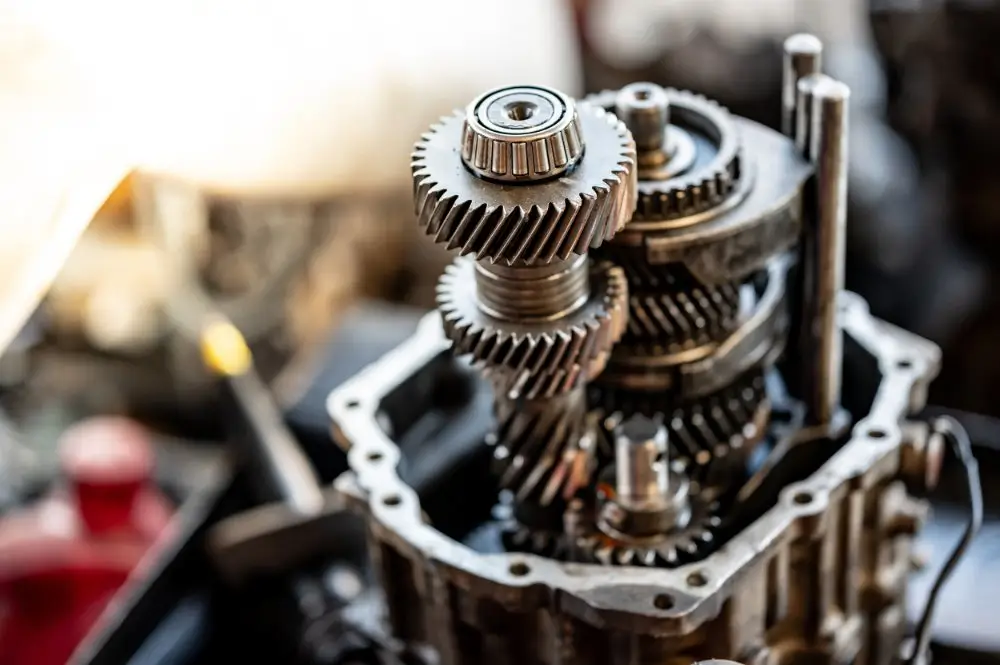
The Auto and Shop Information section of the ASVAB measures your knowledge of vehicles and their parts, plus the basic tools and practices used in automotive shops. To answer the auto questions, you need to know about automobile parts and the systems that use them, from engines to brakes. The shop questions ask you to identify hand tools and explain what each one does.
This subtest rewards anyone who has spent time around engines or worked with tools. Many candidates report that they do not need extensive study here because they already have hands-on familiarity from practical experience or personal interest.
 ASVAB Test Prep · All Military BranchesReady to Pass the ASVAB?
Official subtest drills (AFQT, CAT-ASVAB), timed practice tests, score calculators and detailed step-by-step explanations.
This guide walks through how the subtest is structured, the engine and vehicle systems you should understand, the shop tools you need to recognize, and a study plan to prepare efficiently. Everything here maps to the topics the test actually covers.
What is the ASVAB Auto and Shop Information Subtest?
The Auto and Shop Information subtest, often abbreviated AS, covers two related areas. The auto portion tests automotive systems, repairs, and engine fundamentals. The shop portion tests knowledge of striking, fastening, cutting, drilling, finishing, clamping, and measuring tools, along with the various types of fasteners.
The format depends on which version of the test you take. On the computer-adaptive CAT-ASVAB, the Auto Information section contains 11 questions with 7 minutes to answer, and the Shop Information section contains 11 questions with 6 minutes. On the paper-and-pencil P&P-ASVAB, the two are combined into a single Auto and Shop Information test of 25 questions in 11 minutes. About half the questions are auto-related and the other half are shop-related. There is also a PiCAT version, which some study guides describe as 11 questions, untimed.
| Test Format | Test Name | Number of Questions | Time Limit |
|---|---|---|---|
| CAT-ASVAB | Auto Information | 11 | 7 minutes |
| CAT-ASVAB | Shop Information | 11 | 6 minutes |
| P&P-ASVAB | Auto and Shop Information (Combined) | 25 | 11 minutes |
One point matters more than the rest here. The AS subtest is a specialized subtest that is not used to determine your Armed Forces Qualification Test (AFQT) score. The AFQT is the primary score that decides your overall eligibility for military service, and it comes from other subtests. AS instead determines your eligibility for specific military jobs, especially those in vehicle maintenance, repair, and construction-related fields. A weak score here will not keep you out of the military, but it can limit which technical roles you can pursue.
That distinction also explains why hands-on experience helps so much. The questions reward applied knowledge of how things work, not abstract theory. If you already understand engines and tools, this section is one of the easier ones to prepare for.
Understanding the Four-Stroke Engine Cycle
The four-stroke cycle is the fundamental operating mechanism of the internal combustion engine that powers most cars. The cycle has four distinct strokes: intake, compression, power, and exhaust. Understanding the order and what happens in each stroke is the single most useful piece of engine knowledge for this subtest.
During the intake stroke, the piston moves down from top dead center (TDC), creating a vacuum that draws the air-fuel mixture through the open intake valve into the combustion chamber. On the compression stroke, both valves close and the piston travels back up from bottom dead center (BDC), squeezing the mixture and making it hotter. The power stroke comes next: just before the piston reaches TDC, the spark plug fires and ignites the compressed mixture, and the resulting expansion forces the piston back down toward BDC. Finally, on the exhaust stroke, the exhaust valve opens and the rising piston pushes the spent combustion gases out, completing the cycle.
People often call this a four-cycle engine, but that is not accurate. It is a four-stroke, one-cycle engine, because all four strokes together make up a single complete engine cycle. As an illustration, when a tachometer reads 4,800 rpm, the engine is performing 4,800 of these complete cycles every minute.
The order in which cylinders fire matters too. Cylinder firing order is the sequence in which the cylinders ignite their air-fuel mixture, and it directly affects engine balance, smoothness, vibration, and overall performance. A common four-cylinder firing order is 1-3-4-2.
| Engine Type | Common Firing Orders |
|---|---|
| Inline-4 | 1-3-4-2 |
| Inline-6 | 1-5-3-6-2-4 |
| V6 | 1-2-3-4-5-6 or 1-4-2-5-3-6 |
| V8 | 1-8-4-3-6-5-7-2 or 1-3-7-2-6-5-4-8 |
Key Engine Components and How They Work
A handful of core parts turn combustion into motion, and the test often asks you to identify them or explain their function. Combustion itself is the burning of an air-fuel mixture to produce energy, and it requires air, fuel, and a heat source. In an internal combustion engine, this happens inside the cylinders.
The piston, connecting rod, and crankshaft form the chain that produces power. Cylinders guide the pistons, which translate the heat energy of combustion into mechanical energy. A connecting rod uses a wrist pin to link each piston to the crankshaft. The crankshaft then converts the reciprocating, up-and-down motion of the pistons into the rotational motion that powers the vehicle and its components.
Valve timing is the job of the camshaft. The camshaft controls the opening and closing of the engine's valves by converting the rotational motion of the crankshaft into a reciprocating motion that opens and closes the valves in a precise sequence. A timing belt or chain connects the camshaft to the crankshaft so that the valves open and close at the correct moment.
The camshaft's location defines two common engine layouts. In an overhead valve (OHV) engine, the camshaft sits in the engine block and pushrods actuate the valves in the cylinder head. In an overhead cam (OHC) engine, the camshaft sits in the cylinder head and operates the valves directly. OHC engines are generally more efficient and produce more power than OHV designs. Within the overhead cam family, a single overhead cam (SOHC) engine uses one camshaft for all the valves, while a double overhead cam (DOHC) engine uses two, one for the intake valves and one for the exhaust valves. DOHC engines are common in high-performance applications because they allow better valve control and higher revving.
The combustion chamber is where it all comes together. The engine block is the large casing that holds the cylinders and many internal components. A cylinder head closes off the top of each cylinder to form the combustion chamber, sealed by a head gasket. The combustion chamber receives the air-fuel mixture through the intake valve, and the exhaust valve removes the waste gases. Piston rings seal each piston to its cylinder to contain combustion gases, and they also regulate the oil distribution between the piston and the cylinder wall.
Cylinders are not always arranged the same way. The table below summarizes the main configurations you may see on the test.
| Arrangement Type | Configuration | Common Cylinder Count | Characteristics |
|---|---|---|---|
| Inline (Straight) | All cylinders in a straight line along the same plane | 3, 4, or 6 | Simple, compact, well balanced |
| V | Cylinders arranged in two separate banks forming a V shape | 6, 8, 10, or 12 | Compact, popular for high-performance vehicles |
| Flat (Boxer) | Cylinders arranged horizontally in two opposing banks | 4 or 6 | Low center of gravity, smooth operation, used in Porsche and Subaru |
| Radial | Cylinders arranged in a circle around central crankshaft | Variable | Compact size, high power-to-weight ratio, less common in modern automotive |
Air-Fuel Mixture and the Stoichiometric Ratio
Combustion needs the right balance of air and fuel, and the test expects you to know what that balance is. The stoichiometric ratio is the ideal air-fuel ratio for complete combustion, with no excess oxygen or fuel. For gasoline engines, this ratio is about 14.7:1, meaning 14.7 parts of air for every one part of fuel. Hitting this ratio burns all the fuel cleanly, maximizing power while minimizing emissions.
Mixtures that stray from that ratio behave differently. A lean mixture has more air than the stoichiometric ratio, leaving excess oxygen. Lean mixtures can improve fuel efficiency, but they burn more slowly and hotter, which can cause engine knocking, reduced power, and potential damage. A rich mixture has excess fuel and burns quicker and cooler than the ideal ratio; a ratio of about 12:1 is a commonly cited example of a rich mixture.
The job of mixing air and fuel falls to either a carburetor or a fuel injection system. Carburetors were used on most older cars built before 1990 to mix fuel and air mechanically; as air moves quickly through the carburetor, it creates a vacuum that draws in more fuel. Fuel injectors have since replaced carburetors on newer cars. Fuel injectors are generally dated to the late 1950s, though they were not widely introduced until the late 1980s and early 1990s. A fuel injector acts as a dispensing nozzle that sprays liquid fuel directly into the air stream, usually with help from an external pump.
Modern injection is managed by a computer. The electronic fuel injection (EFI) computer determines how much fuel enters the engine based on information from sensors in the fuel, air, and exhaust systems. A throttle, connected to the gas pedal, controls how much fuel reaches the injectors. Pressing harder on the accelerator opens the throttle further, sending more fuel to the carburetor or injectors.
Ignition Systems and Spark Timing
The ignition system delivers the spark that lights the compressed mixture, and it does so with surprisingly high voltage. The ignition coil is a high-voltage transformer made of a primary coil winding, which uses relatively few turns of heavy wire at low voltage, and a secondary coil winding, which uses thousands of turns of fine wire at high voltage. Current flowing through the primary coil creates a changing magnetic field that induces a very high-voltage current in the secondary coil, which is then fed to the distributor.
Newer designs simplify this layout. Coil-on-plug ignition systems eliminate the need for spark plug wires because the ignition coil mounts directly over each spark plug.
Timing the spark correctly is essential. Ignition timing is the precise moment when the air-fuel mixture in the cylinder is ignited, and it is crucial for performance and efficiency. Two terms describe this timing relative to the piston. Before top dead center (BTDC) means the spark fires before the piston reaches the top of its compression stroke. After top dead center (ATDC) means ignition happens after the piston has passed the top.
Bad timing or fuel quality can cause two destructive problems. Pre-ignition occurs when the air-fuel mixture ignites prematurely, before the spark plug fires, producing high cylinder pressures and damage. Detonation, also called engine knocking, is uncontrolled, violent combustion caused by excessive pressure and temperature; it creates pressure waves that can damage pistons and cylinder heads.
Computers now manage much of this. The powertrain control module (PCM) acts as the brain of the car, gathering signals from the vehicle's sensors and generating outputs that control engine functions. In a computer-controlled ignition system, an ignition module switches the primary current on and off based on signals from the computer, rather than directly altering timing or secondary voltage itself.
Engine Cooling Systems
An engine produces enormous heat, and the cooling system keeps it within a safe operating range. Most modern cars use a liquid-cooled system that circulates a mixture of water and antifreeze, called coolant, through the engine to absorb and dissipate heat. The coolant pulls heat out of the engine, then a pump sends it to the radiator, where it releases that heat to the atmosphere before cycling back through.
Several parts work together to make this happen. The water pump circulates the coolant. The radiator cools the coolant by transferring heat to the air, and the radiator cap regulates pressure. Radiator hoses transport the coolant, while the thermostat regulates its temperature. A bypass tube keeps coolant flowing when the thermostat is closed, the water jacket surrounds the cylinders, and a coolant recovery bottle allows the fluid to expand and contract.
The coolant itself is a specific blend. Modern cooling systems use a mixture of half water and half antifreeze, commonly ethylene glycol. This blend keeps the water from freezing in cold temperatures and raises its boiling point, which makes heat transfer more efficient.
The thermostat does more than prevent overheating. It must stay closed at first to let the engine warm up to its correct operating temperature. If the thermostat sticks open, the engine will struggle to reach proper temperature, because the coolant keeps flowing before the engine has had a chance to warm up.
ASVAB Test Prep · All Military BranchesReady to Pass the ASVAB?Official subtest drills (AFQT, CAT-ASVAB), timed practice tests, score calculators and detailed step-by-step explanations.
Engine Lubrication Systems
Lubrication keeps the engine's moving parts from grinding themselves apart. Oil reduces friction between components, seals combustion gases within the chamber, carries contaminants away to the filter, and helps the engine run more quietly. There are two main ways oil moves through an engine.
In a wet sump system, oil sits in a pan at the bottom of the engine. A pump draws it through a filter and pushes it through internal galleries to the crankshaft and connecting rods, after which it drains back to the sump. In a dry sump system, oil is stored in an external tank; a scavenge pump pulls oil out of the engine sump into that tank, and a separate pressure pump circulates it back through the engine.
Oil is graded by how easily it flows. Viscosity is the oil's resistance to flow at a given temperature, and the SAE grading system uses numbers where lower numbers mean thinner oil and higher numbers mean thicker oil. For example, SAE 5W-30 is thinner at low temperatures than SAE 10W-30, but the two share the same viscosity at high temperatures. Diesel oil is formulated differently from gasoline engine oil because diesel engines run at higher temperatures and pressures; it carries more detergents and additives to handle soot, plus higher levels of zinc and phosphorus to fight wear and corrosion.
Maintenance here is simple but critical. Regular oil and filter changes are the least expensive and most effective way to maximize engine life. Excessive wear on internal parts happens when the oil gets dirty or loses its lubricating properties, so keeping fresh oil in the engine protects everything the lubrication system touches.
Brake Systems: Drum and Disc Brakes
Brakes turn the driver's effort into stopping force through hydraulics. The master cylinder converts pressure on the brake pedal into hydraulic pressure in the brake lines, which then activates the brake mechanism at each wheel. Power brakes go a step further by multiplying the force the driver applies, using a vacuum booster connected to the engine intake manifold.
There are two main brake designs, and one clearly outperforms the other. Disc brakes are more powerful and effective than drum brakes. Disc brakes pinch a rotating disc between two brake pads, which gives a larger surface area for contact, produces more stopping force, and cools more easily.
Many vehicles mix the two types. In a car with front disc brakes and rear drum brakes, wheel cylinders are located only on the rear wheels. The front wheels use calipers, which combine the function of a wheel cylinder and also serve as the attaching component for the brake pads.
Drum brakes have their own internal logic. The secondary brake shoe sits in the rear part of the drum assembly and carries a longer brake lining than the primary shoe in front. This arrangement supports the self-energizing effect that helps the brake grip more firmly as the wheel turns.
Drive Systems and Transmissions
The drivetrain delivers engine power to the wheels, and its layout depends on which wheels drive the car. A transaxle is a transmission that incorporates a differential into one package, used primarily in front-wheel drive cars. Rear-wheel drive cars instead use a separate transmission and differential connected by a drive shaft. All-wheel drive cars typically use a transaxle that also includes an output shaft running to the rear differential.
Power reaches the wheels through axles with flexible joints. A halfshaft is a drive axle that extends from a transaxle or differential to one of the drive wheels, transmitting torque in front-wheel-drive and all-wheel-drive vehicles. Constant velocity (CV) joints sit at both ends of each half shaft and transfer torque to the wheels at a constant speed while accommodating the up-and-down movement of the suspension. The inner CV joint connects the shaft to the transmission, and the outer CV joint connects the shaft to the wheel.
Suspension and Steering Systems
Suspension keeps the tires on the road and the ride comfortable. An independent front suspension lets each front wheel move on its own, so if one wheel drops into a pothole, the other can stay in contact with the road, improving traction and control.
Several parts connect the wheels to the body and let them steer. Control arms connect the suspension to the frame, and the link to the wheels runs through ball joints, which allow the wheels to move vertically while keeping steering control. Shock absorbers connect the axle to the chassis.
Steering response is described by a ratio. Steering ratio is the relationship between how far you turn the steering wheel and how far the wheels turn. For example, if one full revolution of the steering wheel turns the wheels 20 degrees, the steering ratio works out to about 18:1.
Shop Tools: Striking and Fastening Tools
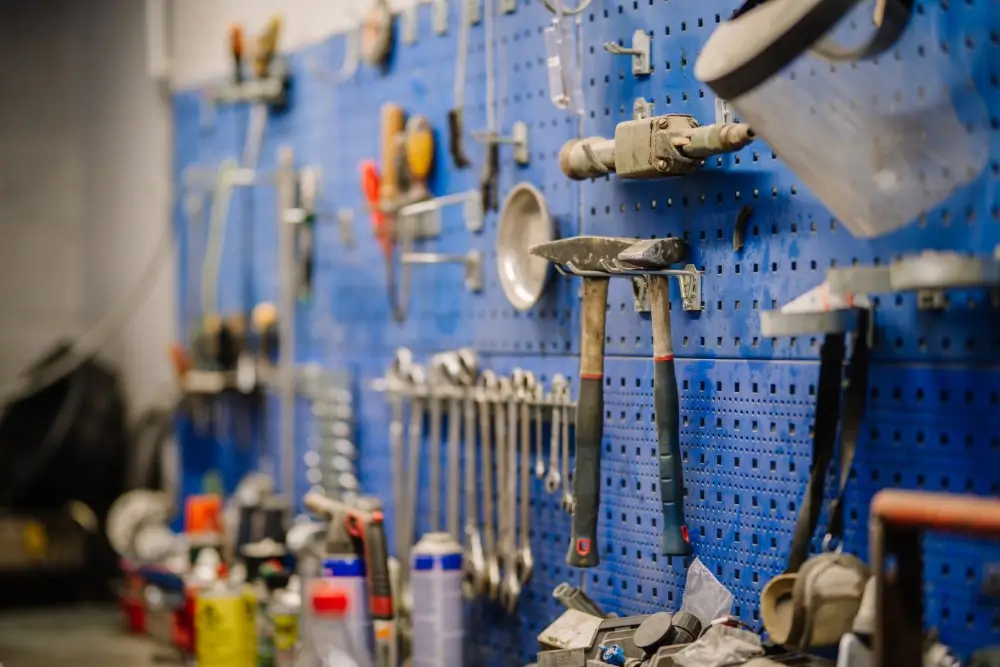
The shop side of the subtest starts with tools that hit and tools that hold. Striking tools apply driving force to an object and include hammers, sledges, and mallets. A hammer is generally made of metal or plastic and consists of a handle, a head, a face, a claw, and a wedge that fastens the head to the handle. A mallet may be made of metal, plastic, wood, rubber, or rawhide, and it strikes another tool or a surface without causing damage. A sledge is a metal tool used to drive bolts and chisels and to break rock. For shaping metal specifically, a ball peen hammer is the right choice rather than a claw hammer or mallet.
Fastening tools tighten and loosen threaded hardware. A ratchet, also called a socket wrench, applies torque in only one direction, with a handle you can swing back and forth without lifting it off the fastener. Sockets come in various drive sizes, and within the same drive size they vary in shape, either six-point or twelve-point, and in the size of the nut opening. Smaller point-sized sockets are stronger and can apply greater torque, while larger point sizes make alignment easier.
Fasteners themselves come in many forms. Bolts and nuts work together through external threads on the bolt and internal threads on the nut. Nuts vary by purpose: wing nuts are made for hand tightening, slotted nuts are secured with cotter pins, and lock nuts resist loosening thanks to nylon in their threads.
Shop Tools: Cutting and Sawing Tools
Cutting tools have teeth, and the number of teeth tells you what kind of work the tool is built for. Because of the way points and teeth are counted, a saw always has one more point per inch than teeth per inch. A saw with fewer teeth is used for rough work, while a saw with more teeth cuts more finely for delicate work. The higher the teeth per inch (TPI), the finer the cut.
Wood saws split into two main types based on tooth shape. Crosscut saws use knife-shaped teeth to cut across the grain of the wood and produce smooth cuts. Rip saws use chisel-shaped teeth to cut with the grain and work much faster. For metal, a hacksaw is the right tool, with an adjustable frame that holds thin blades and a handle set in one end. For intricate, curved shapes in wood, a coping saw is the appropriate choice. The table below covers the cutting tools you should be able to identify.
| Cutting Tool | Description/Function |
|---|---|
| Bolt cutters | Heavy-duty shears that produce enough force when the handles are closed to slice through metal bolts or rods |
| Circle snips | Used to cut curves |
| Crosscut saw | A type of handsaw that cuts against the grain of the wood; the shape of the teeth and the angle in which they're set are the main differences in this type of saw |
| Coping saw | A type of handsaw that's used to cut curved lines or shapes |
| Hacksaw | A type of handsaw that's used to cut metal; a hacksaw has an adjustable frame that holds thin blades of varying length in place; a handle is set in one end |
| Pipe cutters and tube cutters | Used to score and cut metal pipes and tubes |
| Ripsaw | A type of handsaw that cuts with the grain of the wood; the shape of the teeth and the angle in which they're set are the main differences in this type of saw |
| Snips and shears | Snips and shears have two cutting blades that scissor together when the handles close; the blades can be curved or straight |
Shop Tools: Measuring and Precision Instruments
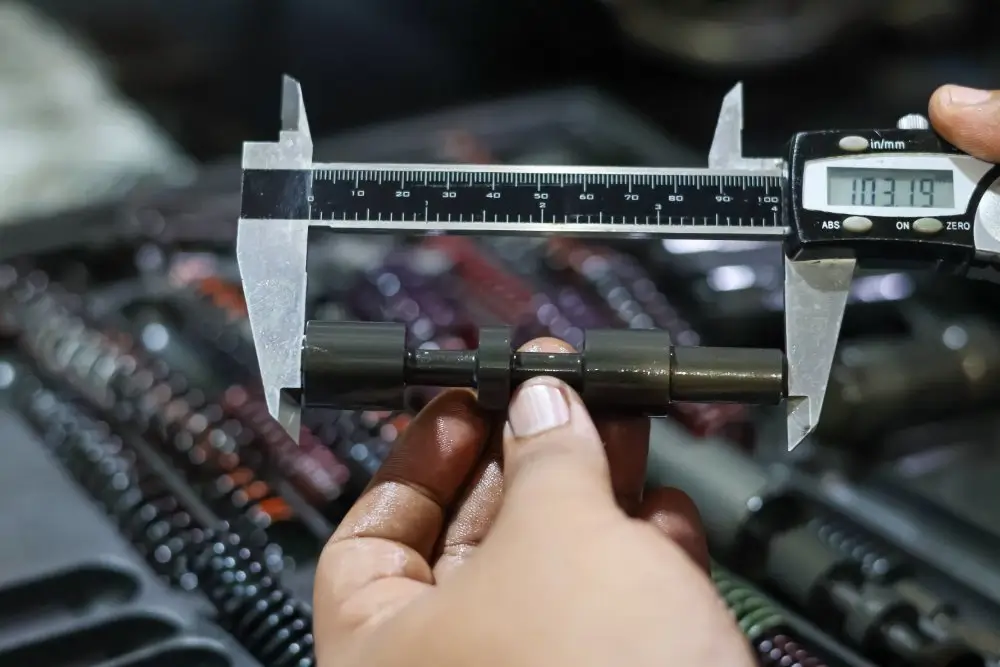
Precision matters in a shop, and several tools measure to very fine tolerances. A micrometer provides accuracy to the thousandths of an inch. An outside micrometer measures outside thickness, such as the diameter of a bolt, while an inside micrometer measures inside dimensions, such as the diameter of a hole or the width of a channel. A vernier caliper is also precise to 1/1000 inch and can measure or transfer either inside or outside dimensions, which makes it especially versatile.
Everyday measuring tools cover the rest. Tape rules, rigid steel rules, steel tape rules, and folding rules all measure material. Calipers handle exact, small measurements and can pair with a rule to measure diameter; their legs curve in to measure outside curves and curve out to measure inside curves, while slide calipers have the rule built in. Depth gauges measure the depth of holes, thickness gauges measure small openings, thread gauges count the threads per inch in threaded fasteners, and wire gauges measure wire thickness.
Alignment tools check whether something is straight or true. A square checks the trueness of an angle; it has two arms, the blade and the tongue, that meet at a right angle, and a gap between the square and the material means the material is not true. A sliding T-bevel has an adjustable blade for checking different angles. A level shows whether a surface is true using a liquid-filled tube with an air bubble that centers when the surface is level. A plumb bob is a heavy weight suspended from a line that indicates vertical trueness.
Shop Tools: Clamping, Drilling, and Finishing Tools
Clamping tools hold a workpiece steady so it will not move while you work on it. Pliers can hold objects during work. Vises hold material while it is sawed, drilled, or glued, and they come in three main types: bench vises have large, rough jaws that keep material from slipping, pipe vises hold round trim or pipes, and handscrew vises use two wooden jaws connected by long screws. Clamps come in when a vise will not work; vises generally attach to a workbench, while clamps connect only to the items being worked on. A C-clamp consists of a stationary frame and a screw that moves to open and close the clamp.
Finishing tools smooth and refine the work. Files sharpen the blades of other tools and smooth the edges of cut metal. Single-cut files handle finishing work and sharpening, while double-cut files handle rough work. Flat and half-round files serve general purposes, and square and round files fit square and round openings. Planes prepare wood for final finishing and help fit doors and trim, using a handle, a knob, a frame, a sole, and a mouth.
Joining metal calls for heat. Soldering is a low-temperature process that uses an electrically powered soldering iron or gun to melt solder, an alloy of lead and tin, into a joint between metal items; flux, a chemical cleaning agent, cleans the surfaces first, and the process joins materials without melting the base metals. Welding works at high temperature. Electric-arc welding is safer than oxyacetylene welding because it does not involve burning explosive gases, and it supports a range of specialized methods including stick welding, MIG (metal inert gas) welding, and TIG (tungsten inert gas) welding.
Preparing for the Auto and Shop Information Subtest
The single most effective preparation is hands-on experience. The best way to learn about engines is practical experience: ask a family member or friend to help, or visit a local mechanic and ask whether you can spend a day learning about engines and the tools used daily. Working with real parts builds the kind of recognition the test rewards.
Video is the next best option. Watching engines and tools in action shows you how things work in a way that reading alone cannot match, and free online videos cover nearly every system and tool on this subtest. Pair that with study of the systems covered above so you can connect what you see to the right terms.
Be ready for image-based questions. Many of the questions on this subtest are pictorial: you are shown an image of an engine component or a tool and asked to identify what it is or what it does. Knowing the names and functions of parts matters as much as understanding how they work, since you will often have to recognize them on sight.
Practice tests build familiarity and confidence. Full-length practice sets with worked answer explanations let you check your reasoning, and retaking them so the questions appear in a different order keeps the practice varied. Taking as many practice questions as possible in the weeks before your exam is the most reliable way to raise your score.
The next step is straightforward: pick one system from this guide, study it until you can explain it in your own words, then test yourself on a practice set. Repeat across the systems and tools, and the pictorial questions will start to feel routine.
Frequently Asked Questions
What is Auto and Shop Information on the ASVAB?
Auto and Shop Information is a practical ASVAB subtest covering automobile systems, vehicle parts, repairs, shop tools, fasteners, and workshop practices. It includes both Auto Information and Shop Information content, depending on the test format.
Does Shop Information count against my overall ASVAB score?
One preparation source states that Auto and Shop Information is not used to determine the Armed Forces Qualification Test score. It is instead used to help determine eligibility for certain military jobs, although candidates should confirm how their target job uses line scores.
Does the ASVAB have mechanics questions?
Yes. Auto Information includes engine operation, fuel delivery, cooling, ignition, electrical, braking, drive, and related vehicle systems, while Shop Information covers tools and workshop practices. Some questions may use pictures of components or tools.
What is the mechanics portion of the ASVAB?
For this topic, the mechanics-focused portion is Auto and Shop Information. It tests practical knowledge of automobile systems and repairs together with the identification and correct use of shop tools, equipment, and fasteners.
What does every automotive shop need?
The sources do not provide one universal checklist for every automotive shop. For ASVAB preparation, focus on striking, fastening, cutting, drilling or punching, finishing, clamping, measuring, leveling, and the main types of fasteners and shop equipment.
What are the top five common hazards in an automotive shop?
The supplied ASVAB sources do not establish an official ranked list of five hazards. They emphasize choosing the correct tool, securing work with clamps or vises, and distinguishing higher-temperature welding from lower-temperature soldering; these are useful safety checkpoints when studying.
What does AS stand for in the ASVAB?
AS refers to Auto and Shop Information. The two related areas are commonly presented as Auto Information and Shop Information, with separate CAT-ASVAB sections and a combined paper-and-pencil section.
How is Auto and Shop Information structured on the CAT-ASVAB and P&P-ASVAB?
On the selected CAT-ASVAB format, Auto Information has 11 questions in 7 minutes and Shop Information has 11 questions in 6 minutes. The P&P-ASVAB combines both subjects into 25 questions with an 11-minute limit.
How can I prepare for Auto and Shop Information?
Study the four-stroke engine, cooling, lubrication, fuel, ignition, electrical, transmission, and braking systems, then practice identifying tools by their functions. Use the embedded 15-question quiz as a checkpoint, review missed concepts, and repeat practice with attention to both terminology and practical applications.
Sources
ASVAB Test Prep · All Military BranchesReady to Pass the ASVAB?Official subtest drills (AFQT, CAT-ASVAB), timed practice tests, score calculators and detailed step-by-step explanations.

ASVAB Assembling Objects: Format, Tips, and Practice Guide

ASVAB Electronics Information: Your Complete Study Guide