
The Electronics Information subtest, usually shortened to EI, is the part of the ASVAB that checks what you know about electricity and electronics. It covers circuits, components, and the basic principles behind electrical systems. If you want a military job in electronics, communications, or electrical maintenance, this is the section that matters most.
Many test-takers arrive with little or no electronics background, and that is fine. The questions stay at a foundational level. You do not need to be an engineer; you need to recognize key terms, read simple circuit symbols, and apply a handful of formulas. This guide covers everything the subtest tests and gives you a clear way to prepare, even starting from zero.
 ASVAB Test Prep · All Military BranchesReady to Pass the ASVAB?
Official subtest drills (AFQT, CAT-ASVAB), timed practice tests, score calculators and detailed step-by-step explanations.
What is the ASVAB Electronics Information subtest?
The Electronics Information (EI) subtest is one of the technical sections of the ASVAB. The official ASVAB program describes it as measuring your knowledge of electricity and electronics fundamentals, including circuits, components, and electrical principles. The questions touch on currents, radio, television, engines, magnets, and more. It is built for candidates interested in electronics or aiming at a military role that involves electronic systems.
The test exists in more than one format, and the question count and timing change with the version.
| Exam Type | Number of Questions | Time Allotted |
|---|---|---|
| CAT ASVAB | 16 Questions | 8 Minutes |
| P&P ASVAB Exam | 20 Questions | 9 Minutes |
| PiCAT ASVAB | 16 Questions | Untimed |
On the computer-adaptive version (CAT-ASVAB), you answer 16 questions in 8 minutes. On the paper-and-pencil version, you answer 20 questions in 9 minutes. The PiCAT version has 16 questions and is untimed. In every timed format the pace is quick, so recognizing answers fast is part of the challenge.
Why EI does not affect your AFQT score
Here is a point that confuses many candidates. The Electronics Information subtest is not included in your AFQT (Armed Forces Qualification Test) score. The AFQT comes from four other subtests covering math and verbal skills, and it sets basic enlistment eligibility. A weak EI score will not lower your AFQT, and a strong one will not raise it. That does not make EI optional, though. It is essential for specific career paths, just not for general qualification.
The EL line score and technical jobs
Your EI performance feeds into the EL (Electronic) line score. This number decides whether you qualify for technical military occupations: electronics, communications equipment, radar systems, avionics, and electrical maintenance. If any of those fields interest you, a strong EI result is what opens the door. So while EI sits outside the AFQT, it carries real weight for anyone aiming at a technical specialty.
Ohm's Law: the foundation of electrical circuits
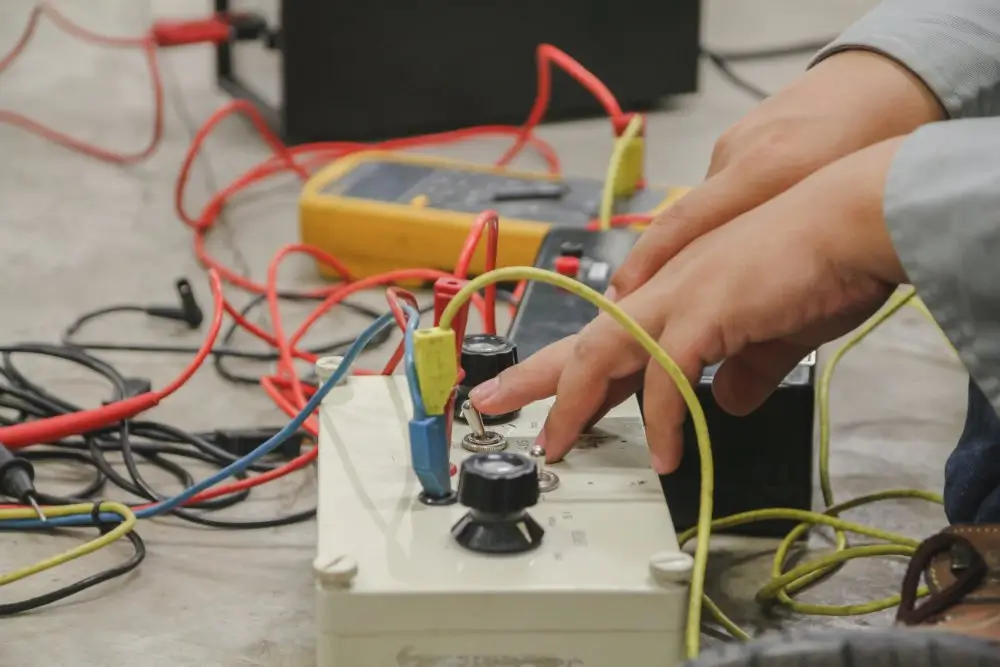
If you learn one thing for the EI subtest, make it Ohm's Law. It describes the relationship between voltage (V), current (I), and resistance (R) in a circuit, and it appears constantly. The formula is V = IR.
You first need the three quantities. Voltage is the electrical potential difference between two points; electrons flow as current from areas of high potential to areas of low potential, and voltage and current are directly proportional, so higher voltage produces higher current. Current is the rate of flow of electrons per unit of time, measured in amperes (A); one ampere equals one coulomb per second. Resistance is the opposition to current flow, measured in ohms (Ω); one ohm allows one ampere to flow when one volt is applied. Resistance and current are inversely proportional, so as resistance rises, current falls.
The strength of V = IR is that you can rearrange it for whatever you do not know. Use I = V/R for current and R = V/I for resistance. A circuit with 8 volts and 4 ohms produces a current of 2 amps, since 8 ÷ 4 = 2. To solve for resistance, a circuit with 750 volts and 7.5 amps gives 100 ohms, since 750 ÷ 7.5 = 100. This kind of calculation is one of the foundational problems tested on the subtest.
One related idea: a closed circuit is a complete loop made of a voltage source, a load, and connective conductors. Break the loop, with a cut or disconnected wire, and it becomes an open circuit where no electricity flows.
Electrical power: understanding P = IV
Power is the next formula to lock in. Electrical power is measured in watts (W) and equals voltage times current: P = IV. Here I is current in amperes and V is voltage in volts, with the result P in watts. Power also measures the rate of energy consumption, which is why loads carry consumption ratings; a 60W lightbulb uses 60W of energy to produce the equivalent in heat and light.
A typical question gives current and voltage and asks for power. Equipment rated at 9 amps and 50 volts consumes 450 watts, since 9 × 50 = 450. Plug in, multiply, done.
When the topic shifts to energy used over time, the unit changes. Energy consumption in homes and businesses is measured in kilowatt-hours, not in amps, current, or voltage alone. Watch for that distinction, since the test likes to check whether you match the right unit to the right quantity.
Series circuits: current flow and voltage distribution
Circuits come in two main configurations, and the subtest expects you to tell them apart. In a series circuit, all components connect one after another, so there is only a single path for current. The same current passes through each component in sequence, which means current is the same at all points and equals the total voltage divided by the total resistance.
Two rules carry most series questions. First, the current stays constant throughout the circuit. Second, the sum of the voltage drops across each resistor equals the total voltage applied. Voltage gets distributed across each resistor by its resistance value, but the drops always add back up to the source voltage. Total resistance is simple here: the equivalent resistance is R_eq = R₁ + R₂ + R₃ and so on.
Parallel circuits: voltage equality and current division
A parallel circuit works the opposite way, with more than one path for current and each load on its own branch. The defining feature is that voltage stays the same across every branch, since the input voltage is fully applied to each path. Current divides among the branches instead, and how much flows through each depends on that branch's resistance, so current strength varies from branch to branch.
This behavior has practical results. Household electrical systems use parallel wiring so every device sees the same voltage. The same rule explains a common trick question: adding a capacitor or inductor in parallel with a lamp does not change the lamp's brightness, because the voltage across the lamp does not change. Parallel circuits are also resilient, since current keeps flowing through the remaining branches if one disconnects.
Equivalent resistance in parallel uses a different formula: 1/R_eq = 1/R₁ + 1/R₂ and so on, in contrast to the simple sum used for a series circuit. Some designs combine both into a series-parallel circuit, so the skill is recognizing which set of rules applies where.
Resistors and color band coding
Resistors are among the most common components on the test. They limit voltage and current and come in fixed and variable types. In practice they limit current, moderate heat, and control voltage; what they cannot do is multiply current, which sometimes shows up as a wrong answer.
Variable resistors handle dynamic control, like a light dimmer or volume knob. A rheostat has two contacts and controls current. A potentiometer has three contacts and controls voltage. There are also preset variable resistors adjusted with a screwdriver during assembly.
Reading the resistor color code
Resistors are rated in ohms and labeled with colored bands, each color mapping to a digit: Black = 0, Brown = 1, Red = 2, Orange = 3, Yellow = 4, Green = 5, Blue = 6, Violet = 7, Gray = 8, White = 9. The first two bands give digits, the last band tells you how many zeroes to add, and gold or silver bands indicate tolerance.
A worked example makes the resistor color code concrete. A resistor banded black, orange, orange reads 3,000 ohms: the first black is zero, the first orange is 3, and the final orange means three zeroes. A leading zero has no effect, so 03000 is simply 3,000 ohms. These questions are pure recall once you know the pattern.
ASVAB Test Prep · All Military BranchesReady to Pass the ASVAB?Official subtest drills (AFQT, CAT-ASVAB), timed practice tests, score calculators and detailed step-by-step explanations.
Capacitors: storing and managing electric charge
A capacitor is the component that stores an electric charge, which sets it apart from diodes, transistors, and other semiconductors. Think of it as a storage shed for a circuit: it holds energy for later use. Capacitors act like temporary batteries, charged by DC current while AC passes through, releasing the stored charge back into the circuit when needed. That lets them maintain power when the primary source is disconnected or smooth out voltage. Because they pass AC and block DC, capacitors are common in filter circuits and, paired with resistors, in timing circuits. Capacitors in series produce less total capacitance than capacitors in parallel.
The test expects you to recognize capacitor symbols. There are four main types. The fixed capacitor is shown by parallel lines. The variable capacitor is used in radio tuning circuits. The polarized capacitor is shown by one curved line and one straight line and must be connected the correct way around. The trimmer capacitor rounds out the set. Knowing these four symbols reliably earns points on symbol-recognition questions.
Diodes and rectification: one-way current control
A diode is an electrical valve. It lets current pass easily in one direction and blocks it in the other, with the arrow in the symbol showing the direction of flow. That one-way property is what makes diodes useful, and their main job is rectification, converting alternating current (AC) into direct current (DC). Half-wave rectification uses a single diode and passes only one half of the AC wave; full-wave rectification uses multiple diodes and captures both halves of the AC wave.
A few diode types appear. Standard diodes handle basic one-way flow, light-emitting diodes (LEDs) emit light when current passes through them, and Zener diodes allow reverse current once a threshold is reached. One sample question contrasts solid-state diodes with tube diodes: because solid-state diodes have no filament, they require less operating power than tubes.
Transistors: amplification and switching
The transistor is the foundation of modern electronics. Made entirely from semiconductor material, which makes it a solid-state device, it can act as a switch, an amplifier, or a current regulator. In function it is most similar to an amplifier.
A transistor has three terminals: the collector, the base, and the emitter. It works by letting a small current at the base control a much larger current through the device. General current flow runs from the base to the emitter. The principle holds across configurations: a small base current controls a large collector-to-emitter current, which is what lets a transistor amplify a signal. On symbol questions you must label each terminal correctly, since the collector, base, and emitter are marked distinctly in the transistor symbol. This amplifying ability is critical for everything from audio systems to radio-frequency circuits.
AC vs DC current: understanding current types
The difference between AC and DC is core terminology. Direct current (DC) always flows in one direction, from the negative terminal of the voltage source to the positive terminal, and batteries are the classic DC source. Alternating current (AC) constantly changes direction, switching many times each second at a specific frequency. Power stations deliver electricity as AC because it moves more efficiently over long distances. The abbreviation AC stands for "alternating current," and the test treats that as basic vocabulary.
Frequency questions sometimes reference specific bands. According to asvabpracticetests.com, AM radio stations broadcast in the 530–1,700 kHz range, one of the standard bands that can appear in electronics questions. Component behavior also differs by current type, which ties back to earlier sections: capacitors pass AC and block DC, while inductors do the reverse.
Inductors and transformers: magnetic fields and voltage control
An inductor is a coiled wire that stores electric energy as magnetic energy and resists changes in the current flowing through it. If current rises, the inductor produces a voltage that slows the increase; if current falls, the stored magnetic energy opposes the decrease and keeps current flowing longer. Compared to a capacitor it behaves in the opposite way, letting DC pass easily but resisting AC.
That resistance to change appears in a specific scenario. In a DC circuit that has been open for a while, the moment a switch closes the inductor resists the sudden change and limits current at first. A lamp in parallel lights immediately, and as the inductor gradually adjusts to the current, its resistance drops, so total current and energy use rise as overall resistance falls.
A transformer puts an inductor to work to raise or lower voltage. AC flowing in a coil wrapped around an iron core magnetizes the core, producing a magnetic field that generates a voltage in a nearby coil. The voltage induced in the secondary coil depends on the number of turns in the primary and secondary coils and how close they are. The exam takeaway is simple: a transformer's voltage output depends on the turn ratio between its coils, which is how voltage gets stepped up or down.
Electrical safety and circuit protection
Protection devices are a small but testable topic, and their job is to stop dangerous current before it damages a circuit. A fuse is a thin wire that melts when current exceeds a preset value, breaking the circuit and helping prevent short circuits from damaging components during a failure or voltage spike. One question type checks fuse ratings: using a fuse rated higher than the circuit requires makes the circuit less safe, since the fuse must match the circuit's specification to protect it.
A circuit breaker does a similar job, cutting off current once it reaches a certain level. Its advantage is that it is reusable, unlike a fuse that must be replaced. The trade-off is that circuit breakers respond more slowly to surges and cost more. One more term to know: a ground is simply a connection to the earth.
Conductors, insulators, and semiconductors
Why electricity flows through some materials and not others comes down to the valence shell. Conductors let electrons flow freely because their valence shell is less than half full, so electrons move easily from atom to atom. Insulators are the opposite, with a valence shell more than half full and electrons tightly bound to the nucleus. Semiconductors sit in between, with a valence shell exactly half full, conducting under some conditions but not others, which is what makes them so useful for controlling current.
Conductivity measures how easily electrons flow through a material. Metals are good conductors, and copper is the standard example, carrying current with little resistance. Materials with very low conductivity are insulators, like rubber, which has high resistivity and often coats the handles of electrical tools. Cost and durability shape real choices: silver and gold conduct best but are more expensive and brittle than copper, which conducts only slightly less well, so engineers balance performance against price. For the test, remember the basic contrast: copper conducts, while glass, plastic, and rubber insulate.
How to prepare for the Electronics Information subtest
You can build a solid EI score from scratch with a focused plan. The subject rewards recognition and repetition more than deep theory, so the right habits go a long way.
Start with vocabulary and symbols, since a large share of the test checks whether you recognize electrical terms and component symbols. Flashcards suit this well. Make cards for circuit symbols, component names, and the core definitions above, learn which materials conduct and which insulate, and drill the resistor color code until it is automatic.
Master the formulas next. Ohm's Law (V = IR) and the power formula (P = IV) are the two you will use most, so practice rearranging them to solve for any variable until plugging in numbers is second nature.
Then practice under realistic conditions. Reading circuit diagrams and, if you can, using a multimeter for hands-on experience helps the concepts stick. Take practice tests repeatedly and review your answers each time to close gaps. According to asvabtutor.com, there are six free Electronics Information practice tests, numbered 1 through 6, with questions that reorder on each attempt so you learn the material instead of memorizing a pattern. Other free practice platforms offer additional full-length EI tests as well. The goal is the same either way: review your mistakes, fix the underlying gap, and build the speed a timed section demands.
Frequently Asked Questions
What should I know about electronics for the ASVAB?
Start with current, voltage, resistance, Ohm's Law, electrical power, and the difference between series and parallel circuits. You should also recognize common components such as resistors, capacitors, diodes, and transistors, as well as AC/DC terminology, measurement instruments, and basic safety devices.
What is the electronics part of the ASVAB?
The electronics part is the Electronics Information, or EI, subtest. It measures foundational knowledge of electricity, circuits, components, electrical principles, and practical terms such as AC and resistance.
What is Electronics Information on the ASVAB?
Electronics Information is an ASVAB subtest focused on electrical systems and electrical flow. It is not used to calculate the AFQT score, but it can matter for candidates seeking technical military career fields.
What is the electronics on the ASVAB?
“Electronics” on the ASVAB generally refers to the Electronics Information subtest. Its material includes circuits, current, voltage, resistance, component functions, electrical formulas, and the interpretation of basic circuit symbols.
What is EI on the ASVAB?
EI stands for Electronics Information. The subtest measures basic knowledge of electricity and electronics, and its result can contribute to the Electronic (EL) line score used in technical military job qualification.
Does EI affect the AFQT score?
No. The Electronics Information subtest is not included in the AFQT calculation. It may still be important for candidates targeting military jobs that use electronics knowledge or the EL line score.
How do I use Ohm's Law on the EI subtest?
Use V = IR, then rearrange it according to the unknown: I = V/R for current or R = V/I for resistance. For example, a circuit with 8 volts and 4 ohms has a current of 2 amps.
Which components should I study for ASVAB Electronics Information?
Focus on resistors, variable resistors, capacitors, diodes, transistors, inductors, transformers, fuses, switches, and circuit symbols. Learn each component's basic function rather than memorizing its name alone.
How should a beginner start studying Electronics Information?
Begin with short definitions of current, voltage, resistance, conductors, insulators, and semiconductors. Then learn V = IR and P = VI, compare series with parallel circuits, memorize common symbols, and use explained practice questions to review mistakes.
What is the hardest subject on the ASVAB?
The provided Electronics Information sources do not rank one ASVAB subject as the hardest. EI is presented as foundational technical knowledge, so its difficulty will depend largely on how familiar a candidate is with electrical vocabulary, formulas, circuits, and symbols.
Sources
ASVAB Test Prep · All Military BranchesReady to Pass the ASVAB?Official subtest drills (AFQT, CAT-ASVAB), timed practice tests, score calculators and detailed step-by-step explanations.

ASVAB Assembling Objects: Format, Tips, and Practice Guide
ASVAB Auto and Shop Information: A Complete Study Guide