
If you just took the ASVAB or you're preparing for it, the number that decides whether you can enlist is your AFQT score. It's the single figure recruiters look at first, and it often gets confused with the ASVAB itself. This guide explains what the AFQT actually measures, how the score is built, what your percentile means, and the minimum you need for each branch.
By the end you'll be able to read your own score sheet without guessing, know whether your result qualifies you, and understand what to do next if you want to improve it.
 ASVAB Test Prep · All Military BranchesReady to Pass the ASVAB?
Official subtest drills (AFQT, CAT-ASVAB), timed practice tests, score calculators and detailed step-by-step explanations.
What Is the AFQT Score?
The AFQT (Armed Forces Qualification Test) is not a separate test. It's a score drawn from four specific ASVAB subtests, and every U.S. military branch uses it to decide whether an applicant is eligible to enlist. You take the ASVAB; the AFQT is calculated from part of it.
This causes a common misunderstanding. There is no actual "overall" ASVAB score. When someone says they got a 75 or an 80 on the ASVAB, they're really talking about their AFQT score, which comes only from the verbal and math subtests. The four subtests that feed the AFQT are Arithmetic Reasoning (AR), Mathematics Knowledge (MK), Word Knowledge (WK), and Paragraph Comprehension (PC).
The Colorado Department of Education describes the AFQT as a basic measure of how trainable a person may be for military jobs. It's the determining factor for minimum enlistment qualification across all branches. The remaining ASVAB subtests don't disappear; they're used later to decide which specific jobs you qualify for. But the gate to getting in at all is the AFQT.
One education services specialist quoted by Today's Military framed the ASVAB this way: "The ASVAB is an aptitude test rather than an achievement test, and it measures potential to learn rather than what you've learned up to this point." That framing applies directly to the AFQT, which is built to estimate trainability rather than recall.
AFQT scores are reported as percentiles, ranging from 1 to 99. That percentile is the heart of what your score means, and we'll come back to it shortly.
AFQT vs. ASVAB: The Key Difference
The ASVAB (Armed Services Vocational Aptitude Battery) is the full exam. On the paper version it has nine subtests; the computerized version splits one of them, giving ten. The AFQT is a score pulled from just four of those subtests.
Here's the practical consequence. The AFQT decides which branches you can join. Your individual ASVAB subtest scores, combined into composite scores, decide which jobs and Military Occupational Specialties (MOS) you qualify for once you're in. Two different questions, two different metrics.
This matters more than it sounds. A candidate can score very high on the mechanical or science portions of the ASVAB and still be ineligible for every branch if the AFQT minimum isn't met, because the AFQT is built only from the four verbal and math subtests. Strength in the areas that don't count toward the AFQT won't get you through the door.
The six subtests that don't feed the AFQT (General Science, Electronics Information, Auto Information, Shop Information, Mechanical Comprehension, and Assembling Objects) determine specialized job qualifications and certain enlistment incentives. They shape your career path inside the military, not your basic eligibility.
The table below shows exactly which subtests count toward the AFQT.
| Subtest | Used to Determine AFQT |
|---|---|
| Arithmetic Reasoning | X |
| Word Knowledge | X |
| Paragraph Comprehension | X |
| Mathematics Knowledge | X |
| General Science | |
| Electronics Information | |
| Auto Information | |
| Shop Information | |
| Mechanical Comprehension | |
| Assembling Objects |
The AFQT Formula: How Your Score Is Calculated
The AFQT raw score comes from a single formula: 2VE + AR + MK. Each piece has a specific meaning, and the structure tells you something about what the military values.
VE stands for Verbal Expression. You get it by adding your Word Knowledge and Paragraph Comprehension raw scores together, then converting that sum to a scaled score between 20 and 62. So VE is really two subtests rolled into one number.
Once you have VE, you double it and add your Arithmetic Reasoning and Mathematics Knowledge scores. The full equation reads: two times Verbal Expression, plus Arithmetic Reasoning, plus Mathematics Knowledge. That produces your raw AFQT score.
The double weighting of Verbal Expression is deliberate. Counting VE twice reflects the military's emphasis on clear, concise communication as vital to operational success. Verbal ability carries more weight in the formula than either math subtest alone.
The raw score by itself doesn't mean much until it's converted into a percentile. That conversion compares your performance to a base group of roughly 6,000 test takers ages 18 to 23. The percentile that results is what determines your eligibility for the armed forces.
Behind that conversion sits a more technical process. The official ASVAB program documentation explains that scoring uses a three-parameter logistic (3PL) model from Item Response Theory. The 3PL model represents the probability that an examinee at a given ability level answers an item correctly, based on the item's difficulty, discrimination, and guessing characteristics. Final ability estimates are turned into standard scores through equating studies run for every CAT-ASVAB item pool and paper form. Equating is what keeps scores comparable across different versions of the test.
You don't need to run this math yourself; the Department of Defense handles the official scoring. But knowing the formula helps you see why math and verbal prep matter so much: those two areas are the entire AFQT.
How to Read Your AFQT Percentile Score
The most important thing to understand about your AFQT score is that it's a percentile, not a percentage of questions answered correctly. This single distinction trips up most first-time test takers.
An AFQT percentile indicates the percentage of examinees in the reference group who scored at or below your score. So an AFQT of 90 means you scored as well as or better than 90% of the reference group. An AFQT of 50 means you matched or beat 50% of that group. Scoring a 65 means you outperformed 65% of people in the comparison sample, not that you got 65% of the questions right.
The reference group is specific. Your score is compared against a nationally representative sample of 18 to 23 year olds who took the ASVAB during a national norming study conducted in 1997. This is known as the PAY97 study, a joint effort by the Departments of Defense and Labor. The Enlistment Testing Program sample within it included approximately 6,000 American youth, with a 77% participation rate.
The standard score scale used for the subtests sets the average at a mean of 50 with a standard deviation of 10. About half the population scores at or above a standard score of 50, and roughly 16% score at or above 60. That's why a 50th percentile result sits right at the national average.
The percentile scoring system was renormalized in 2004, making a score of 50 represent performing better than exactly 50% of test takers. The point of all this is consistency: your number is a comparison, and the comparison group is fixed.
A practical example helps. If you score a 70, you didn't answer 70% of questions correctly. You performed better than 70% of the people in the benchmark group. Because the scale is built on a normal distribution, small improvements in your raw score near the middle can produce meaningful jumps in percentile rank, which can change which jobs and programs you qualify for.
AFQT Score Categories: From Category I to Category V
The military groups AFQT percentiles into categories for reporting and eligibility purposes. The official ASVAB program uses eight bands, and they map directly onto opportunity.
| AFQT Category | Score Range |
|---|---|
| I | 93–99 |
| II | 65–92 |
| IIIA | 50–64 |
| IIIB | 31–49 |
| IVA | 21–30 |
| IVB | 16–20 |
| IVC | 10–15 |
| V | 1–9 |
Each band acts like a gate. Category I and Category II candidates, scoring 65 and above, tend to have the widest range of options, from elite technical roles to officer training programs. These bands represent above-average to exceptional aptitude and open access to nearly every Military Occupational Specialty.
Category IIIA, starting at the 50th percentile, is a meaningful threshold. The official ASVAB enlistment eligibility page states that applicants who score in Category IIIA or higher (50 or above) may qualify for enlistment incentives. So 50 isn't just average; it's the line where bonuses and added opportunities start to open up.
Category IIIB (31–49) is below average. It can still meet some branch minimums, but it tends to limit job options. The lower categories narrow choices further.
Category V (1–9) is the floor. Applicants in Category V are legally ineligible for enlistment. There's also a legal cap on lower scorers overall: The law limits the share of accessions falling between Categories IV and V to 20% of all persons originally enlisted in a given armed force in a given fiscal year. That cap is one reason higher scores are competitive even above the bare minimum.
ASVAB Test Prep · All Military BranchesReady to Pass the ASVAB?Official subtest drills (AFQT, CAT-ASVAB), timed practice tests, score calculators and detailed step-by-step explanations.
Minimum AFQT Scores by Military Branch

Meeting a branch's minimum AFQT score is the basic requirement to enlist. The number depends on both the branch and your education level. The table below shows the current minimums for high school graduates and for GED or equivalency holders.
| Military Branch | High School Graduate Minimum | GED/Equivalency Minimum | Additional Requirements for GED Holders |
|---|---|---|---|
| Air Force | 31 | 50 | Must not have completed 15 hours of college credit |
| Army | 31 | 50 | None specified |
| Marine Corps | 31 | 50 | None specified |
| Navy | 31 | 50 | Must complete 15 hours of college credit |
| Coast Guard | 32 | 50 | Must complete 15 hours of college credit |
A few points are worth flagging. The official Air Force recruitment website lists 31 as the minimum AFQT for high school graduates. Some older sources cite 36, but the official source confirms 31 as the current standard. For high school graduates, the Army, Air Force, and Marine Corps set the bar at 31, the Coast Guard at 32, and the Navy at 31.
GED and equivalency holders face higher bars. For GED holders, the Air Force requires 50, the same figure as the Army and the Marine Corps. The Navy and Coast Guard each require 50 for GED holders, with the added condition of completing 15 hours of college credit. The Air National Guard requires 50 for both education tiers.
Space Force is newer and its requirement is less firmly documented. Some guides still list 36 for the Air Force; that was its earlier published figure, but the current official minimum is 31.
These minimums are standards, not guarantees, and they can change. The figures can fluctuate based on military needs, so checking with a recruiter for the current requirement is the safest move. Waivers also exist. Applicants with special skills or experience, such as fluency in a needed language or computer programming experience, may be eligible for waivers of current AFQT minimums. Scoring well on subtests tied to occupations the military is actively recruiting for can also open waiver eligibility.
What Is a Good AFQT Score?
"Good" depends on your goal. There's a difference between meeting a minimum and being competitive, and most applicants benefit from aiming higher than the floor.
Meeting the minimum gets you in the door but limits your options. A score of 31 allows entry in several branches but severely restricts occupational choices, often to basic roles such as infantry. Competitive technical and specialized positions generally require scores in the 50 to 70 range. The minimum is the start of the conversation, not the end.
An AFQT of 50 to 64 is generally considered solid, showing above-average performance, while 65 and above is considered standout. Scores at 65 and up open more opportunities, including eligibility for specialized positions, training programs, and technical specialties. The 50th percentile is also where enlistment incentives begin, since it marks the bottom of Category IIIA.
A useful way to think about it: 50 and above qualifies for most enlistment paths and some bonuses; 65 and above broadens bonus and education-fund eligibility; 80 and above qualifies for almost every MOS; and 90 and above is considered elite, opening cyber, intelligence, and special programs. Published data indicates that over 90% of Air Force applicants approved for enlistment score 50 or above, which shows how the competitive middle of the scale really functions.
To make this concrete, here's how some specific scores land:
- An 84 sits in Category II (65–92), above average. It qualifies you for every branch, makes you eligible for most Military Occupational Specialties, and typically opens enlistment bonuses and advanced training.
- A 90 is excellent, near the top of Category II. You qualify for virtually all branches and most MOS, and you're competitive for elite roles in cyber operations, intelligence, and technical fields.
- A 99 is the highest achievable, in Category I (93–99), the top of the scale relative to the 1997 reference group. Nearly every specialty is available, including fields like Air Force cyber warfare and the Navy's Nuclear Power Program.
- A 42 falls in Category IIIB (31–49), below average. It meets the high school graduate minimum for the Army, Air Force, and Marine Corps (31) and the Coast Guard (32), but not the Navy (31), and it limits available jobs.
- A 32 is at the low end of eligibility. It clears the 31 floor shared by the Army, Air Force, and Marine Corps, and meets the Coast Guard's 32 exactly, but falls short of the Navy and the Space Force, and it noticeably restricts MOS options. Retesting is worth considering for more flexibility.
The pattern is clear: the higher your percentile, the more branches, jobs, and incentives become available.
AFQT and Composite (Line) Scores: Two Different Metrics
Once you understand that the AFQT decides eligibility, the next piece is composite scores, which decide your career path. These are also called line scores or aptitude area scores, and they combine different ASVAB subtests in branch-specific ways.
The logic is straightforward. According to the official ASVAB program, each service develops and validates its own set of composites based on the subtest combinations most strongly correlated with on-the-job performance for clusters of occupations. A formula combines the standard scores of chosen subtests, and the result determines which MOS you qualify for. Your AFQT gets you into a branch; your composite scores match you to a job within it.
Because each branch builds its own formulas, the same ASVAB performance produces different line scores depending on where you apply. Arithmetic Reasoning and Mathematics Knowledge appear in nearly every line score across branches, which is part of why test prep leans so heavily on math even though math is only two of the nine subtests.
The Army, for example, uses ten composite line scores covering areas from clerical work to electronics to skilled technical roles.
| Composite Score | Acronym | Formula |
|---|---|---|
| Clerical | CL | WK + PC + AR + MK |
| Combat | CO | WK + PC + AS + MC |
| Electronics | EL | GS + AR + MK + EI |
| Field Artillery | FA | AR + MK + MC |
| General Maintenance | GM | GS + AS + MK + EI |
| General Technical | GT | WK + PC + AR |
| Mechanical Maintenance | MM | AS + MC + EI |
| Operators and Food | OF | WK + PC + AS + MC |
| Surveillance and Communications | SC | WK + PC + AR + AS + MC |
| Skilled Technical | ST | WK + PC + GS + MC + MK |
One composite deserves special attention. The GT (General Technical) score is used to qualify candidates for Officer Candidate School and warrant officer programs. A GT of 110 or higher is generally required for those paths. Notably, the GT score is calculated from verbal and arithmetic subtests, much like the AFQT itself, which is why strong AFQT performance often signals officer-track potential.
The Air Force takes a different approach, collapsing subtests into four composites known as MAGE: Mechanical, Administrative, General, and Electronic. The structure differs from the Army's, but the principle is the same: match aptitude to occupation.
The ASVAB Test Format: What Feeds the AFQT
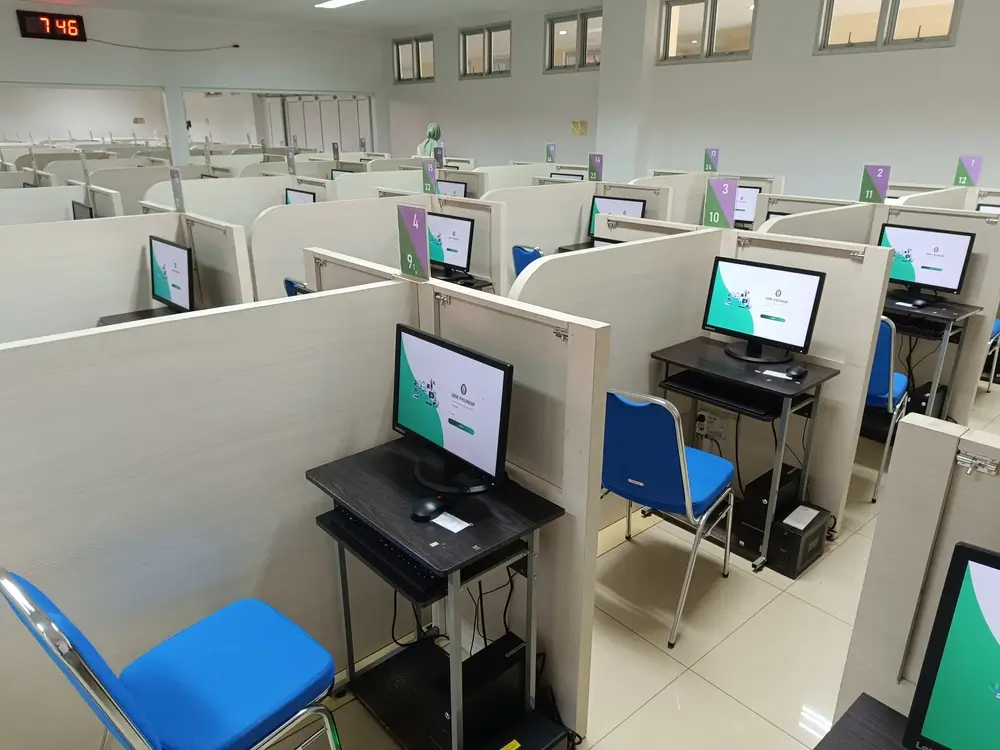
Understanding where and how you take the test helps you plan. The ASVAB comes in two main formats, and they feed the same AFQT calculation.
The computerized version, CAT-ASVAB, is administered at Military Entrance Processing Stations (MEPS). It's adaptive, meaning it adjusts question difficulty to your performance as you go. The paper-and-pencil version, P&P-ASVAB, is given at Military Entrance Test (MET) sites with a fixed set of questions. The full battery takes roughly three hours.
The two formats differ in length. The paper version contains 225 questions in 149 minutes. The computerized CAT-ASVAB is shorter, with about 135 questions in 198 minutes, because the adaptive design reaches a reliable estimate with fewer items.
There's also a notable structural difference between the two. The paper version has nine subtests, while the computerized version splits Auto & Shop Information into two separate subtests, Auto Information and Shop Information, giving ten. The Colorado Department of Education confirms this 9-versus-10 distinction.
For the adaptive version, the official ASVAB documentation describes how the 3PL model selects items. Every examinee starts with an initial ability estimate, and after each scored response the estimate is updated using a sequential Bayesian procedure. When the test ends, a final ability estimate is computed, and a penalty applies for examinees who don't finish within the time limit.
There are also at-home and predictive options. Today's Military explains that the Pending Internet Computerized Adaptive Test (PiCAT) is identical to the ASVAB but is unproctored and untimed, taken at home. It can only be taken once and only by people who have never taken the ASVAB before, and it requires a supervised 20-minute follow-up exam at MEPS to verify the score. Separately, the AFQT Predictor Test (APT) is a short, unproctored, online 20-item adaptive assessment that estimates your AFQT before the real thing. It includes only the four AFQT subtests and usually takes 20 to 30 minutes, with only the registering recruiter able to view the result.
ASVAB Score Validity, Retesting Rules, and TAPAS
Your score isn't permanent, and you can retake the test, but the rules are specific.
ASVAB scores remain valid for two years from the date you took the exam. After two years, you'll need to retest to stay in consideration for enlistment.
If you want to improve your score, there are mandatory waiting periods. You must wait one calendar month after your initial attempt before a first retest, another calendar month before a second retest, and at least six months before testing again after two retests. One detail matters a great deal here: only your most recent score counts, even if it's lower than a previous attempt. That makes preparation before each sitting essential, since a rushed retake can replace a better score.
There's also a safeguard against unusual jumps. If a new score rises 20 points or more within six months, the applicant may be required to take a special confirmation test to verify the improvement is genuine.
Beyond the cognitive test, the military is piloting an additional assessment. The Tailored Adaptive Personality Assessment System (TAPAS) is a computer-adaptive personality test of 120 questions designed to measure noncognitive traits such as motivation. Its primary goal is to identify high-potential candidates who may perform well in service even if they don't quite meet the standard AFQT thresholds. It's a sign that the military is looking at more than test scores alone, though the AFQT remains the eligibility gate today.
How to Calculate Your AFQT Score Step by Step
You can estimate your own AFQT with the same logic the military uses. Online calculators give approximations only, since official scoring involves statistical scaling that only the Department of Defense performs accurately, but the steps clarify what's happening.
Step 1: Add your verbal scores. Take your Word Knowledge score and add your Paragraph Comprehension score. This raw verbal total is the starting point.
Step 2: Convert to a scaled VE score. That sum is converted to a Verbal Expression score on a scale from 20 to 62, using an official conversion chart. VE is the single number that represents your verbal ability.
Step 3: Apply the formula. Double your VE score, then add your Arithmetic Reasoning and Mathematics Knowledge scores. The equation is 2VE + AR + MK, which gives your raw AFQT score. On the CAT-ASVAB, AR and MK questions can be worth one to three points each depending on difficulty.
Step 4: Convert to a percentile. The raw standard score is mapped to a percentile from 1 to 99 using a conversion table. The raw standard score runs from 80 to 320: a standard score of 80–120 corresponds to the 1st percentile, while a standard score of 254–320 corresponds to the 99th percentile.
The chart below shows the full mapping from standard score to AFQT percentile.
| Standard Score (2VE + AR + MK) | AFQT Percentile |
|---|---|
| 80-120 | 1 |
| 121-124 | 2 |
| 125-127 | 3 |
| 128-131 | 4 |
| 132-134 | 5 |
| 135-137 | 6 |
| 138-139 | 7 |
| 140-142 | 8 |
| 143-144 | 9 |
| 145-146 | 10 |
| 147-148 | 11 |
| 149-150 | 12 |
| 151-153 | 13 |
| 154 | 14 |
| 155-156 | 15 |
| 157-158 | 16 |
| 159-160 | 17 |
| 161-162 | 18 |
| 163-164 | 19 |
| 165 | 20 |
| 166-167 | 21 |
| 168-169 | 22 |
| 170-171 | 23 |
| 172 | 24 |
| 173-174 | 25 |
| 175 | 26 |
| 176-177 | 27 |
| 178 | 28 |
| 179-180 | 29 |
| 181 | 30 |
| 182 | 31 |
| 183-184 | 32 |
| 185 | 33 |
| 186 | 34 |
| 187-188 | 35 |
| 189 | 36 |
| 190 | 37 |
| 191 | 38 |
| 192 | 39 |
| 193 | 40 |
| 194 | 41 |
| 195-196 | 42 |
| 197 | 43 |
| 198 | 44 |
| 199 | 45 |
| 200 | 46 |
| 201 | 47 |
| 202 | 48 |
| 203 | 49 |
| 204 | 50 |
| 205 | 51 |
| 206 | 52 |
| 207-208 | 53 |
| 209 | 54 |
| 210 | 55 |
| 211 | 56 |
| 212 | 57 |
| 213 | 58 |
| 214 | 59 |
| 215 | 60 |
| 216 | 61 |
| 217 | 62 |
| 218 | 63 |
| 219 | 64 |
| 220 | 65 |
| 221 | 66 |
| 222 | 67 |
| 223 | 68 |
| 224 | 69 |
| 225 | 70 |
| 226 | 71 |
| 227 | 72 |
| 228 | 73 |
| 229 | 74 |
| 230 | 75 |
| 231 | 76 |
| 232 | 77 |
| 233 | 78 |
| 234 | 79 |
| 235 | 80 |
| 236 | 81 |
| 237 | 82 |
| 238-239 | 83 |
| 240 | 84 |
| 241 | 85 |
| 242 | 86 |
| 243 | 87 |
| 244 | 88 |
| 245 | 89 |
| 246 | 90 |
| 247 | 91 |
| 248 | 92 |
| 249 | 93 |
| 250 | 94 |
| 251 | 95 |
| 252 | 96 |
| 253 | 97 |
| 254-320 | 99 |
Use this to translate a practice raw score into a rough percentile, then aim for the band that unlocks the branches and jobs you want.
Frequently Asked Questions
Are the ASVAB and AFQT the same thing?
No. The ASVAB is the broader aptitude battery, while the AFQT is a derived percentile score calculated from only four ASVAB subtests: AR, MK, WK, and PC. There is no single overall ASVAB score; the AFQT is the number generally used when people mention an ASVAB score such as 75 or 80.
How is the AFQT calculated?
First, combine Word Knowledge and Paragraph Comprehension into the Verbal Expression (VE) score. Then calculate the raw score with AFQT = 2VE + AR + MK, and convert that raw result into a percentile against the reference group.
Is the AFQT a percentile or a percentage?
The AFQT is a percentile from 1 to 99, not a percentage of correct answers. A score of 60 means you performed as well as or better than 60% of the reference group; it does not mean you answered 60% of the questions correctly.
What is considered a good AFQT score?
There is no single universal cutoff for a “good” AFQT score: the practical baseline is the minimum for the branch and educational category you are pursuing. Category IIIA begins at 50, Category II begins at 65, and higher scores generally provide more flexibility, but specific jobs still depend on line scores and service requirements.
Is an 84 AFQT score good?
Yes, an AFQT of 84 falls in Category II, which covers the 65-92 percentile range. It means you performed as well as or better than 84% of the reference group and is above the listed high-school-diploma minimums for the Army, Navy, Marine Corps, Air Force, and Coast Guard, although job qualification still depends on composite scores.
Is 42 a good AFQT score?
An AFQT of 42 is in Category IIIB, the 31-49 range. It is above the listed high-school-diploma minimums for the five branches covered here, but it leaves fewer opportunities than a Category I, II, or IIIA score and does not by itself qualify you for a specific military job.
What do AFQT scores of 62, 70, 71, 77, 82, 90, and 99 mean?
A score of 62 is Category IIIA; 70, 71, 77, 82, and 90 are Category II; and 99 is Category I. Each number is a percentile ranking, so the score reflects comparison with the reference group rather than a percentage of correct answers.
Is a 70 or 77 on the ASVAB good, and how rare is a 70?
The ASVAB does not have one overall score, so first establish whether 70 or 77 refers to the AFQT or an individual subtest. If it is an AFQT percentile, 70 means performing as well as or better than 70% of the reference group and 77 means performing as well as or better than 77%; neither number means that percentage of questions was correct.
Is a 32 or 47 on the ASVAB a low score?
If these are AFQT percentiles, both 32 and 47 fall in Category IIIB. A 32 is above the Army, Air Force, and Marine Corps high-school-diploma minimums but below the listed Navy and Coast Guard minimums, while 47 is above all five listed baselines; if the numbers refer to individual ASVAB subtests, there is no overall ASVAB score to interpret.
What minimum AFQT score do I need for each military branch?
For high-school-diploma applicants, the baseline figures used in this guide are Army 31, Navy 35, Marine Corps 32, Air Force 31, and Coast Guard 40. GED and other high-school-equivalency applicants generally face higher thresholds and may have additional education conditions, so confirm the current requirement with the recruiter or official service website before relying on a score.
Sources
ASVAB Test Prep · All Military BranchesReady to Pass the ASVAB?Official subtest drills (AFQT, CAT-ASVAB), timed practice tests, score calculators and detailed step-by-step explanations.
Marine ASVAB Score: Minimum AFQT, Line Scores & MOS Guide
Coast Guard ASVAB Score: Minimums, Ratings & How to Prep