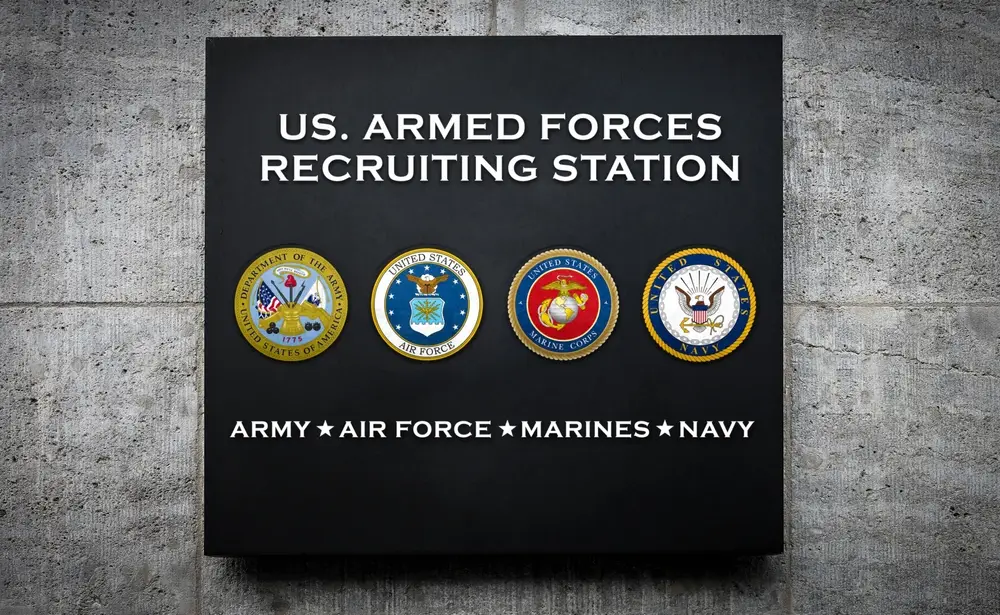
If you have taken the ASVAB and want to know which military jobs you actually qualify for, an ASVAB job calculator does the heavy lifting. It takes your scores, compares them against real job requirements, and tells you what you can pursue right now. It can also work backward: pick a job first, and the tool shows you the exact scores you still need to hit.
This matters because the number most people obsess over, the AFQT, only gets you in the door. The job you end up training for depends on a different set of numbers called line scores. A calculator is the fastest way to see both at once and to spot the gap between where you are and where you want to be.
 ASVAB Test Prep · All Military BranchesReady to Pass the ASVAB?
Official subtest drills (AFQT, CAT-ASVAB), timed practice tests, score calculators and detailed step-by-step explanations.
This guide explains how these calculators work, the difference between AFQT and line scores, the minimum scores each branch demands, and how to read line score requirements for popular jobs. The goal is simple: help you turn a screen full of numbers into a clear plan.
What an ASVAB Job Calculator Does and Why You Need It

An ASVAB job calculator is a dual-mode tool that bridges the gap between your test results and the jobs the military offers. According to the Navy's official ASVAB Calculator, you can either enter your scores to discover matching positions or select a job you want and see the exact scores and correct-answer thresholds it requires.
The value is that it removes guesswork. Instead of cross-referencing dozens of tables yourself, you get a direct answer about eligibility based on your real performance.
Forward mode: I have scores
The first mode, often labeled "I have scores," is a forward lookup. You enter your ASVAB line scores, and the calculator checks them against a military job database, then returns every position you meet the minimum standard for. The Navy's ASVAB Calculator notes that this mode mirrors a MOS Finder, giving candidates a quick overview of their options the moment they know their results.
This is the natural starting point for anyone who has already tested. You see your reachable jobs in seconds, across one or more branches.
Reverse mode: I want a job
The second mode, "I want a job," runs in the opposite direction. You pick a target position from a searchable list, and the tool displays the required line scores for that job along with how many correct answers you need on each subtest to reach them. The Navy's ASVAB Calculator describes this as turning abstract score goals into concrete, actionable targets.
Both modes pull from the same database, so the numbers stay consistent no matter which direction you approach from. ASVAB Hero, a free prep platform, offers the same dual setup across all six branches, letting you plug in subtest scores to find qualifying jobs and your AFQT percentile, or reverse-search a job to see its requirements.
Why gap analysis matters
The feature that makes these tools genuinely useful is gap analysis. When your scores fall short of a target job, the calculator quantifies the deficit. The Navy's ASVAB Calculator gives a clear example: if your General Technical (GT) score is 95 but the job needs 110, the tool tells you that you need 15 more points on GT.
That precision changes how you study. Rather than reviewing everything, you focus on the subtests that actually move your target score. It is the difference between broad effort and targeted effort.
Understanding ASVAB Scores: AFQT vs. Line Scores
Before the calculator results make sense, you need to understand the two kinds of scores it works with. They do different jobs, and confusing them is the most common mistake applicants make.
What the AFQT score measures
The AFQT (Armed Forces Qualification Test) score is a percentile from 1 to 99 that determines whether you can enlist at all. According to ASVAB Tutor, it is the most critical single number from your results, used to decide if you meet enlistment requirements and to rank candidates within a branch.
It is built from four subtests: Word Knowledge (WK), Paragraph Comprehension (PC), Arithmetic Reasoning (AR), and Mathematics Knowledge (MK). Because it is a percentile, an AFQT of 70 means you scored as well as or better than 70% of the reference group, not that you got 70% of questions right.
Line scores: the real gatekeeper
Line scores, also called composite scores, decide which specific jobs you can apply for. According to ASVAB Tutor, while the AFQT determines eligibility to enlist, line scores determine which Military Occupational Specialties you can actually pursue.
Each line score is a different combination of subtests. Common ones include GT (General Technical) for technical and administrative roles, CL (Clerical) for office work, EL (Electronics) for communication and electronics jobs, MM (Mechanical Maintenance) for mechanical work, and CO (Combat) for combat roles. This is why the AFQT alone never tells the whole story.
How branches calculate line scores differently
Each branch builds its line scores from the nine ASVAB subtests in its own way, which is why the same raw performance can qualify you for different jobs depending on the service. The Army's official scoring framework converts your results into 10 line scores: clerical, combat, electronics, field artillery, general maintenance, general technical, mechanical maintenance, operators and food, surveillance and communications, and skilled technical.
The Marine Corps uses a tighter set. Its scoring system translates ASVAB results into five line scores: clerical, electronics, general technical, mechanical maintenance, and skilled technical.
The table below shows the Army composite formulas, which give a feel for how subtests combine into each line score.
| Composite Score | Abbreviation | Components |
|---|---|---|
| Clerical | CL | Word Knowledge (WK) + Paragraph Comprehension (PC) + Arithmetic Reasoning (AR) + Mathematics Knowledge (MK) |
| Combat | CO | Word Knowledge (WK) + Paragraph Comprehension (PC) + Auto & Shop Information (AS) + Mechanical Comprehension (MC) |
| Electronics | EL | General Science (GS) + Arithmetic Reasoning (AR) + Mathematics Knowledge (MK) + Electronic Information (EI) |
| Field Artillery | FA | Arithmetic Reasoning (AR) + Mathematics Knowledge (MK) + Mechanical Comprehension (MC) |
| General Maintenance | GM | General Science (GS) + Auto & Shop Information (AS) + Mathematics Knowledge + Electronics Information |
| General Technical | GT | Word Knowledge (WK) + Paragraph Comprehension (PC) + Arithmetic Reasoning (AR) |
| Mechanical Maintenance | MM | Auto & Shop Information (AS) + Mechanical Comprehension (MC) + Electronic Information (EI) |
| Operators and Food | OF | Word Knowledge (WK) + Paragraph Comprehension (PC) + Auto & Shop Information (AS) + Mechanical Comprehension (MC) |
| Surveillance and Communications | SC | Word Knowledge (WK) + Paragraph Comprehension (PC) + Arithmetic Reasoning (AR) + Auto & Shop Information (AS) + Mechanical Comprehension (MC) |
| Skilled Technical | ST | Word Knowledge (WK) + Paragraph Comprehension (PC) + General Science (GS) + Mechanical Comprehension (MC) + Mathematics Knowledge (MK) |
The takeaway is that you need both numbers. Your AFQT gets you into a branch; your line scores decide what you do once you are in. That is why studying every section, not just the four AFQT subtests, is what opens up real choice.
What Your AFQT Score Means: Categories and Eligibility
Your AFQT percentile slots you into a category, and that category gives a rough sense of how many jobs are within reach. The AFQT score is calculated with the formula AFQT = 2VE + AR + MK, where VE (Verbal Expression) comes from PC + WK.
The official category breakdown looks like this.
| Category | Percentile Score | Description |
|---|---|---|
| Category I | 93-99 | Top performers. Eligible for any job in the military. |
| Category II | 65-92 | Above average. Will have a wide range of job opportunities in the military. |
| Category IIIA | 50-64 | Average. Will have several job options available in the military. |
| Category IIIB | 31-49 | Below average. May only have a few job options available in the military. |
| Category IV | 16-30 | Below standards. Very few job options will be available in the military. |
| Category V | 1-15 | Not eligible for military enlistment. |
This explains what specific scores actually mean. A 47 lands you in Category IIIB, which clears the enlistment bar for most branches but is below average and may limit technical roles. A 70, 73, or 77 puts you in Category II, an above-average band that qualifies you across all branches and opens a wide set of jobs. A 93 sits at the floor of Category I, the top tier, where virtually any job is on the table.
It is worth being honest about the limits of these labels. A Category II score is common, not rare, so a 70 or 77 is genuinely good without being exceptional. And even a Category I score does not bypass line score requirements: a 93 AFQT still needs the right line scores for a competitive MOS. The category tells you the breadth of your options, not your lock on any one job.

Minimum ASVAB Scores Required by Military Branch
Every branch sets its own minimum AFQT score for enlistment, and the differences are real. The figures below reflect the most current, corroborated values.
| Military Branch | Minimum AFQT Score | Notes |
|---|---|---|
| Army | 31 | Offers the most waivers for lower scores |
| Navy | 31 | Focus on technical and engineering roles |
| Air Force | 31 (50 with GED) | Emphasis on intellectual and technical aptitude |
| Space Force | 36 (enlisted minimum) | Scores in 60s needed for many positions |
| Marine Corps | 31 | Fewer job fields, seeks multi-skilled individuals |
| Coast Guard | 32 | Small service, narrow set of ratings |
The Army requires 31, the Navy 31, the Air Force 31, the Marine Corps 31, the Coast Guard 32, and the Space Force 36 for enlisted positions, though many Space Force jobs need scores in the 60s.
Why GED holders face higher thresholds
If you hold a GED instead of a high school diploma, the bar usually rises. According to Peterson's, GED holders typically need a minimum AFQT of 50. The Air Force is a clear case: its minimum is 31 for high school graduates but 50 for GED holders.
The same pattern appears in the Army. According to Peterson's, the Army requires 31 for high school seniors and diploma holders, and 50 for GED holders.
Waivers and alternative pathways
A score below the standard minimum does not always end the conversation. Some branches grant waivers on the AFQT; the Coast Guard rarely does.
There are also preparatory programs. According to ASVAB Hero, the Army runs the Future Soldier Preparatory Course (FSPC) for applicants scoring 21 to 30 AFQT, letting them retest after a short academic program. These minimums are entry points only; qualifying for a specific job almost always requires higher line scores on top of clearing the AFQT bar.
How to Use Mode 1: Enter Your Scores to Find Your Jobs
Mode 1 is the fastest way to see your options once you have results in hand. According to the Navy's ASVAB Calculator, you enter your line scores across all measured areas, and the tool checks them against the job database, then returns every position you meet the minimum standard for.
Which scores to input
Start with the four core AFQT subtests. According to ASVAB Tutor, you fill in Word Knowledge (WK), Paragraph Comprehension (PC), Arithmetic Reasoning (AR), and Mathematics Knowledge (MK) to calculate your AFQT percentile and check branch eligibility across all six services.
For sharper results, add the rest. According to ASVAB Tutor, you can optionally enter General Science (GS), Electronics Information (EI), Auto & Shop Information (AS), and Mechanical Comprehension (MC), which refine the line score estimates and unlock a fuller picture of which jobs you match.
Reading and filtering your results
Once you calculate, the tool lists the jobs you qualify for. ASVAB Hero covers all six branches, so you can plug in your subtest scores and see every job you match, plus your AFQT percentile, then narrow the list by branch or category to focus on what interests you.
When you qualify for several jobs, that is a good problem. Use it as a shortlist, then move to Mode 2 to compare the score requirements and decide which roles are worth targeting or stretching for.
ASVAB Test Prep · All Military BranchesReady to Pass the ASVAB?Official subtest drills (AFQT, CAT-ASVAB), timed practice tests, score calculators and detailed step-by-step explanations.
How to Use Mode 2: Select Your Target Job to See Required Scores
Mode 2 is built for people who already know what they want. According to the Navy's ASVAB Calculator, you select your desired job from a searchable dropdown, and the tool displays the required line scores for that position along with how many correct answers you need on each subtest to hit them.
Choosing your job from the database
The searchable menu makes it easy to find a specific role by name. According to the Navy's ASVAB Calculator, the calculator shares the same database as the MOS Finder, so listings and requirements stay synchronized, and the database spans positions across every branch.
Turning score goals into answer targets
The real strength of this mode is the breakdown of correct answers per subtest. According to the Navy's ASVAB Calculator, this granular view is critical for focused preparation: instead of an abstract target like "GT 110," you see exactly what you need to accomplish on each component of the test.
That converts a vague goal into a study plan. You know which subtests carry your target score and how much work each one needs.
Understanding the Gap Between Your Current Score and Your Goal
The space between your current scores and your target job's requirements is where a calculator earns its keep. According to the Navy's ASVAB Calculator, the tool clearly shows the deficit, for example displaying "You need 15 more points on GT" when a candidate sits at 95 but needs 110.
Which line scores matter most
Not every line score is equally valuable. According to ASVAB Hero, GT is the most important Army line score because it gates the largest set of MOS, including most technical and leadership tracks. A GT of 110 or higher unlocks Cyber (17C), Officer Candidate School eligibility, and Green to Gold programs.
So if you can only optimize one number, GT is usually the one. Its reach across the job catalog makes every point count more than in a niche composite.
Prioritizing subtests for maximum gain
Here is the detail that makes GT especially worth targeting. According to ASVAB Hero, the formula is GT = VE + AR, where VE (Verbal Expression) = 2×WK + PC. Because Word Knowledge counts twice, improving WK by one standard score point raises your GT by two points.
That double weighting makes Word Knowledge a high-return area. A focused vocabulary push moves your GT faster than almost any other single effort, which is why it deserves a spot at the front of your study plan.
A good ASVAB score, in the end, is one that qualifies you for the job you want. According to Duran Learning, exceeding the minimum opens more placements and potential bonuses, while a lower score narrows the field because many positions demand specific line scores.

Reading Line Score Requirements for Popular Military Jobs
Seeing real requirements makes the abstract concrete. The table below lists line scores for ten common Army MOS.
| MOS | Title | Line Score |
|---|---|---|
| 11B | Infantryman | CO 87 |
| 68W | Combat Medic | ST 101 + GT 107 |
| 25B | IT Specialist | ST 95 + GT 100 |
| 35F | Intelligence Analyst | ST 101 |
| 15T | UH-60 Helicopter Repairer | MM 104 |
| 13F | Fire Support Specialist | FA 96 |
| 31B | Military Police | ST 91 + GT 90 |
| 17C | Cyber Operations | GT 110 + ST 112 |
| 92Y | Unit Supply Specialist | CL 90 |
| 92G | Culinary Specialist | OF 85 |
Army MOS examples
A few of these illustrate how requirements scale with technical demand. The Army's published MOS requirements list Infantryman (11B) at a Combat line score of 87, while Cyber Operations Specialist (17C) requires both General Technical of 110 and Skilled Technical of 112.
Some jobs stack multiple requirements. The Diver (12D) needs General Maintenance of 98, General Technical of 107, and Skilled Technical of 106 all at once, which shows how specialized roles raise the bar across several competencies. Combat Medic (68W) is similarly demanding at ST 101 plus GT 107, according to ASVAB Hero.
Navy, Air Force, Marine Corps, and Coast Guard
Each branch frames its requirements in its own currency, so the same job title can look very different across services. The table below pulls sample jobs and their score requirements from across the branches.
| Branch | Minimum Score | Sample Jobs | Score Requirements |
|---|---|---|---|
| Army | 31 | Human Resources Specialist, Culinary Specialist, Intelligence Analyst, Combat Medic Specialist, Avionic Mechanic | GT 100 + CL 90, OF 85, ST 101, GT 107 + ST 101, EL 93 |
| Navy | 31 | Logistic Specialist, Missile Technician, Information Systems Technician, Navy Diver, Airman | GT 102, EL 222 or GT + MK + MC (222), AR + MK + GS (222) or EL 222, GT 103 + MC 51, AR + AS + MK + WK + PC (185) |
| Air Force | 31 | Ground Transportation, Flight Attendant, Paralegal, Aircraft Elec. and Env. Systems, Cyber Systems Operations | M40, A50, G51, M41 + E61, G64 |
| Marine Corps | 31 | Postal Clerk, Scout Sniper, Aviation Comm. Systems Technician, Helicopter Crew Chief, Artillery Electronic Technicians | CL 100, GT 100, EL 115, MM 105, EL 115 |
| Coast Guard | 32 | Quarrying Specialist, Watercraft Operator, Parachute Rigger, Cyber Network Defender, Financial Management Technician | GM 93, MM 99, GM 88 + CO 87, GT 105 + ST 105, CL 101 |
| National Guard | 31 | (Varies by location) | (Varies by location) |
The Navy and Coast Guard lean heavily on combined sums. According to Duran Learning, Navy positions like Missile Technician require EL 222 or a GT + MK + MC total of 222, and Navy Diver needs GT 103 plus MC 51. The Air Force uses its own four qualification areas, which the next point explains.
How the Air Force Scores Jobs: The MAGE System
The Air Force does not use the Army's line scores. It sorts ASVAB results into four qualification areas known by the acronym MAGE: M (mechanical), A (administrative), G (general), and E (electrical). Jobs, identified by Air Force Specialty Codes (AFSCs), each require a minimum in one or more of these areas.
The four areas are built from these subtests.
| Qualification Area | ASVAB Subtests |
|---|---|
| G — general | Verbal expression (WK plus PC) and arithmetic reasoning (AR) |
| M — mechanical | Arithmetic reasoning (AR), mechanical comprehension (MC), auto and shop information (AS) and two times verbal expression (VE) |
| A — administrative | Numerical operations* (NO), coding speed* (CS) and verbal expression (WK plus PC) |
| E — electrical | Arithmetic reasoning (AR), mathematics knowledge (MK), electronics information (EI) and general science (GS) |
The range of requirements is wide. The lowest qualification score for any AFSC is G24 for Services (3F1X1), while the highest is G72, required for several AFSCs including Airborne Cryptologic Language Analyst (1A8X1), 1N2X1, 1N3X1, 1N7X1, 3H0X1, and 6C0X1.
According to JobTestPrep, recruits can choose from approximately 120 AFSCs, so the catalog is large. A calculator helps you find the handful where your qualification area scores actually clear the bar.
How to Target Your ASVAB Study to Close the Gap Fast
Once you know your gap, the smart move is to study narrowly, not broadly. The biggest lever, as noted, is Word Knowledge's double weight in the GT formula. According to ASVAB Hero, raising WK by one standard score point lifts GT by two points, making vocabulary one of the highest-return areas to drill.
Using adaptive practice on weak areas
Targeted practice beats rereading. According to ASVAB Hero, its free core includes a daily adaptive practice block that picks the right question at the right difficulty across the four AFQT subtests, a Mistake Bank that resurfaces missed questions on a spaced schedule, and a weekly plan aligned to your test date.
The methodology behind this matters. According to ASVAB Hero, the platform is built on evidence-backed cognitive science, including retrieval practice, spaced repetition, interleaving, and adaptive difficulty, rather than the passive rereading many apps rely on.
Retake rules and waiting periods
If you need to test again, know the timing. Under the official retake rules, you must wait one month after your first attempt before retaking, and six months before a third try. Crucially, the most recent score counts, not your highest, so a rushed retake can work against you.
Give yourself runway. Standard preparation guidance suggests starting at least two months before test day, beginning with practice tests to identify weak areas before you drill them. An ASVAB score generally stays valid for enlistment for up to two years from your last test date, according to JobTestPrep.
What Happens After You Qualify: Guaranteed MOS vs. Open Contracts
Qualifying for a job and being assigned to it are not the same thing. The contract you sign decides which one you get.
Guaranteed MOS contracts
A guaranteed MOS contract locks in your training before you enlist. According to ASVAB Hero, if the Army offers you a contract for a specific MOS, that is what you will train for, which gives you control over your career path. The standing advice is to always ask for a guaranteed MOS when you have a clear goal.
The risk of open contracts
Open contracts hand that control back to the military. According to ASVAB Hero, an open contract lets the Army assign you based on its needs, which means you may land in a job you did not choose. For anyone with a specific ambition, that is a real downside.
Bonuses and a reality check
Higher scores can also pay, sometimes literally. According to ASVAB Hero, FY26 Army enlistment bonuses reach up to $50,000 for critical MOS with six-year contracts, with eligibility tied to the specific MOS, AFQT category, and current staffing needs. Treat that figure as a guide and confirm current amounts with a recruiter, since bonuses shift frequently.
One important caveat applies to every calculator result. According to Rate My ASVAB, being qualified for a job does not guarantee it is available, or that you are physically and morally qualified for service. Recruiters hold the most accurate information on qualifications and openings, so a tool's output is a strong starting point, not a final answer.
Additional Resources to Build Your Score
A calculator pairs well with practice tools that close the gaps it reveals. A good first step is a quick baseline. According to ASVAB Hero, it offers a 30-question diagnostic that runs about 36 minutes with no signup and ends with a real AFQT estimate, so you know where you stand before committing to a study plan.
Beyond diagnostics, fuller prep platforms add depth. According to Peterson's, its Air Force ASVAB prep includes a diagnostic covering all nine sections, full-length practice tests, more than 900 interactive lessons, instructional videos, and flashcards aimed at lifting scores and job prospects.
Mobile practice helps you study in small windows, and branch-specific guides keep you oriented. According to ASVAB Hero, every practice question includes a written explanation, and its question bank uses PAY97 norming tables to match the Department of Defense's official AFQT calibration.
The last resource is human. According to USAMM, smart strategies include using official practice tests to find weak areas, taking prep courses, practicing on mobile apps, retaking after the required wait if needed, and consulting recruiters to confirm exact score requirements. A recruiter turns your calculator results into a concrete enlistment plan.
Frequently Asked Questions
Is a 73 ASVAB score good?
A 73 is a 73rd-percentile score and falls in AFQT Category II, which covers the 65–92 range. Whether it is good for you depends on the line scores and requirements of your target MOS, AFSC, or rating, so check the job-specific result rather than AFQT alone.
What jobs can I get with my ASVAB score?
Enter your current scores in the calculator's forward mode to see jobs whose minimum score requirements you meet. The result depends on line scores and branch-specific formulas, not just your overall AFQT percentile.
Are 43 and 47 good ASVAB scores?
Both 43 and 47 fall in AFQT Category IIIB, the 31–49 range, which is below average in the published category system. They may still align with some jobs, but qualification depends on the required line scores, branch, and other eligibility conditions.
Is a 77 on the ASVAB good?
A 77 is a 77th-percentile score and falls in Category II, the 65–92 range. It is above average, but the calculator should still be used to compare the line scores required by the specific job you want.
What ASVAB score do I need to get any job?
There is no single AFQT score that guarantees access to every military job. AFQT establishes enlistment eligibility, while each branch and job may impose separate line-score thresholds and other requirements.
What is the MOS formula?
There is no universal MOS formula because each military service develops its own composite-score formulas. For the Army, one important example is GT = VE + AR, while other Army line scores combine different subtests and other branches use different systems.
What is a 93 AFQT score?
A 93 falls in AFQT Category I, the 93–99 percentile range, which represents the highest-performing category in the published system. It can indicate broad job possibilities, but job-specific line scores and non-score eligibility requirements still apply.
How do I calculate a GT score?
For the Army, GT is calculated as VE + AR. VE is the verbal composite based on Word Knowledge and Paragraph Comprehension, but official score conversions and branch formulas should be checked against the reported scores and current recruiter guidance.
What Air Force jobs can I get with my ASVAB score?
Use the forward mode to compare your scores with available AFSC requirements, or use the reverse mode to inspect a target Air Force job. Air Force qualification areas include General, Mechanical, Administrative, and Electronics, and some jobs require more than one area threshold.
How rare is a 70 on the ASVAB?
A 70 is a 70th-percentile score, meaning the test-taker performed as well as or better than about 70% of the reference group. It falls in Category II, but the percentile is not the percentage of questions answered correctly and does not replace job-specific line-score requirements.
Sources
ASVAB Test Prep · All Military BranchesReady to Pass the ASVAB?Official subtest drills (AFQT, CAT-ASVAB), timed practice tests, score calculators and detailed step-by-step explanations.

Army Jobs by ASVAB Score: Full MOS Line Score Requirements

Air Force Jobs by ASVAB Score: Complete AFSC Requirements