Getting into the U.S. Space Force starts with one number: your ASVAB score. The branch-wide minimum is a 36 on the AFQT, the highest of any branch. That figure clears the door, but it rarely gets you the job you want.
Most Space Force roles are highly technical, and many ask for composite scores in the 60s. So the real question is not just whether you pass, but whether you score high enough for the career field you have in mind. This guide breaks down the minimum, the job-by-job requirements, and the rest of what it takes to enlist as a Guardian.
 ASVAB Test Prep · All Military BranchesWhich branch fits your score?
Take a free practice test to see where you stand against each branch's minimum score.
The minimum ASVAB score for the Space Force
The minimum ASVAB AFQT score for Space Force enlistment is 36, according to the official Space Force recruitment pages and the Department of the Air Force. The ASVAB, short for Armed Services Vocational Aptitude Battery, produces an overall qualifying number called the AFQT, or Armed Forces Qualification Test. A 36 is the floor for every applicant.
That number matches the Air Force for a simple reason. The Space Force is the newest U.S. military branch, created in 2019 under the Department of the Air Force, and it grew out of the Air Force Space Command that was activated in 1982. When the branch stood up, the airmen already serving in Space Command became Guardians, and the Air Force qualification standard carried over.
Clearing 36 only gets you in the door. Published recruitment data shows that qualifying for most Space Force jobs takes a score in the 60s, which reflects how technical the work is. Many Air Force enlisted careers open up with a score around 31, but the Space Force sits well above that for most of its specialties.
Applicants who hold a GED rather than a traditional high school diploma usually face a higher bar. GED holders need an AFQT of 50.
How ASVAB scores work: AFQT and line scores

Understanding two kinds of scores makes the rest of this easier. The first is the AFQT, your overall percentile that decides whether you can enlist at all. The second is your set of line scores, also called composite scores, which combine specific subtests and decide which jobs you qualify for.
Your AFQT comes from four subtests.
| Subject Test | Abbreviation |
|---|---|
| Word Knowledge | WK |
| Paragraph Comprehension | PC |
| Arithmetic Reasoning | AR |
| Mathematics Knowledge | MK |
The military converts your raw answers across these four areas into a percentile. An AFQT of 36 means you scored as well as or better than 36 percent of test takers.
Line scores work differently. For the Air Force and Space Force, your results are grouped into four composite categories: Mechanical, Administrative, General, and Electronics. A Space Force job lists the category and the minimum it needs, such as a General score or an Electronics score.
| Score Category | Abbreviation | Component Subtests |
|---|---|---|
| Mechanical | M | AR + AS + MC + PC + WK |
| Administrative | A | MK + PC + WK |
| General | G | AR + PC + WK |
| Electronics | E | AR + EI + GS + MK |
Because Space Force specialties lean toward technical work, the General and Electronics composite scores matter most for many of its careers.
Why the Space Force sets the bar so high
The Space Force is the most specialized branch in the U.S. military, and its entry standards reflect that. The service runs only 28 career specialties, far fewer than the Air Force, and nearly all of them are technical.
The force is also small. Available figures put the force at about 4,200 enlisted Guardians, about 4,300 officers, and roughly 8,000 civilians, for a total of around 16,000 people. It has no National Guard or reserve component, so every member serves full time.
What Guardians do explains the demand for high scores. The Space Force protects U.S. and allied interests in space, with a focus on defending the large U.S. satellite fleet. Its work touches the Global Positioning System, cyber operations, and broader defense technology. Daily jobs range from developing and defending communication satellites to engineering cybersecurity networks, supporting rocket launches, and tracking space debris.
These career fields are identified by Air Force Specialty Codes, or AFSC, and the Space Force has only a limited set of them. Each AFSC represents a narrow, demanding role, which is why recruiters look for strong technical aptitude rather than a bare passing score. The branch is also growing. Under its 2024 budget request, the Space Force set a target of nearly 10 percent growth, backed by almost 5 million dollars in new recruitment and retention bonuses.

Space Force jobs and their ASVAB requirements
This is where scores get specific. Each enlisted specialty sets its own minimum on a particular composite, and the technical roles sit at the high end. The table below shows the published requirements for several common Space Force careers.
| Job Title | Required Score Line | Minimum Score |
|---|---|---|
| Intelligence Analyst | General | 46 |
| Space Systems Operator | Electronics | 60 |
| Geospatial Intelligence Analyst | General | 66 |
| Cyber Operations | General | 60-64 (depending on specialty) |
Space Systems Operator
The Space Systems Operator needs a minimum Electronics score of 60, according to the official Space Force career page. The role sits at the heart of the service. Operators detect, identify, and maintain orbital parameters on Earth satellite vehicles, and they run both defensive and offensive space control systems.
The job also covers detecting and tracking missile launches, performing on-orbit operations for military satellites, and supporting ballistic missile and space launches. After Basic Military Training, technical training for this specialty runs 51 to 100 days at Vandenberg SFB in California. Applicants without a high school diploma face a tougher screen and must reach an AFQT of 65.
All Source Analyst
The All Source Analyst requires a General score of at least 46, per the official Space Force career page. Analysts in this field produce intelligence by combining several disciplines: Signals Intelligence (SIGINT), Geospatial Intelligence (GEOINT), Human Intelligence (HUMINT), and Open-Source Intelligence (OSINT).
Their work includes assessing offensive and defensive weapon system capabilities, producing situation estimates and adversary assessments, and preparing intelligence reports for leadership. Because the role handles sensitive material, candidates must clear a National Agency Check with Local Agency and Credit Checks and complete a Single Scope Background Investigation, or SSBI.
Geospatial Intelligence Analyst and Cyber Operations
Two of the most demanding roles ask for the highest scores. According to the published score requirements, the Geospatial Intelligence Analyst needs a General score of 66, one of the steepest ASVAB thresholds in any branch, while Cyber Operations specialties call for a General score in the range of 60 to 64, depending on the exact specialty.
These thresholds are not a formality. Cyber roles defend space assets against attacks and jamming aimed at satellites and other space control systems, while geospatial analysts turn raw data into intelligence that supports space domain awareness. Scores in this range put these jobs out of reach for anyone who only meets the 36 minimum.

ASVAB Test Prep · All Military BranchesWhich branch fits your score?Take a free practice test to see where you stand against each branch's minimum score.
Who can join: eligibility beyond the ASVAB
A qualifying score is necessary, but it is not the whole picture. The Space Force sets clear baseline requirements for every enlisted applicant.
| Requirement | Details |
|---|---|
| Age | At least 17 years old; maximum age limit 42 |
| Citizenship | Must hold U.S. citizenship |
| Education | High school diploma or GED equivalent required |
| Standards | Must meet moral and physical standards of the Space Force |
| Testing | Must earn a minimum score on the ASVAB test |
On age, you must be 17 to 42 years old, and applicants under 18 need parental consent. U.S. citizenship is mandatory, with no exceptions. You also need a high school diploma or a GED equivalent, and you have to meet the service's moral and physical standards.
Once you pass the ASVAB, the process moves to a medical exam at the Military Entrance Processing Station, known as MEPS. According to published recruitment guidance, that exam includes alcohol and drug testing, a vision test with color perception, hearing and ear checks, an HIV test, blood pressure and pulse readings, and a full review of the main body systems.
The recruitment process step by step
The path to enlistment follows a clear sequence, and it starts with a conversation. You begin by working with an Air Force recruiter, who handles Space Force enlistment and can walk you through your options. There is no obligation at this stage, and talking to a recruiter does not commit you to anything.
The official Space Force process then runs through four stages: aptitude testing, application, physical and mental screening, and Basic Military Training preparation. In practice that means taking the ASVAB, completing your paperwork, passing the MEPS exam and a background check, and then signing your enlistment contract. The background check is comprehensive and reviews your personal, financial, and criminal history.
Many recruits do not ship out immediately. Successful candidates often enter the Delayed Entry Program, or DEP, which reserves a spot and a start date while they wait to leave for Basic Military Training. The Delayed Entry Program gives you time to prepare physically and mentally before you report.
Basic Military Training for new Guardians
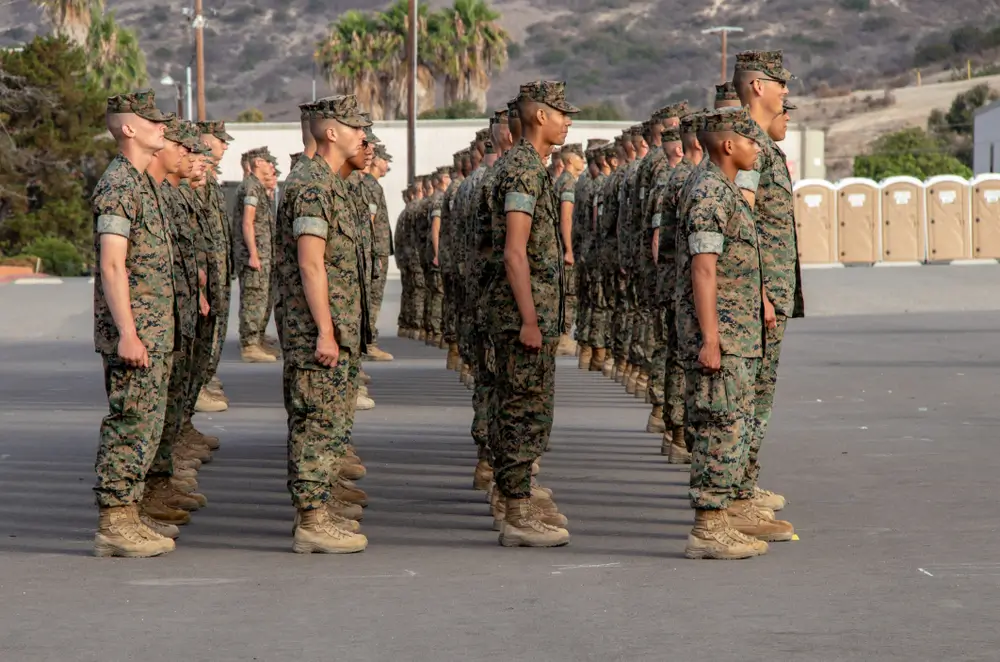
Every enlisted Guardian starts with Basic Military Training, or BMT. The course lasts 7.5 weeks and takes place at Joint Base San Antonio in Texas, the same location the Air Force uses.
Space Force trainees follow the Air Force program and then add their own material. Guardians go through an additional 35 hours of classroom instruction compared with airmen, covering the origins of the service, global threats in space, and the satellites the branch controls.
Physical fitness is part of the program and part of staying in. In 2022, the Space Force updated its fitness test options, allowing hand-release push-ups, the plank pose, and a 20-meter shuttle run as alternatives to classic push-ups, sit-ups, and the 1.5-mile run.
Becoming a Space Force officer: the AFOQT and commissioning routes
Enlisting is one path; commissioning as an officer is another, and it uses a different test. Officer applicants do not rely on the ASVAB. Instead they take the Air Force Officer Qualifying Test, or AFOQT, which measures verbal, math, and other aptitudes.
Beyond the AFOQT, officer candidates must hold U.S. citizenship, pass a clean background investigation, and clear medical examinations. There are three main routes in.
| Route | Key Details |
|---|---|
| U.S. Air Force Academy | Free tuition in exchange for Space Force service |
| Reserve Officers' Training Course (ROTC) | Scholarship program available at approximately 1,000 colleges and universities |
| Officer Training School (OTS) | 9.5-week training program |
The U.S. Air Force Academy offers free tuition in exchange for Space Force service. Air Force ROTC runs scholarship programs at about 1,000 colleges and universities across the country. The third route, Officer Training School, or OTS, is a 9.5-week program.
How to prepare for the ASVAB
If you want a Space Force career, aim well above the minimum. Because most specialties want composite scores in the 60s, the practical target is strong performance on the General and Electronics line scores, not just a passing AFQT.
A few habits make the biggest difference. Study with official practice tests so you know the format and timing of each subtest. Specialized prep courses with video lessons and practice questions help with weaker areas, and mobile apps make it easy to review on the go.
If your first result falls short, you can retake the ASVAB after a waiting period. It also pays to talk with a recruiter early, since they know the exact scores your target jobs require and can point you toward the right preparation.
Frequently Asked Questions
What ASVAB score do you need to get into the Space Force?
The official minimum for Space Force enlistment is an AFQT score of 36. This is the branch-entry threshold; many individual Space Force jobs require higher line or composite scores.
Is a 47 on the ASVAB good for the Space Force?
If 47 is your AFQT score, it is above the official Space Force enlistment minimum of 36. It does not guarantee a specific AFSC because job qualification depends on line scores and additional requirements.
How rare is a 70 on the ASVAB?
The provided sources do not give a percentile-distribution statistic showing how rare a 70 is. A 70 AFQT is above the Space Force enlistment minimum, but the relevant line scores still determine which technical jobs you may qualify for.
What can disqualify you from the Space Force?
The cited requirements include a qualifying AFQT score, U.S. citizenship, an age range of 17–42, a high school diploma or GED, and compliance with moral and physical standards. Specific jobs may also require color-vision qualification, background investigations, SSBI clearance, and communication standards.
Does the Space Force require the ASVAB?
Yes, enlisted applicants must take the ASVAB and earn a qualifying score. Officer applicants follow a separate testing route that includes the Air Force Officer Qualifying Test, or AFOQT.
What is the average ASVAB score for the Space Force?
The provided sources do not report an average Space Force ASVAB score. They provide the 36 AFQT enlistment minimum and role-specific examples such as General 46 and Electronics 60.
Is a 27 a bad ASVAB score for the Space Force?
A 27 AFQT score is below the official Space Force enlistment minimum of 36, so it does not meet the cited branch standard. Applicants should confirm current options with a recruiter, including whether retesting is available under current rules.
How hard is it to join the Space Force?
Entry can be selective because the Space Force has a limited number of highly technical AFSCs, and many positions require scores in the 60s rather than only the branch minimum. Applicants must also pass citizenship, education, medical, moral, and background requirements.
Is a 72 a good ASVAB score for the Space Force?
A 72 AFQT score is well above the official enlistment minimum of 36. However, it does not guarantee a job because Space Force AFSCs use specific line-score requirements and may impose additional technical, medical, or security standards.
Sources
ASVAB Test Prep · All Military BranchesWhich branch fits your score?Take a free practice test to see where you stand against each branch's minimum score.

ASVAB Branches Comparison: Minimum AFQT Scores by Service