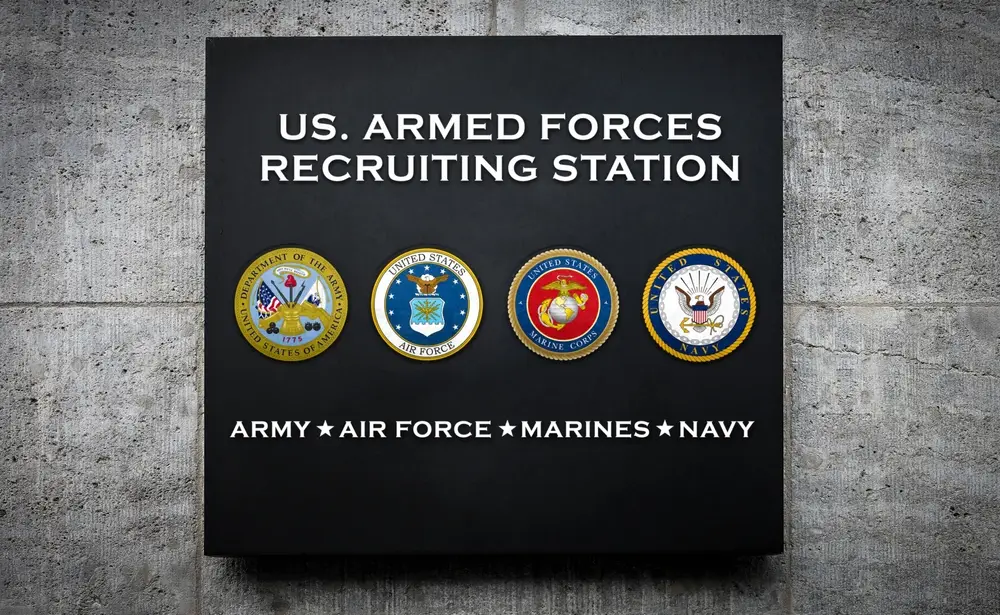
If you are planning to enlist, your ASVAB result is the first hard number that decides what comes next. It controls whether you qualify for service at all, and which military jobs open up once you do. A practice test is the fastest way to see where you stand before you sit down with a recruiter.
This page gives you a free practice test plus a clear walkthrough of how the real exam works. You will learn what the test measures, how it is scored, the minimum scores each branch expects, and how to prepare so your official result reflects your real ability instead of test-day nerves.
 ASVAB Test Prep · All Military BranchesReady to Pass the ASVAB?
Official subtest drills (AFQT, CAT-ASVAB), timed practice tests, score calculators and detailed step-by-step explanations.

What the ASVAB Is and Who Takes It
The ASVAB (Armed Services Vocational Aptitude Battery) is a multiple-aptitude test that measures developed abilities and helps predict future academic and occupational success in the military. According to the official ASVAB program, it is administered to more than one million military applicants, high school students, and post-secondary students every year.
It is not an intelligence test, and it is given only in English. The test determines whether you qualify to enlist in the United States military and helps match you to jobs that fit your strengths across several subject areas.
Most people who take it are high school students in grades 10, 11, and 12, along with post-secondary students considering service. You must be at least 16 years old to take the ASVAB. If you decide to enlist afterward, you must be 17 or older, and you need parental consent if you are under 18.
Schools also use the test through the ASVAB Career Exploration Program, which helps students discover strengths that apply to both military and civilian careers. That version leaves out the Assembling Objects section. Whatever path you take, your scores stay valid for enlistment for two years from the test date, after which you would need to retest.

The Two Test Formats: CAT-ASVAB vs. Paper-and-Pencil
There are two main versions of the exam, and the format you take affects timing, question counts, and how guessing is handled.
The CAT-ASVAB (Computer Adaptive Test) is taken on a computer at a Military Entrance Processing Station (MEPS). The U.S. Army reports that roughly 70% of applicants take this version, and it usually finishes in about an hour and a half. It is adaptive, so each question adjusts to your performance: a correct answer leads to a harder one, a wrong answer to an easier one. There is a penalty for guessing, and you cannot return to questions you have already answered. If you run out of time, remaining questions are scored randomly, which can hurt your result.
The P&P-ASVAB (Paper and Pencil) is given at Mobile Examination Test (MET) sites, which is why this version is also known as the MET-ASVAB. It can take three to four hours. There is no penalty for guessing, the questions do not adapt, and you may return to earlier questions within the same section.
The two versions also differ in length. The CAT-ASVAB contains 135 questions across a total of 197 minutes, with Auto and Shop Information split into two separate subtests. The paper version has 225 questions in 149 minutes and keeps Auto and Shop as a single section.
Computer Adaptive Test (CAT-ASVAB) Format
| Subtest | Questions | Time (Minutes) |
|---|---|---|
| General Science (GS) | 15 | 12 |
| Arithmetic Reasoning (AR) | 15 | 55 |
| Word Knowledge (WK) | 15 | 9 |
| Paragraph Comprehension (PC) | 10 | 27 |
| Mathematics Knowledge (MK) | 15 | 31 |
| Electronics Information (EI) | 15 | 10 |
| Auto Information (AI) | 10 | 7 |
| Shop Information (SI) | 10 | 6 |
| Mechanical Comprehension (MC) | 15 | 22 |
| Assembling Objects (AO) | 15 | 18 |
| Total Scored | 135 | 197 |
Paper-and-Pencil (P&P-ASVAB) Format
| Subtest | Questions | Time (Minutes) |
|---|---|---|
| General Science (GS) | 25 | 11 |
| Arithmetic Reasoning (AR) | 30 | 36 |
| Word Knowledge (WK) | 35 | 11 |
| Paragraph Comprehension (PC) | 15 | 13 |
| Mathematics Knowledge (MK) | 25 | 24 |
| Electronics Information (EI) | 20 | 9 |
| Auto & Shop Information (AS) | 25 | 11 |
| Mechanical Comprehension (MC) | 25 | 19 |
| Assembling Objects (AO) | 25 | 15 |
| Total Scored | 225 | 149 |
The Nine ASVAB Subtests Explained
The ASVAB groups its sections into four domains: verbal, math, science and technical, and spatial. Knowing what each one measures tells you where to focus your study time.
The verbal domain covers Word Knowledge and Paragraph Comprehension. Word Knowledge tests your ability to understand the meaning of words through synonyms. Paragraph Comprehension tests how well you pull information from short written passages.
Math is split between Arithmetic Reasoning and Mathematics Knowledge. Arithmetic Reasoning uses everyday word problems built on whole numbers, ratios, proportions, interest, and percentages. Mathematics Knowledge covers high school concepts like algebra, geometry, and probability.
The science and technical domain is the widest. General Science draws on life science, earth and space science, and physical science. Mechanical Comprehension deals with physics and engineering ideas such as velocity, force, energy, and power, often through diagrams. Electronics Information covers voltage, current, resistance, circuits, and the principles of alternating current. Auto and Shop Information covers car maintenance and repair along with wood and metal shop work.
The spatial domain is a single section, Assembling Objects, which checks your ability to picture how parts fit together and how shapes rotate in two and three dimensions.
| Domain | Section | What It Measures |
|---|---|---|
| Verbal | Paragraph Comprehension | Understanding written material |
| Verbal | Word Knowledge | Meaning of words through synonyms |
| Science and Technical | General Science | Life, earth, space, and physical sciences |
| Math | Arithmetic Reasoning | Solving basic math and word problems |
| Math | Mathematics Knowledge | Math concepts and applications |
| Science and Technical | Mechanical Comprehension | Mechanical devices, structures, and materials |
| Science and Technical | Auto and Shop Information | Car repair, plus wood and metal shop |
| Science and Technical | Electronics Information | Current, circuits, devices, and systems |
| Spatial | Assembling Objects | How parts come together as one object |
How the ASVAB Is Scored: AFQT, Standard Scores, and Line Scores
When someone tells you their ASVAB score, they almost always mean their AFQT score. The AFQT (Armed Forces Qualification Test) is not a separate exam. It is a number built from four subtests: Arithmetic Reasoning, Mathematics Knowledge, Word Knowledge, and Paragraph Comprehension. The formula is AFQT = 2(AR + MK) + WK + PC.
The AFQT is a percentile that ranges from 1 to 99. It does not tell you the percentage of questions you got right. A score of 70 means you performed better than 70% of a national reference group of 18-to-23-year-olds. There is no pass or fail, but each branch sets its own minimum.
Your individual subtest results are reported as standard scores, built on a scale with a mean of 50 and a standard deviation of 10. So a score of 60 sits one standard deviation above average. Most recruits land somewhere between 30 and 70, which is why a number that would look like a failing percentage is actually solid on this scale.
Your AFQT percentile also places you in a category that signals how competitive you are.
| AFQT Category | Score Range | Meaning |
|---|---|---|
| Category I | 93–99 | Exceptional — top percentile; highly competitive for any military role. |
| Category II | 65–92 | Above average — qualifies for most military jobs and advanced opportunities. |
| Category IIIA | 50–64 | Average to above average — meets standards for many military occupations. |
| Category IIIB | 31–49 | Below average — qualifies for enlistment but with more limited job choices. |
| Category IVA | 21–30 | Low — may qualify for enlistment with significant restrictions; fewer career options. |
| Category IVB | 16–20 | Very low — not normally accepted unless there are special waivers. |
| Category IVC | 10–15 | Extremely low — rarely eligible for enlistment. |
| Category V | 1–9 | Not eligible — score too low to qualify for military service. |
ASVAB Test Prep · All Military BranchesReady to Pass the ASVAB?Official subtest drills (AFQT, CAT-ASVAB), timed practice tests, score calculators and detailed step-by-step explanations.
Minimum AFQT Scores by Military Branch
Your AFQT decides whether you can enlist, and the bar is different for each branch. According to the U.S. Army's official enlistment guidance, you need at least 31 to join the Army. The Air Force, Marine Corps and Navy set the same floor. Only the Coast Guard, at 32, and the Space Force, at 36, ask for more.
| Military Branch | Minimum AFQT Score |
|---|---|
| Air Force | 31 |
| Army & National Guard | 31 |
| Coast Guard | 32 |
| Marine Corps | 31 |
| Navy | 31 |
These minimums can change over time, so confirm the current requirement with a recruiter before you set a target.
Requirements are stricter if you hold a GED instead of a high school diploma. Most branches expect at least 50, with the Air Force setting the highest bar.
| Military Branch | Minimum AFQT Score with GED |
|---|---|
| Air Force | 50 |
| Army & National Guard | 50 |
| Coast Guard | 50 |
| Marine Corps | 50 |
| Navy | 50 |
Clearing the minimum only gets you in the door. A higher AFQT opens up far more jobs, and some of those jobs carry an enlistment bonus or special pay. Scoring well above the minimum, especially in Arithmetic Reasoning and Verbal Expression, keeps nearly every specialized role on the table.
The Army also offers a second chance for applicants who fall short. According to the U.S. Army's official guidance, candidates scoring as low as 21 can enter the 90-day Future Soldier Preparatory Course, an academic program covering every ASVAB subject with a chance to retake the test. Those scoring between 31 and 49 can take a 30-day version with one opportunity to improve their score.
How Line Scores Shape Your Military Career
Beyond the AFQT, the military uses line scores, also called composite scores, to match you to specific jobs. A line score combines results from several subtests, and each branch builds its own formulas. In the Army these map to a Military Occupational Specialty (MOS), in the Navy to ratings, and in the Air Force to an Air Force Specialty Code (AFSC).
One building block worth knowing is Verbal Expression (VE), which is a combined score from Word Knowledge and Paragraph Comprehension rather than a standalone subtest. It feeds many Army formulas, such as General Technical, calculated as AR + VE.
The Army organizes its line scores into career categories, each tied to high scores in specific subjects. This is why neglecting the technical subtests can quietly close off jobs you might want.
| Career Category | Required High Scores | Example Job |
|---|---|---|
| Clerical | Verbal Expression, Arithmetic Reasoning, Mathematics Knowledge | Human Resources Specialist (42A) |
| Combat | Verbal Expression, Auto and Shop Information, Mechanical Comprehension | Infantryman (11B) |
| Electronics | General Sciences, Arithmetic Reasoning, Mathematics Knowledge, Electronics Information | Radar Repairer (94M) |
| Field Artillery | Arithmetic Reasoning, Mathematics Knowledge, Mechanical Comprehension | Field Artillery Recruit (13U) |
| General Maintenance | General Science, Auto and Shop Information, Mathematics Knowledge, Electronics Information | Parachute Rigger (92R) |
| General Technical | Verbal Expression, Arithmetic Reasoning | Stryker Systems Maintainer (91S) |
| Mechanical Maintenance | Auto and Shop Information, Mechanical Comprehension, Electronics Information | Self-Propelled Artillery Systems Mechanic (91P) |
| Operators & Food | Verbal Expression, Auto and Shop Information, Mechanical Comprehension | Culinary Specialist (92G) |
| Surveillance & Communication | Verbal Expression, Arithmetic Reasoning, Auto and Shop Information, Mechanical Comprehension | Electronic Warfare Specialist (17E) |
| Skilled Technical | General Sciences, Verbal Expression, Mechanical Comprehension, Mathematics Knowledge | Ammunition Specialist (89B) |
The Navy applies its own composite thresholds for certain ratings, such as a Technical Standard requiring GS + MC + EI of at least 170. The lesson holds across branches: the AFQT decides if you can serve, but line scores decide what you actually do.
Sample ASVAB Practice Questions
Working through real questions is the fastest way to learn what each subtest feels like. Here are a few examples in the style of the official sample items, with answers.
Arithmetic Reasoning leans on everyday word problems. Sample questions published on the official ASVAB resources include this one: if there are three quarts of gas in a gallon container, how full is the container? The answer is 75%, the kind of ratio and proportion problem the section is built around.
Word Knowledge is built on synonyms. A typical item asks what "observe" most nearly means among options like maintain, watch, organize, and protest, where the answer is watch. Mathematics Knowledge rewards knowing core formulas instead of long calculation, such as recognizing that (x − 4)(x + 4) equals x² − 16 through the difference of squares.
The technical sections cover material many applicants see less often. A General Science sample asks where digested food is absorbed into the bloodstream, with the answer being the small intestine. An Electronics Information item asks how the rate of electrons through a conductor is measured, where the answer is in amperes, the unit of electrical current.
How Our Free Practice Test Works and How It Compares to the Real Exam
The practice test on this page mirrors the structure of the real CAT-ASVAB, with all nine subtests, the same question types, and timed sections that recreate test-day pressure. You can pick a short sample to warm up, a quicker test for a focused check, or a full-length simulation for the closest match to the real thing.
After you finish, you get instant results: an estimated AFQT score, a breakdown of how you did on each subtest, and a clear view of your weak areas. That last part matters most, because a diagnostic result tells you exactly where to put your study hours.
The biggest difference between practice and reality is the adaptive engine. On the real CAT-ASVAB, difficulty shifts question by question based on your answers, which makes the score more precise but removes any chance to revisit earlier items. A few other rules apply on test day: the exam is in English only, no calculator is allowed, recruiters cannot be in the room, you need valid ID, and arriving late means rescheduling. One detail trips up many applicants, since the most recent score, not the highest, is the one used for enlistment.
The ASVAB is rarely hard because any single subject is difficult. It is hard because nine or ten subtests cover a wide spread of topics, and most people are far more comfortable with math, science, and English than with automotive, shop, and electronics material. A full-length practice run shows you that gap before it costs you.
Retake Policy and Score Validity
You can take the ASVAB more than once, but there are waiting periods. After your first attempt, you must wait one calendar month before retaking the test. A third attempt cannot happen earlier than six calendar months after your second test. There is no official lifetime cap on the total number of attempts.
Keep two facts in mind before you retest. First, your most recent score is the one that counts, even if an earlier attempt was higher, so only retake when you are genuinely better prepared. Second, your scores are valid for two years from the test date, which gives you a reasonable window to use a strong result.
There is also an alternative path. The PiCAT (Pending Internet Computerized Adaptive Test) is an unproctored, full version of the ASVAB that you can take on your own time. The score it produces is "pending" until you validate it at a MEPS, so it works as a head start rather than a final result.

How to Prepare for the ASVAB
Start with a baseline. A full diagnostic practice test shows your starting point and flags the subtests that need the most work, which is the single most useful first step. From there, build your plan around two priorities: the four AFQT sections first, then the technical subtests that drive line scores.
Give yourself time. Common guidance suggests beginning at least two months out, and many people need eight to twelve weeks to reach their target score. A simple routine works well: a quiet study space, your materials ready, and a weekly schedule you can actually keep.
Use practice tests for more than scoring. Strong ones come with timed conditions, detailed answer explanations for every question, and a report that breaks performance down by topic. The explanations turn wrong answers into learning, and the topic breakdown keeps you from wasting time on material you already know.
Watch out for the mistakes that quietly lower scores. Guessing behaves differently on each version, since the paper test has no penalty while the CAT-ASVAB does, and random guessing there also confuses the adaptive engine. Many applicants underestimate Electronics Information, Auto and Shop, and Mechanical Comprehension because those topics rarely show up in school, yet they decide eligibility for high-demand jobs. Time management is the other trap: some sections give you only about 30 seconds per question, so practicing under the clock is not optional.
When you feel ready, talk to your recruiter to schedule the official test and confirm the location and time. Then take one last full-length practice run so the real exam feels familiar instead of intimidating.
Frequently Asked Questions
Is there a way to practice for the ASVAB test?
Yes. A timed practice test can familiarize you with the test format, establish a baseline, and show which subjects need more study. Official ASVAB resources also provide sample questions organized by subtest.
How can I practice the ASVAB test?
Start with the four AFQT subtests—Arithmetic Reasoning, Mathematics Knowledge, Word Knowledge, and Paragraph Comprehension—then work through the science, technical, and spatial areas. Use timed sessions, review every explanation, and repeat the weakest subtests rather than relying only on an overall score.
Is there a free practice ASVAB test?
Yes. Free online ASVAB practice resources and official sample-question pages are available, including subtest previews and short practice assessments. Treat any result as a diagnostic estimate rather than an official enlistment score.
Is there a mock ASVAB test, and can you take a mock ASVAB?
Yes. A mock ASVAB can reproduce the multiple-choice structure, subject coverage, timing, and review process of the real exam. The official ASVAB itself is taken at an authorized testing location such as MEPS or a MET site, not from home.
What do ASVAB scores of 27, 42, 47, 57, 70, 77, and 92 mean?
These are AFQT percentile scores, not percentages of questions correct. Based on the cited categories, 27 falls in Category IVA, 42 and 47 in Category IIIB, 57 in Category IIIA, and 70, 77, and 92 in Category II; higher scores generally indicate broader eligibility and more job options, but exact requirements depend on the branch and occupation.
Is 70 a good ASVAB score, and is a 70 on the ASVAB hard?
A 70 is above average: it means the candidate performed better than 70% of the norming group and falls in AFQT Category II in the cited table. Whether it feels difficult depends on the candidate's familiarity with math, reading, science, and technical subjects, so a timed baseline is the best way to identify the work required.
Is 47 a good or bad ASVAB score?
A 47 falls in AFQT Category IIIB, described in the cited scoring table as below average but potentially qualifying for enlistment with more limited job choices. It is not enough to judge job eligibility by itself because branches and occupations also use their own minimums and line scores.
How rare is a 99 ASVAB score?
A 99 is the highest possible AFQT percentile and belongs to Category I, which the cited table describes as exceptional and in the top percentile. The supplied sources do not provide a precise frequency for 99, so the safest interpretation is that it represents the extreme upper end of the normed scale.
Sources
ASVAB Test Prep · All Military BranchesReady to Pass the ASVAB?Official subtest drills (AFQT, CAT-ASVAB), timed practice tests, score calculators and detailed step-by-step explanations.
ASVAB Flashcards: Best Study Tools and Methods

ASVAB Tutor: Costs, Platforms, and How to Raise Your Score